When used properly, mulches and composts can improve soils and provide many beneficial effects to plant health and vigor. Undesirable nuisance fungi, however, may also occur when different types of mulches or composts are used under certain conditions. Some of the more common examples of these nuisance fungi include the shotgun or artillery fungus (Sphaerobolus), slime molds (Physarum), stink horns (Mutinus), bird’s nest fungi (Crucibularium), toadstool mushrooms, and several plant pathogens.
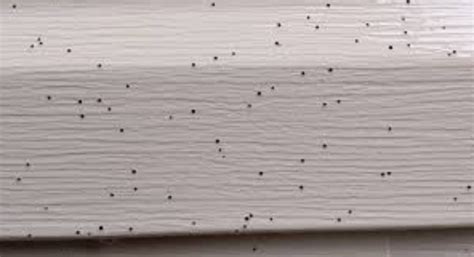
Organic landscape mulches & composts under certain conditions can promote nuisance fungi. Although stone mulch will certainly eliminate any growth of nuisance fungi, it does not benefit plant health. Artillery Fungus shoot dark colored spores that create tar-like spots on house siding. The artillery fungus (Sphaerobolus) found in mulched areas has probably caused the most concern to landscapers and potentially pose some economic concern to their clients.
This fungus produces fruiting structures that resemble tiny cream or orange-brown cups that hold a spore mass resembling a tiny black egg. When enough water accumulates, the spores are shot high into the air up to several yards. The dark colored spores resemble small tar spots and will stick to house siding, downspouts, cars, leaf surfaces, and any nearby structure. The artillery fungus is strongly phototrophic and will shoot their spores toward light sources or white colored surfaces.
Close-up of the Artillery Fungus on house siding shows that this fungus will often shoot their spores toward white surfaces. No, the dark spots stuck to the leaf underside are not scales, but are Artillery Fungus spores. The slime molds (Physarum) in fact, are not a fungus, but are soil-dwelling amoeba. They are a single-celled organism that contain multiple nuclei when they clump together to form a single mass. They can potentially move several feet per day over mulched landscape beds and can climb vertically up plants.
Slime molds have numerous colored species, but the “dog vomit” species has a white color and is commonly observed in our area. Slime Mold amoeba can clump together when looking for food. The Slime Mold has fully clumped together to form a single cell with multiple nuclei.
Stinkhorn fungi grow on organic, decomposing hardwood mulch. The common stinkhorn (Phallus impudicus) is often found in coniferous forests and has a strong, objectionable odor. The dog stinkhorn (Muinus caninus) is commonly found growing within landscape mulch and is smaller and less odorous. The numerous species all have a slimy, gelatinous body surface that emerge during rainy periods, but will shrink and dry out on their own in a few days after the weather dries. They often will be seen growing together in large clusters. The Dog Stinkhorn Fungus has a slimy, gelatinous body surface and shamelessly displays an obvious phallic appearance. The Stinkhorn Fungus will often be found growing together in large clusters.
The bird’s nest fungi (Crucibularium) are commonly encountered nuisance fungi found in landscape mulch. Their fruiting bodies resemble tiny egg-filled birds’ nests. They are much larger than the artillery fungus structures but are often found together feeding on decomposing organic matter such as wood chips or bark mulch. The nests are “splash cups” and when raindrops strike at the right angle, the fruiting bodies or “eggs” are expelled from the nest for distances of 2-3 feet. The Bird’s Nest Fungus have fruiting bodies that resemble tiny egg-filled birds’ nests.
Artillery Fungus growing alongside Bird’s Nest Fungus shows that fungal colonies can coexist in mulch. The dark spores and nest structures illustrate how multiple nuisance fungi may appear in the same mulched beds. Toadstool mushrooms are collectively a grouping of mushroom species that are poisonous and potentially deadly if consumed. Like all the mulch nuisance fungi discussed, these mushrooms are primarily hardwood mulch decomposers. A deadly poisonous toadstool mushroom species when consumed is Amanita phalloides, the death cap, though it is more commonly found in Europe and can sometimes be observed in some areas. Species identification requires close examination.
Most of the nuisance fungi problems in the landscape increase when mulch is created from both fresh hardwood bark and fresh ground wood originating from almost all tree species. Such wood products decompose readily because they contain large concentrations of cellulose. The finer the wood products are ground, the more troublesome the problem will be. Bark chips (nuggets) from mature softwood trees such as pine or cypress contain mostly lignin, wax, and protected cellulose that are more resistant to decay and usually produce fewer problems. Fresh mulch from young softwood trees does not contain bark cellulose with protective lignin waxes or tannins, so rot-resistant materials do not form within softwood trees until they have matured. Nuisance fungi can be more problematic in mulch made from fresh hardwood bark.
The finer the wood mulch is ground, the more troublesome nuisance fungi can become. A variety of composting methods on display by the Monmouth County Master Gardeners suggests adding nitrogen and then composting the mix for a minimum of 6 weeks. The nitrogen source can include grass clippings, poultry manure and urea (applied at a rate of 1 lb of available nitrogen per cubic yard of mulch material). Nuisance fungi can still potentially inhabit composted mulch when it cools after being applied in the landscape. Sometimes high quality, composted mulch products are applied around the landscape and yet problems with colonization by undesirable fungi still occur. This scenario can happen when thermophiles, microorganisms requiring high temperatures to survive, begin to die when temperatures cool to the 50-80℉ range after application. This “biological vacuum” within the fresh compost is rapidly colonized by mesophiles (low temperature microorganisms). If the composted mulch is dry (moisture content below 35%), some of the nuisance fungi can become the primary colonizers. The pH levels can predetermine the likelihood of nuisance fungi colonizing the mulch; when pH drops below 5.2, beneficial bacteria/fungi that inhibit nuisance fungal growth cannot colonize and compete successfully.
Applying water to dry mulch or compost materials as they are placed in the landscape can prevent many of the fungal nuisance problems. It is important to soak all mulches immediately after they have been applied. Sour mulches with pH levels below 5.2 should not be applied within the landscape. The low pH and resulting fungal problems are usually prevented if the wood and bark products are nitrified (i.e., addition of 1 lb of nitrogen per cubic yard of mulch material). Generally, a good game plan is to purchase composted products with a low percentage of woody material. Remember, softwood bark is rot resistant and does not promote the growth of nuisance fungi. Fresh woody products, such as ground wood pallets, with particle sizes less than 3/8 inches should be avoided unless composted first. If composting fresh woody products is not feasible, then coarse particles greater than ¾ inches should be applied. Larger diameter mulches will less likely create problems if they are not applied to a depth greater than two inches. Mulch volcanoes create multiple problems for plants and nuisance fungi can be added to the list.
Once nuisance fungi have colonized and become a problem within mulched areas, control options are often limited. Probably the most attempted solution is the application of fresh dry mulch on top of the existing mulch colonized by nuisance fungi. Such an approach rarely solves anything; the problem will recur the following year, if not sooner. A more effective control is to spade the infected mulch into the soil layer and thoroughly soak with water. The best control option is to remove the mulch and place it in a heap after completely wetting it. Often, raking is the simplest and relatively effective method to deal with nuisance fungi.
Wood chip and bark mulches and composts can be a source for several interesting fungi including artillery fungus, slime molds, bird’s nest fungi, stinkhorns and mushrooms. These fungi are natural components of the mulch environment, are not harmful to landscape plants, and no known health hazards are associated with them unless they are eaten. They are usually found from April through October, following rainy weather. The spores of artillery fungus can be a problem because they stick to surfaces and resemble tar spots, but the fungus is not pathogenic to living plants. To minimize artillery fungus near buildings, avoid using wood chips or bark mulches adjacent to structures; certain study results show pine bark nuggets or large dry pieces reduce sporulation compared to finely shredded wood.
In many cases, mold or mildew on mulch is not dangerous to humans or animals. Mulch mold helps decompose organic matter, enriches the soil, and signals an active ecosystem. If you observe a ghostly white fuzz or yellowish blob, it is usually a natural part of soil health, not a sign of a disease. Still, people with asthma, allergies, or weakened immune systems should avoid prolonged exposure to airborne spores. If mold becomes a problem near structures or around vulnerable individuals, replacement with composted blends or pine bark nuggets can help. A practical approach includes watering to damp mulch after placement, choosing mature, durable mulch types, and occasionally raking to aerate and dry the surface.
For medical concerns related to mold allergies or respiratory issues, consult a healthcare provider.
Fungi: Death Becomes Them - CrashCourse Biology #39
Table: Quick guidelines for managing nuisance fungi in mulch
| Factor | Impact | Management |
|---|---|---|
| Moisture | High moisture promotes fungal activity | Keep mulch dry; water after application |
| Particle size | Smaller particles increase risk | Prefer larger pieces or composted material |
| pH | pH < 5.2 reduces beneficial competition | Avoid sour mulches; nitrify with nitrogen |
| Wood type | Fresh hardwood bark increases risk | Use softwood bark nuggets or aged material |
| Temperature | Thermophiles die off as temperature cools | Ensure adequate moisture and aeration |
In summary, mold and certain nuisance fungi in mulch are usually not harmful to humans or plants when managed properly. The key is selecting appropriate materials, preventing excessive moisture, ensuring adequate drying, and applying mulches with proper depth. If infestations occur, mechanical removal, wetting and redistribution, or replacement with more stable materials can mitigate issues. Regular monitoring and sensible mulch practices help maintain soil health while minimizing health risks.