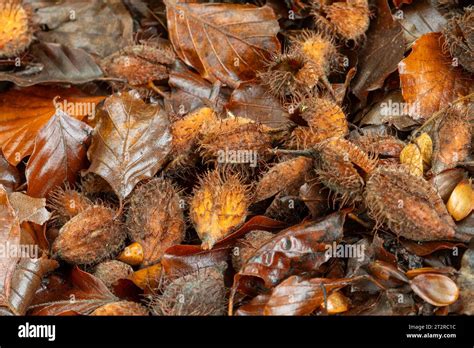
This is a beech seed pod or beechnut. They look remarkably like a small chestnut seed pod and are an important food source for many species of animal in our northern hardwood forests such as wild turkey, black bear, and white-tail deer. Black bears will even climb beech trees to reach these delectable beechnuts.
You may be familiar with beech trees from the golden leaves that hang from their branches during fall and refuse to drop during the coldest months of the year. Or from their smooth bark that is often easy to spot among the more heavily ridged bark of trees dotting the landscape. Often, it is hard to find a forested area in Vermont that does not have beech trees somewhere within. It has become a symbol of modern northern hardwood forests. These symbols, however, are being threatened.
Beech trees have been attacked over the past century due to a disease known as Beech Bark Disease (BBD). BBD is a complex disease which forms from the combination of an invasive scale insect and two species of fungi. The fungi will manifest itself in the lesions caused by these insects which becomes mottled with black lesions and bumps. While not directly responsible for mature beech death, this fungus has been known to cause significant stress to mature beech trees and mortality among the saplings. In the past a beech tree could easily live to be around 400-600 years old, now one is hard pressed to find any beech tree above 80-years-old.
If that was not enough, a new disease has been witnessed ravaging beech populations in North America and is expected to be widespread in the Northeast relatively soon. Beech Leaf Disease (BLD) was first discovered in Ohio in 2012, and since has been detected in Pennsylvania, New York, Connecticut, Massachusetts, and Rhode Island. It effects both American and European beech species, causing leaf deformation, dieback, and potential mortality of infested hosts. It is caused by a nematode that lives within the leaf that make the leaves near branch tips to become curled or shriveled, discolored, and deformed. The nematode can stress the tree and cause premature leaf-drop or dieback which can lead to decreased production of leaves and buds. Leading to the eventual death of the tree, generally due to stress. Pair beech leaf disease (BLD) with beech bark scale disease (BBD) and it is a recipe for disaster.
Help us to cultivate this dying breed and keep the diversity of our forests alive. The roller coaster changes between winter and spring go on in this area. But the cold won’t hurt the early spring plants any, especially those in the pansy family like viola tricolor. They’re hardy, and built for cold finicky weather, and that’s why you’ll often see them blooming away beautifully in window boxes in March. I have to say I was quite surprised to see them blooming in February though. I think that is a first, but after two or three days in the 50s they responded.
This is why, when I talk about spring on this blog, I’m not talking about calendar spring. Except for an ice shelf over there on the left the ice has melted off the stream that runs through the skunk cabbage swamp. And the skunk cabbages are growing quickly. It rained hard the night before this was taken and instant ponds popped up everywhere. That’s a good sign that the soil under them is still frozen. Since the water can’t soak into the ground and has nowhere to go it ponds up in the low spots. After it started to cool off again, I went to a waterfall to see if any ice had formed. This grass plant had grown ice on its leaves that was thicker than my thumb, all from splashing drops of water. When I see ice like this I think of a candle. A candle starts with a wick, which is dipped again and again into melted wax. This stone was covered in round spheres of ice. There was also plenty of white puddle ice to be seen. I’ve read that it is oxygen that makes the ice white like this. Microscopic bubbles, I suppose.
This was a surprise and it was flowing right out of the ground just where I stood. I thought it was bright red but my color finding software sees rosy brown, chocolate and dark salmon pink. Though it looks strange it’s really just groundwater that has leeched out various minerals in the soil. Most of those minerals I’d guess, are iron oxide based. There are probably bacteria present as well and I’d guess that the heavy rain we had flushed everything out of a groundwater reservoir of some kind. I can remember as a boy seeing the Ashuelot River run almost the color of that seep in the last photo, when the woolen mills in Keene released their dyes into it. It ran all the colors of the rainbow, but when I need to think of a good success story I think of the river, because over the years it was cleaned up. Now trout swim in it once again and bald eagles fish here. The river looked fairly placid in that previous shot but this is what was going on downstream. The camera made the water look dark but it was really chocolate brown from all the soil that is washing into it from flooding.
Instead of a roar the ice on Halfmoon Pond in Hancock pings, creaks and twangs, especially when the wind blows. It was covered in melt water recently and looked like a mirror. It will freeze and thaw until one day, it won’t freeze any longer. When warm air flows over the cold ice sometimes the pond creates its own fog. The witch hazels didn’t dare to unfurl their petals on this cold day. It’s kind of amazing how they can pull their long strap shaped petals back into such tiny buds but they’re fairly accurate. I’ve seen them get frost killed in the past but that doesn’t happen often. Each fuzzy bud that the petals come out of is less than the diameter of a BB that you would put in an air rifle.
The reticulated iris (I think) had grown some in the week since I had seen them last, and so had the daffodils. The seed pods you see are from redbud trees. Tree buds were calling to me as they always do in spring but I couldn’t see any signs of swelling in the pretty blue buds of the box elders. This tree in the maple family has beautiful flowers in spring so it’s always one of those I check regularly. These are the beautiful sticky, lime green female box elder flowers, for those who haven’t seen them. I’ll be waiting impatiently for both them and the red maple flowers. Box elders usually flower in April and red maples sometimes by mid-March. Speaking of red maples, here are some of their flower buds. I can see a little movement in them. The bud scales are starting to ease and open but I hope they won’t because it’s too early. I’ve seen trees with every flower killed by frost but nature has that all figued out, and not all trees bloom at the same time. They were all empty, even the ones still on the tree.
Many, many years ago someone went around Keene with a stencil of a foot and spray-painted small feet here and there throughout town. It told me to stay on the trail. It doesn’t take much to make my heart soar in spring; seeing sap buckets hanging on the sugar maples will do it every time. Though this post might seem to be all over the place, with flowers and ice and snow, that’s what spring is in New Hampshire. We are in the push-pull transition time between winter and spring and right now, winter is making a comeback. We are expecting a foot of snow as I finish this post, but it won’t last long and spring will win out as it always does. The trees producing sap means the ground has thawed and soon everyone will be wearing a smile. If you ask most of them why they’re smiling chances are they won’t be able to tell you but it’s just that spring tonic. The first day of spring is one thing, and the first spring day is another. The difference between them is sometimes as great as a month.
Beech Species Profiles and Seed Information
Discover the majesty of Fagus sylvatica, European Beech, a breathtaking addition to any landscape. This impressive deciduous tree can tower up to 160 feet, making it a focal point in gardens and parks. With a typical height ranging from 80-110 ft and a trunk diameter reaching 5 feet, its smooth, gray bark and elegantly arching branches create a stately silhouette. European Beech's leaves are a visual delight, emerging in pale green and transitioning to a rich, dark hue, casting an enchanting golden bronze in the fall. This resilient species can thrive in diverse environments, withstanding rigorous pruning and making an excellent choice for hedges. Its timber, known for its fine grain, is prized for furniture crafting and more, offering superb workability and resistance to compression. Beyond horticultural glory, the beech yields seeds with a sweet flavor, their oil rivalling the delicacy of olive oil. Zones: 4 to 9Mature Height: 60 to 100 feetMature Spread: 60 feet
The American Beech is an impressive and sturdy native Beech with smooth grey bark, dark green leaves and glorious golden brown foliage in fall. This large tree is naturally low-branched and has an irregular shape. It has edible nuts and makes an excellent shade tree. When choosing a location, keep in mind that the American Beech has a slow growth rate. It grows up to 100 feet in height and 60 feet in spread. It can be planted in zones 4 to 9.
How To Start These Seeds: Scarification: Soak in water, let stand in water for 24 hours. Stratification: Cold stratify for 90 days. Germination: Sow seed 3/8 inch deep, tamp the soil, keep moist, mulch the seed bed, can be sown outdoors in the fall for spring germination. Seed Count Per Packet: This packet contains 20 hand-sorted, high-quality seeds. These are the husks, not the nuts. Every autumn a beech, Fagus sylvatica, drops its seed in a woody four-lobed case called a cupule, and once the nuts have shaken out the empty cases lie scattered across the woodland floor. Those cases are what is in the bag. The hobby often calls them beech mast, though mast strictly means the nut crop itself, the food that brings in jays and squirrels and once fattened village pigs. What you have here is the packaging. It is a small distinction that happens to be worth making, because beech nuts carry oxalic acid and are mildly toxic in quantity. The shape is what earns them their place. A cupule is a fruit case that has already done its job and split, so it sits on the substrate as four stiff lobes half-closed over a cavity, and that cavity is scaled to a springtail or a newly released juvenile, not to an adult. As the cupules soften they take on biofilm, and for springtails the biofilm is as much of the attraction as the case. Beech litter is slow stuff. It is high in lignin, low in nutrients and has a wide carbon to nitrogen ratio, which puts it in the same camp as oak and well behind ash, lime or sycamore for speed of breakdown. In an enclosure that counts as a feature. Cupules persist for a long time, feeding into the decomposition cycle gradually rather than collapsing into mush in a fortnight, so they hold their structure as cover while they slowly become food. Ours are naturally shed, collected in the UK, cleaned, and then held in the freezer a full three days before they go out. That deals with mites, eggs and the other passengers that come with anything gathered outdoors, so they can go straight into the enclosure with no soaking, baking or further sterilising. Scatter them across the surface or tuck them in among leaf litter and bark. Top up now and then as the older ones soften and disappear. They suit springtail cultures, isopod setups, millipede enclosures and anyone building a bioactive tank that should look like a forest floor. Not essential kit by any measure, but a simple way to add structure that behaves the way the real thing does. A handful covers a starter tub and they store dry indefinitely. We have had a mature copper beech tree in our yard for the 7 years we have lived here, but have NEVER seen the tree develop seed pods before. This last Fall there were THOUSANDS of hairy-like pods that cracked open and fell to the ground, and THOUSANDS more still hanging onto bare limbs this Spring. Maybe it wasn't old enough. How mature is "mature", in this instance? Beech does have mast years, but there is usually smaller crops inbetween. Maybe you only noticed it for the first time because this year it was such a heavy crop, whereas in the previous 6 years it only had smaller crops that weren't so conspicuous? Thanks for the replies. To answer one question, the tree must be about 20+ years old, and we have been here since 2001, with NO seed 'cupules' ever seen before. I know there might have been one or two small ones that I missed sometime, but I doubt it. This year the cupules almost formed a ''blanket'' on the ground, there were so many. The tree is planted near (and growing into a huge 'cedrus deodora' which itself has created huge cones that flake like the dickens and create a huge mess. Continues to appear that it did not reach sexual maturity until now. Yep, when I saw the statement 'mature', I took that to mean maybe 50 years. Age 20 isn't really mature for a beech! I bought my current house in London Ontario with it's 1-acre garden in 1965 and I planted a copper beech south of the house as a 4-foot whip in 1966. Today it is roughly 70 feet high, has a 29-inch caliper, and is flourishing. In the autumn of 2013, for the first time ever, I was astonished to find the lawn and ground-cover under this copper beech covered with thousands of seed pods. London is located on the boundary between zones 5 and 6. There us only one causal circumstance I can think of for this singular event.