Pruning trees is the act of cutting and removing branches from a tree to encourage new growth and develop a good structure. Why Prune Trees? Pruning should be done with a purpose in mind. In the early years of a tree’s development, pruning is about developing a good structure for the tree to help it grow well and be strong enough to tolerate the challenges of weather. This structural pruning serves to maintain a good shape and size, within the limits of a plant’s normal size range. The best results are attained through selective pruning, rather than shearing. Selective removal of certain branches allows us to remove weaker branches and maintain those that are stronger. Selective pruning does take more time, but it yields better results. It allows us to make healthier cuts and work with the natural shape of each plant. Focusing on structure and safety early in the tree’s life means that later in the tree’s life, pruning can be about fixing problems as they arise. These problems can include storm damage, keeping branches clear of structures, and removal of diseased or dying branches. Maintenance pruning of a maturing tree will also include removal of objectionable growth like root suckers, water sprouts, crossing branches, and thorny branches below eye level.
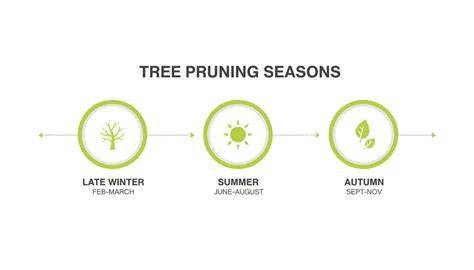
When to Prune Trees It is important to prune at the right time. For most deciduous trees, the best time to prune is between late fall, after the trees go dormant (lose their leaves), through very early spring, just as new growth is ready to begin. This time frame makes pruning easier because the structure of the tree can be seen. It is also a time when diseases and insects are dormant and won’t attack fresh pruning cuts. Pruning in mid- to late winter, just a few weeks before new growth starts, allows for production of callus tissue to be underway early in the growing season. Callus tissue seals the edge of the wound. For most deciduous trees, pruning time can be extended into very late spring or very early summer, but it will be more difficult to see the structure of the tree and diseases and insects will start to be more active. While trees can be pruned in summer, it is a less than ideal time. Summer is often very hot and dry, and the trees are under stress. Pruning at that time can add to the stress on the tree. If a tree must be pruned in summer, be sure to water it regularly to reduce stress. Pruning in late summer (August and September) should be avoided. At that time, trees are beginning to prepare for winter and are slowing their growth accordingly. Pruning at this time works against the natural cycle of the tree. Pruning is a stimulus and will promote new growth that may not harden off in time for winter.
Pruning Evergreens and Bleeders
Pruning Evergreens Prune all evergreens, except pine, before new growth starts in the spring. When pruning evergreens, follow the general branching pattern to maintain the natural shape. You can remove dead, diseased, or broken branches anytime. In most cases, selective pruning (one branch at a time) is better than shearing. Pruning “Bleeder” Trees There are exceptions to the general time frame for pruning. One exception is a group of trees known as bleeders. Some of the trees that belong to this group are: Maple, Walnut, Birch, Beech, Hornbeam, Yellowwood. Bleeding is an excessive flow of sap that occurs when these trees are pruned in late winter and early spring. The bleeding is unsightly, but it does not harm the tree. It can be avoided by pruning in the coldest part of winter or by delaying pruning until after the foliage has fully emerged in very early summer.
Pruning Oaks and Elms
Another exception includes trees that are prone to serious diseases spread by insects, specifically oaks and elms. Oaks and elms should be pruned in the dormant season to avoid insect pests that can spread oak wilt and Dutch elm disease, which are very serious and often fatal diseases. Traditionally, the recommendation was to prune those species between mid-October and mid-April, so pruning can be done when insects are not present. Changing weather patterns are affecting that time frame. With longer, warmer autumns becoming more common, it is wise to watch the condition of the trees, not the calendar. When trees are losing their leaves in autumn, they are entering dormancy, and that time is safer. For oaks that hold their leaves through winter, watch when other trees are losing leaves to signal dormancy. Spring weather has always been erratic in northern Illinois, but is more so than it used to be. This makes it more difficult to decide when to end the pruning season for oaks and elms. There is a tool to help with oaks. University of Wisconsin Extension has a thermal model to help predict when the insect that spreads oak wilt may be active. It works for northern Illinois as well as Wisconsin.
Pruning After Storm Damage
A third exception to the general pruning time frame is storm damage. Prompt pruning of storm-damaged limbs and dead branches should be done to encourage wound closure and avoid potential hazards. While pruning sealants are no longer recommended, if an oak or elm must be pruned in the growing season, a pruning sealant can help prevent the insects that spread disease from attacking fresh cuts.
How to Prune Trees
Though mature trees may need only occasional pruning to remove dead wood, young trees should be pruned regularly to provide strong branch structure for future growth. Basic Pruning Cuts To prune well, an understanding of basic pruning is needed, as well as the knowledge of how to make a good cut that will be able to heal properly. There are two basic cuts that are used in most pruning: heading back and thinning out. A heading back cut removes only a portion of the branch, cutting it back to a bud or side shoot. That bud or side shoot becomes the next growing point, so take into consideration what direction that growth will take after the cut. Try to envision if that new growth will grow outward and keep the canopy of the tree more open, or will it grow back towards the tree or up into the tree and crowd the canopy. Keeping the canopy more open is the desired outcome. That will let light enter the tree to stimulate future bud development and will also let air flow through the canopy to reduce the potential for disease to develop. Thinning out cuts remove branches all the way to the ground, when done on a shrub. For a tree, a thinning out cut removes a branch all the way back to a main limb, or possibly to the main trunk of the tree. The removal of an entire branch back to the trunk may be needed if too many branches are coming out of the trunk too close to one another or if they are at risk for crossing each other and causing damage to each other in the future.
Making Good Pruning Cuts
Making good cuts is vital to the healing of the cut and the overall health of the tree. When cutting smaller branches with a hand pruner or long-handled lopper, cut above a bud, close enough so that no stub is left, but not so close that the bud is damaged. The bud is the next growing point, so it needs to be undamaged. A stub that is left beyond the bud will eventually die back and can become an entry point for diseases and insects. When cutting larger branches with a pruning saw, use a three-step process (see pictures below). First, cut partially (no more than one-third) through the branch from the underside. Making the first cut one-third through from below. Then, make a second cut through the branch from the upper side, a short distance beyond the first. This removes most of the weight of the branch and prevents the base of the branch from ripping bark off the trunk as that base is removed. Making the second cut through the branch from the upper side. The third and final cut is the most critical. This final cut is made where the branch arises from the trunk at a swollen area known as the branch collar. The final cut should not be made flush with the trunk. This results in a very large wound and a greater possibility for poor healing and the introduction of decay. Instead, place the saw just outside the branch collar. This leaves a smaller wound and retains the branch collar. The branch collar contains the tissues that are most beneficial to the healing process. Making the third and final cut at the branch collar, the swollen area where the branch arises from the trunk. Pruning paints or sealants are not recommended, except when pruning oaks and elms in the growing season. In those cases, the sealant should be applied immediately after the cut. This prevents insects that can transmit serious diseases from coming to the cut.
Practical Guidance and Regional Notes
Gallery (4) Slider controls Slider Aiming where the final cut will be at the branch collar. Making the first cut one-third through from below. Making the second cut through the branch from the upper side. Making the third and final cut at the branch collar, the swollen area where the branch arises from the trunk. FORT COLLINS, Colo. - With spring around the corner, the Colorado State Forest Service is reminding residents that late winter or early spring is the best time to prune most trees. Trees are still dormant at this time of year and, unlike in early winter, wound closure will happen sooner if pruning occurs just prior to the time new growth emerges. Long noted that although some elms, maples, birch and walnut trees may visibly exude sap if pruned in the late winter or early spring, this should not harm the tree. Know what you want to accomplish before you start pruning. For shade trees, develop or maintain one dominant vertical top stem, or leader, and don’t cut off the tops of trees. Avoid removing too many of a tree’s branches in any one year, which puts undue stress on the tree. If a job requires running a chainsaw over your head or removing large branches or entire trees, Long said it is best to contact an insured, ISA Certified Arborist. A list of these professionals can be found at www.isa-arbor.com. The Colorado State Forest Service (CSFS) provides professional forestry assistance, wildfire mitigation expertise and outreach and education to help landowners and communities achieve their forest management goals. The CSFS is a service and outreach agency of the Warner College of Natural Resources at Colorado State University and provides staffing for the Division of Forestry within the Colorado Department of Natural Resources.
By Tree Type and Seasonal Nuances
It’s winter and for many, gardening may not be the first thing on their mind. season. season (late winter to early spring). wounds that can allow entry of disease-causing organisms). are formed on the previous year’s growth). which is tender and susceptible to cold damage as the winter months approach. When considering a pruning project, a good strategy is to follow this order of priorities: 1. rate. 2. Choose the appropriate pruning cuts (heading cuts vs. job and desired results. growth from buds below the cut. 3. Pruning is most successful when addressed in a timely manner. Don’t remove more than 1/3 (30%) of branches at a time. one inch in diameter (or smaller). a fixed blade or folding hand saw). Sanitize tools. Use a 70% alcohol solution or disinfectantspray to sanitize tools between plants. Don’t apply wound paints and dressings. to cover the exposed area. Sharpen pruning tools regularly. Don’t top trees. Only tackle projects you are comfortable with. know that it is a skill that is best achieved through practice. areas that have been pruned. When is the best time to trim trees? Many believe it is as soon as the bright leaves begin falling, but that assumption could damage your trees. Arborists agree the best time to prune a tree is typically in the winter after the tree has gone dormant. However, it isn’t always that simple. We’ll show you when it is the best time to prune trees based on your tree’s age, type, and location. When to Prune Trees (by Tree Type or Age) The winter months are the ideal time, approximately November through March, which are the dormant months for trees and most plants. With a few exceptions, these colder months are generally the best time to trim a tree. Here are the reasons why winter pruning is regarded as the best practice: There is better visibility when pruning during the dormant season due to the lack of leaves. Proper wound closure heightens in late winter before a spring growth spurt. Wound closure is crucial to successful tree pruning because it prevents the spread of decay in the tree. Pests and pathogens are less likely to enter trees. If you’re ready to give pruning a try, here is the best time of the year to prune trees according to different tree types. Deciduous Trees Photo Credit: baianliang / Canva Pro / License Deciduous trees shed their leaves each year. Late fall to winter is when you should trim trees of this kind, according to the University of Wisconsin-Madison Division of Extension. Why you should prune deciduous trees from late fall to winter: The trees are in their dormant season. Easy to see the framework of the branches. Diseases and insects will be gone. Avoids “bleeding” - some trees “bleed” (the sap flowing out of trees) in spring if pruned in the late winter. Bleeding does not damage the tree. Young Trees Photo Credit: v_zaitsev / Canva Pro / License Generally, young trees don’t need to be pruned immediately after they are first transplanted. So when should you prune trees after they are planted? It’s better to wait a year, and then prune as the tree grows: Remove broken or damaged branches. This is the first and only thing that should be done in the first year. Leave the temporary low branches. These branches should be short enough that they don’t compete with permanent branches but low enough to protect the young trunk. Prune these off gradually as the tree grows. From that point, you can develop a solid and well-shaped tree by training the tree naturally and shaping it as it continues to grow. Recently Planted Trees Photo Credit: Dusan Ilic / Canva Pro / License Whether trees are young or more mature, recently planted trees are a special case. While it might be tempting to get the pruners out immediately for your newly planted tree, as with young trees, it’s usually better to wait a year. Pruning before the root system has had a chance to develop and strengthen can reduce the tree’s ability to manufacture food. Additionally, it can slow the overall growth of the tree. Inspect the tree before you make any cuts. Typically, newly planted trees require only corrective pruning. Corrective pruning involves removing: Double leaders (two competing lead branches) Dead branches Crossing branches Broken branches As with young trees, maintain the lower branches to protect the recently planted tree and provide it with nutrition in the first few years. If you’re wondering whether or not you should be fertilizing your trees, test your soil. Your soil nutrition and pH levels will tell you if your tree needs added nutrition from fertilizers. After the first few years, you can gradually remove these lower limbs over the next five to 10 years as the tree becomes more stable. See Related:- Signs Your Trees Need Pruning Subtropical Trees Photo Credit: Bill Oxford / Canva Pro / License The best time to trim trees in California, Florida, and other subtropical areas is year-round as needed. Because of the growing environment, tropical trees are replacing lost tissue constantly and have plentiful sources of sunshine and water 12 months a year, says Tchukki Andersen, staff arborist for the Tree Care Industry Association in Manchester, New Hampshire. The industry standard is never to make pruning cuts that remove more than 30% of live tissue from a tree in any season. “If you have a giant broken branch and 30% of the leaves are on that branch, you are done for the season,” Andersen says. Flowering Trees The best time to prune flowering trees depends on what time of year they bloom. As a general rule, prune spring-blooming trees immediately after they flower. Prune trees that bloom in the summer or fall in late winter or early spring before the end of their dormancy. Routine pruning of dead or dying branches can be done at any time. However, your type of tree might have specific needs and rules for trimming. Some specifics for flowering trees: Late spring to early summer: Prune trees that develop flowers on old wood immediately after the flowers have faded. For example: flowering cherries, crabapple, dogwood, saucer magnolias Late winter into early spring: Prune late-blooming trees that bloom in the summer or fall during this time. For example: crape myrtles, American holly, smoke tree Fruit Trees Fruit trees should be pruned in the late winter to early spring. There is also the option of pruning in late July or August. However, severe pruning during this time can be harmful to the tree because it weakens it. This is why most pruning should begin closer to the beginning of spring. Pruning fruit trees allows for an open canopy rather than a cluttered and overwhelmed canopy of branches that block sunlight from the rest of the tree. A fruit tree that has been pruned and gets enough sun produces healthier and larger fruits. Note: Pruning during early winter can lessen the tree’s winter hardiness, allowing room for disease if severe cold temperatures meet the exposed stumps. Late winter is usually the best option, as it will take around two weeks for a tree to become winter-hardy again after pruning.
When Not to Prune Generally, pruning in late summer and early fall is the worst time to prune most trees. Andersen explains: “The fall is not the time to learn how to prune. Trees are preparing for dormancy then, and it’s taking all the good stuff out of its leaves to store.” You don’t want to prune at this time because pruning often encourages new growth, and that can prevent the tree from entering its natural dormancy. Pruning trees in the fall will cause trees to struggle to heal in time for the cold season, which may lead to disease and decay within your tree. Exception: Trimming trees in the fall works for deciduous types. Deciduous trees should be pruned in the late fall or early winter. This is at the start of the trees’ dormancy and helps prevent bleeding in the spring.
Experts Break the Rules Andersen stresses that qualified tree care specialists prune trees every day, year-round without a lot of detrimental effects. “However, tree service professionals know more on how to care for the health of a tree,” she states. “They understand its stages and processes such as dormancy and new growth.” Andersen adds that many homeowners really don’t know what kind of trees are on their property until a crisis happens. Learning about those trees and their needs for staying healthy can add value to homes and add shade and beautification to the landscape. “The hard part for people to understand is that we have to prune at the pace the tree wants us to. You can’t make it look good just in one season,” Andersen says. If you’re unsure what types of trees you have or when your trees should be pruned, Andersen recommends getting an assessment from a local tree care pro or an arborist before doing anything. See Related:- What is Pruning?- What’s the Difference Between Trimming and Pruning?- Signs Your Tree Needs Pruning- How to Trim a Tree- 8 Common Tree-Trimming Mistakes
FAQ: Timing, Technique, and Professional Help
- When should you not cut tree branches? As a general rule for deciduous trees, you should not cut tree branches from spring to early fall. Cutting during summer and early fall can be damaging. Exceptions include flowering trees that bloom in early spring and subtropical trees in warm climates.
- Can you trim trees in the summer? Generally not, because trees are active and pruning can stress them. Some exceptions exist for dead or dangerous branches and certain flowering or subtropical trees.
- Can you trim trees yourself? Yes for small and young trees. For large trees, consult a licensed tree trimmer or ISA Certified Arborist.
- What about pruning cuts and tools? Use proper cuts above buds, and for larger branches use a three-step process to protect the branch collar and ensure quick healing. Do not rely on wound paints except for oaks and elms in the growing season.
- Should you call professionals? If unsure about tree type or pruning timing, seek assessment from a local tree care pro or arborist.