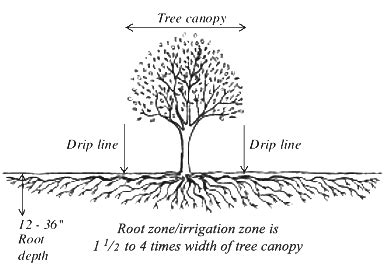
Japanese maples, Acer palmatum, are popular landscape trees available in a wide range of growth habits and leaf colors. These trees are slow growing and thrive with moderate to low levels of nutrients. Established Japanese maples benefit from consistent fertilization, especially if your soil lacks sufficient organic matter. Fertilize Japanese maples if you see signs of nutrient deficiencies, such as yellowing of the leaves with darker veins, or when the growth rate has slowed significantly. Before you fertilize your Japanese maple, identify the location of the drip line. This is the area on the ground that is located directly under the circumference of the tree’s canopy. The feeder roots are concentrated at the drip line, most of them being about a foot deep into the soil. Apply a slow-release fertilizer about halfway between the trunk and the drip line, evenly spreading it to roughly 1-2 feet beyond the drip line. Water well after fertilizing.
Japanese maples should only be fertilized if a soil test indicates a nutrient deficiency. Too much fertilizer may lead to an abundance of weak, thin growth and fertilizer burn, especially if the fertilizer is high in nitrogen. A soil test will also indicate the soil pH, which is important for the bioavailability of plant nutrients. The best time of the year to fertilize Japanese maples is in early spring before the tree leafs out. Japanese maples only need to be fertilized once per year. If the tree is growing in soil enriched with plenty of organic matter, fertilization can be reduced to about every other year. Make sure the soil is sufficiently moist before fertilizing, and refrain from applying fertilizer during periods of extreme drought or heat to prevent fertilizer burn. Avoid fertilizing Japanese maples in late summer through fall, which can cause spurts of weaker, new growth that will be sensitive to winter damage.
Choose a slow-release, granular formula for Japanese maples. An organic fertilizer formulated for trees, such as Espoma Tree-Tone 6-3-2, will provide a continuous supply of nutrients throughout the growing season. Always wear protective gloves and a face mask when handling chemical fertilizers. This post may contain affiliate links. Applying the right amount of Japanese maple fertilizer at the right time is a lesson in attentiveness and restraint. Exercise both of these when offering your Japanese maples supplemental nutrition and you’ll be rewarded with consistent, healthy growth.
In general, the Japanese maple (Acer palmatum) is prized for its vibrantly colored leaves and relatively compact habit. Japanese maple trees look lovely when planted amongst other ornamentals, along the edges of lawns, or as centerpieces in container gardens. They are easy to care for and prune. Truly understanding the needs of these beautiful trees starts with a good soil test. To learn all you can about the makeup and fertility of your planting bed, contact your local extension office about soil testing or use a quality DIY soil test kit. Japanese maple trees prefer soil that’s light, well-draining, and rich in organic matter. And, since Japanese maples are acid-loving plants, the soil they’re in also should be slightly acidic. If your trees are planted in heavy clay or soil with a very basic pH level, they aren’t likely to thrive. What’s more, because pH problems can impede nutrient uptake, adding fertilizer in this instance won’t help. Instead, you’ll need to amend the soil with a mixture of well-rotted compost, worm castings, or other organic materials. Doing so will help to improve drainage and aeration, boost the numbers of beneficial microorganisms, and correct pH levels.
Now, let’s say the structure and pH of your soil are adequate but your soil test reveals that it’s low in nitrogen, phosphorus, potassium, or other essential micronutrients. Do not fertilize Japanese maples at the time of planting. Their young roots can be burned. If you determine that the Japanese maples in your landscape do need extra nutrients, the best time to apply the Japanese maple fertilizer of your choice is in early spring a little before your trees begin to leaf out. By feeding your trees at this time, you help spur and support their early season growth. And, although you could, alternatively, apply fertilizer a little later in the growing season, you’d better examine the fertilizer package label closely first to see how long the application is intended to last. Do not fertilize Japanese maples in the late summer or fall. You may recall that a fertilizer’s NPK ratio refers to the respective percentages of nitrogen (N), phosphorus (P), and potassium (K) contained by weight. Requiring little nitrogen, phosphorus, or potassium, Japanese maples are fairly light feeders. Fortunately, there are a few Japanese maple fertilizer products that have been developed to serve the needs of Japanese maples.
Determining how much fertilizer to apply is as important as choosing the right Japanese maple fertilizer. After all, if you use too much-or if you fail to water regularly-these products can cause fertilizer burn. Generally, older, more well-established Japanese maples can handle more fertilizer than smaller, younger trees can. Follow label instructions to determine how much to apply based on the size and maturity of the tree. Typically, dry granules are worked into holes dug into the top four to six inches of soil. Depending on the size of your tree, you might sprinkle one-eighth to one-quarter cup of pellets in each hole and the holes themselves should be spaced every two to three feet apart within and slightly beyond the tree canopy drip line. Before applying liquid fertilizer, water the application area well. Dilute the liquid concentrate per the package instructions. Apply granular fertilizers beneath the drip line of the tree.
Knowing how and when to apply Japanese maple fertilizer appropriately comes down to paying attention to detail and using a light touch. Choose a product that’s no more than 15 percent nitrogen by weight, since Japanese maples are particularly sensitive to excess nitrogen. Photos courtesy of Anthony Fajarillo of Bonsaiko Applying fertilizer to a Japanese Maple that lives in a pot requires special care. The followingTips are provided by Ryan Shields, owner of Spruce & Maple Nursery in Collierville, Tennessee.
Fertilizing in pots and choice of products
Timing: In early spring, your tree is going to push top growth. This is the time to apply fertilizer if you’re going to. Just be sure to do it when the pot temperatures remain consistently at or above 70 degrees. Spring Fertilizer: I ALWAYS use a 90-day slow release, typically in the following profile: N 10-15, P 9-12, K 9-15. Or anything in that range. 10-10-10 or 14-14-14 is often readily available to the public, and those would be okay too. Make sure your fertilizer is slow release if you’re using anything that has over 9 on your N rating. Summer Fertilizer: In the summer, you can follow up with an instant release fertilizer to promote root growth. That should be around the time your 90 days of slow release spring fertilizer has worn off. At this point you can focus on a fertilizer with more P/K to promote root growth. Amount of Fertilizer: In all cases, read the label to make sure you add the right amount for your pot size. If you make a mistake and put an instant release down with high N rating, you run the risk of burning your trees and plants. Watering: During spring, make sure you don't over water. Your roots aren’t technically growing much, so they need to stay on the dry side. Under-sized trees can die from drowning or over watering. In the summer, your potted maples can tolerate a lot more water than usual. In Case of Emergency: If you ever apply too much fertilizer and you’re worried about phytotoxicity, you can get a product called Charzorb. Start by removing as much fertilizer as possible by hand; use a blower to remove even more. Place Charzorb on the spill.
Maple trees, especially the enchanting Japanese maple, are like the prima donnas of the garden: dramatic, showy, low-maintenance if you do them right. Before discussing fertilizer or watering, we must talk about the foundation: the soil. Japanese maples thrive in slightly acidic, well-draining soil. When planting, don’t make the mistake of digging a deep hole and planting too deeply. The planting hole should be twice as wide as the root ball, but only as deep as the roots-no deeper. Mulch is also part of the soil-care story: a 2-3 inch layer of shredded hardwood bark (or compost) helps retain moisture, regulates soil temperature, and suppresses weeds. Young or newly planted maples need more frequent watering: aim for deep watering several times a week until the roots establish. Established maples fare better with less frequent, deeper watering. Let the top inch (or so) of soil dry out between waterings. In summer, afternoon shade helps, especially for delicate laceleaf varieties-they burn easily under intense sun. Watch for leaf tip burn, wilting, or premature leaf drop. These are signals that your tree is under water stress, either too much or too little.
Fertilizing Japanese maples is about restraint as much as generosity. Too much can lead to weak growth, poor color, or frost vulnerability. When to Fertilize: Early spring, just as buds begin to swell, is prime. A gentle second feeding mid-summer may help if growth seems sluggish. Type of Fertilizer: Look for slow-release, low-nitrogen formulas. Balanced N-P-K blends (with moderate N) suit best. Organic vs Synthetic: We lean toward organic where possible: compost, well-rotted manure, slow-release shrub/tree fertilizer. These tend to be gentler. How Much: For young trees, use smaller doses. Spread around the drip line-not piling right at the trunk. If using pellets, work them into the soil surface and water in. Each season has its quirks.
Herter Nursery emphasizes that many maple problems stem from well-meaning over-care-pruning too much, feeding too late, or keeping soil constantly wet. Even with mistakes, maples often bounce back if you catch the problem early. Overwatering can lead to root issues: If the soil is soggy, improve drainage, reduce watering, and add mulch. Some Japanese maples are forgiving, others more finicky. The right soil, consistent yet not excessive watering, and gentle fertilizers at the right time are key. So go ahead-choose your maple, plant it thoughtfully, water with purpose, fertilize with care.
We’re a family-owned business-Herter Nursery-started in 1993 by John and Carol Herter. We specialize in rare and hard-to-find Japanese maple trees. Browse our collection if you’re looking for a Japanese red maple, an orangeola Japanese maple, a bloodgood Japanese maple, or even a large Japanese maple tree for sale. Check out our Japanese Maple Specials or join our Maple of the Month Club to receive handpicked Acer trees. Want to see what we ship?
PHC ROOTS 7-7-7 fertilizer meets all of the above criteria. All organic, slow release with added beneficial bacteria and microbes that improves the health of your soil or pot mix and your tree. This is hands down the ONLY fertilizer that I will use on maples. I have been using for 4 years after a 10 year hands on research project. You will get growth that is healthy and true to form. No long leggy shoots or reversion. The growth needs to be dense and sustainable, able to stand up to the heat of summer. The tree must remain healthy and free of bacteria, pests, and disease. Organic and slow release is important too.
PHC roots are the only fertilizers that I will recommend. I used to be of the option that Japanese maples don't need fertilizer. Note that I have no relationship with phc roots or am Leonard, I do not benefit in any way by my recommendation. I want to see other people have great success with their maples. It makes me sad to see people lose their trees to stress and bacterial infections. I like to share my knowledge so that people can have healthy and happy maples!
When Do I Fertilize My Japanese Maples?
PHC 7-7-7 for container and landscape maples, shrubs, conifers, and perennials. For all fertilizers I use half the recommended dose. Synthetic fertilizers fuel bacterial outbreaks. Do not use them! When I get a new tree the first thing I do is rinse away the synthetic fertilizer and dispose of it. Better yet, don't use them on your lawn either. The other problem with synthetic fertilizers is that the growth is usually not true to form and will destroy the structure and character of your tree. The growth tends to only be at the tips making the tree look more sparse over time. The long shoots of growth caused by synthetic fertilizers are very porous and less dense increasing the likelihood of winter snow damage and wind damage. The branches tend to be more likely to die back over winter and the foliage tends to burn easier in the Summer heat. I find all this to be true even with the most expensive slow release synthetic fertilizers that cost more than $90 for 25lb bags. Reversion along with loss of spring color also have been a problem with synthetic fertilizers in my experience. PHC roots are the only fertilizers that I will recommend.
Quick notes for soil and watering
Before discussing fertilizer or watering, the foundation is soil. Mulch is part of soil care: a 2-3 inch layer of shredded hardwood bark helps retain moisture, regulate soil temperature, and suppress weeds. Young maples need more frequent watering; let the top inch of soil dry out between waterings. In summer, afternoon shade helps, especially for laceleaf varieties. Watch for leaf tip burn, wilting, or premature leaf drop as signs of water stress.
tags: #fertilizing #japanese #maple