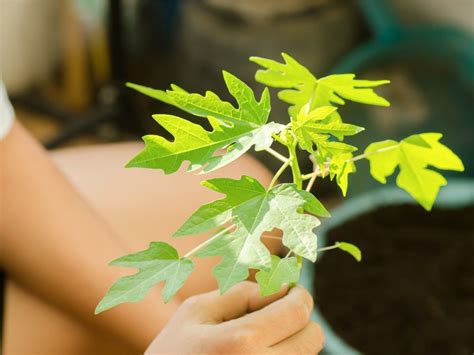
Growing papaya tree as a house plant will give you a dramatic tropical accent for a sunny room. And, that's not all. Papaya is a fast-growing fruit tree with an unbranched woody trunk. Its big leaves are spectacular. Deeply lobed into 5-9 segments, they're held on long, horizontal petioles at the top, giving papaya tree the look of an umbrella.
Papayas do not need to be pruned. Put this tropical native in a warm, sunny spot year-round. If you move it outdoors for the summer, protect it from strong winds. Also, bring it in when the temperature drops below 60°F/16°C. Papayas don't like the cold at all. Two things will quickly kill papaya trees -- frost and soggy soil.
Light, temperature and positioning
Full sun is essential for robust growth and fruiting. Give your papaya tree as much direct sunlight as you can year-round. Moving it outdoors for the summer will help the fruits to ripen. Turn the plant a quarter turn every week because it will tend to grow toward the light source. Average room temperatures (65-75°F/18-24°C) suit this tropical tree just fine. Aim to keep it warm year-round. If you put your plant out on the patio for the summer, don't worry -- it can take the heat. Just bring it back in when the temperature drops. Prolonged cold can damage the tree, and even a brief exposure to 32°F/0°C can kill a papaya tree.
Watering, humidity and soil
Water: Keep the soil moist in hot weather and drier in the winter. Water thoroughly, but don't allow the soil to get soggy which can quickly kill this fruit tree. Humidity: Try to maintain 40-50% relative humidity. The most efficient way to raise humidity around tropical houseplants is with a cool-mist room humidifier. Soil: Slightly acidic (pH 6.0-6.5) potting mix that drains well.
Potting and repotting
Repot young plants every year. Move to a pot only 1 size larger when the roots fill the container. Use a heavy pot to prevent toppling, and make sure it has a drainage hole to prevent root rot.
Pollination and fruiting indoors
Trumpet-shaped papaya flowers appear in the leaf axils of the tree in the summer. The fragrant, creamy white or yellow flowers are tiny -- just 1 inch (2.5 cm) long, with 5 petals. Papaya flowers may be male or female. Carica papaya 'Solo' carries both types of flowers. Some papaya trees that are grown indoors may need to be hand-pollinated to trigger fruit production.
How to pollinate a papaya: Use a small, dry paintbrush to dab each flower. Wiggle the brush around the center of each flower, moving from flower to flower. The fruits change from deep green to yellow as they ripen. Harvest papaya fruits when they are mostly yellow. Allow fruit to ripen a few more days at room temperature. It's ready for eating when the skin is fully yellow and slightly soft to the touch. Green papayas should not be eaten raw, and will not properly ripen if picked while still green.
Harvesting and fruit quality
Papaya fruit has juicy, firm flesh, and is slightly sweet. It's also good for you. One of the health benefits of papaya fruit is that it contains the enzyme papain, which aids in digestion. The fruits change from deep green to yellow as they ripen. Harvest papaya fruits when they are mostly yellow and slightly soft to the touch; then allow them to ripen a few more days at room temperature.
Pests, diseases and care
Watch for pests and diseases. Papaya trees aren't bothered much by insects indoors. However, watch for spider mites, which love dry conditions in winter. Thrips and white flies may also be invaders. Treat any infestation immediately. An all-purpose organic spray of neem oil will get rid of pests and mildew.
Varieties and growing from seed
Origins: Southern Mexico and Central America. Height: Up to 10 ft (3 m) when grown in a container. Dwarf varieties are only 4-8 ft (1.2-2.4 m). You can also grow papayas from seed. You'll find papaya seeds for sale from nurseries.
Choosing a plant and where to buy
Buy papaya plants from a reputable grower. If you’re seeking a compact option, a dwarf cultivar such as Carica papaya 'T.r. Hovey' is an option that only reaches 4-8 ft (1.2-2.4 m), making it an ideal indoor tree. Indoor fruit trees for sale can also be found from online nurseries.
Propagation from seed: practical steps
You can grow papayas from seed. Sow seeds in moist perlite and cover pot with a plastic bag to maintain humidity. Keep in a warm, bright place. For best results, use a heat mat to maintain a steady 75°/24°C temperature. Seeds should germinate in about 5-8 weeks.
- Choose a sunny, warm indoor location and a heavy pot with drainage.
- Water consistently and monitor humidity to keep a tropical feel.
- Pollinate indoors if fruiting is desired, using a small dry brush.
- Harvest fruits when yellow and slightly soft; enjoy fresh or in smoothies.
Note: If you move the plant outdoors in summer, protect it from strong winds and return it indoors before temperatures dip below 60°F/16°C.
How to hand pollinate papaya to get fruits.
Table: Quick reference for indoor papaya care
| Aspect | Guidance |
|---|---|
| Light | Full sun; rotate weekly |
| Water | Keep soil moist in heat; drier in winter |
| Humidity | 40-50% RH; use humidifier if needed |
| Temperature | 65-75°F (18-24°C); protect from frost |
| Soil | Slightly acidic; well-draining |
| Fertilizer | Monthly in spring/summer; organic fruit tree fertilizer |
| Repot | One size larger annually until roots fill pot |
| Pests | Watch for spider mites, thrips, whiteflies; neem oil |
Origin: Southern Mexico and Central America. Height: Up to 10 ft (3 m) when grown in a container. Dwarf varieties are only 4-8 ft (1.2-2.4 m).