Ivy leaf geraniums offer a summer of colour and are a popular choice for hanging baskets, thriving in vibrant colours and pastel shades in single and double forms. Trailing geraniums, in particular, excel when planted on their own or in large group plantings, and they are easy to grow.
Understanding the plants: geraniums vs. pelargoniums
All plants have a species or Latin name, as well as a common name. 'Geranium' is the common name for the species Pelargonium. Confusingly, 'Geranium' is also the botanical name of hardy geraniums, also known as cranesbills or 'true geraniums'. Despite sharing a common name, geraniums (pelargoniums) and cranesbills (geraniums) are different species, and have different growing requirements.
In the family Geraniaceae, Pelargonium peltatum is commonly known as ivy leaf, trailing, or cascading geranium. An herbaceous perennial native to South Africa, P. peltatum was introduced to the cool climates of Holland and England by 1704. Winter hardy only in Zones 9-11, their fast growth and easy propagation soon saw them being used as an annual - as they still are today.
A classic balcony display seen in Switzerland and Austria is not easy to replicate in Scotland, but a green wall is one way to try. I trialled mixed trailing annuals with mine, but trailing geraniums worked even better.
A green wall is a stackable, modular living wall system only requiring restraint fixings. Each trough is typically 60cm wide and both stacks vertically and clips horizontally, fitting any space. The 1.8L water reservoir and capillary felt allows plants to draw up the water they need and the cascading overflow system avoids the risk of overwatering and water wastage. Pots and hanging baskets are a less expensive and more traditional option.
Pelargonium 'Viletta White' planted with lobelia and California poppies
How to grow ivy geraniums in hanging baskets
Plant into good quality compost and irrigate moderately from spring to summer, allowing the compost to dry between waterings. Apply a balanced liquid fertilizer during the growing season and switch to a high potassium fertilizer when flowering starts. These plants thrive in full sun and don’t appreciate constantly wet compost when the leaves can become prone to downy mildew. An advantage of a hanging basket or green wall is that watering can be controlled and the plant in the rain shadow won’t be soaked by showers. Unlike most companion annuals in the same basket, trailing geraniums don’t mind drying out. Regular deadheading should mean flowers from June until the first frost.
‘Super Cascade Red’ dazzles in midsummer.
Overwintering and care across seasons
These plants are tender perennials rather than annuals and overwinter well in pots in an unheated greenhouse when allowed to go dormant, and flower much earlier than plugs or seed raised plants in the following spring. They will cope with surprisingly low temperatures as long as the compost is dry. Keep them in your porch, conservatory or on a windowsill in an unheated room in the house. Mine have survived -5C, but probably no lower. Allow to dry out completely and cut back by about one third. Take off leaves that succumb to mildew. In early spring water very sparingly and cut back by another third in late February or March. They will begin to bud profusely in the greenhouse so water and feed at this stage, and bring out in sunny days. Bring out after the risk of frost has passed.
Propagation and planting options
Seeds or plug plants: They are slow to grow from seeds, which need to be started early, around late January, so plug plants can be a better option. Online suppliers sell named varieties or collections of 10 or 20 plug plants for around £1 each which is my preferred option. Propagation: Pelargoniums are usually easy to take cuttings from. You need a small pot with gritty, peat-free compost. Choose a non-flowering side shoot and make a clean cut using a sharp knife or scissors between two of the bumps (nodes) on the stem that the leaves grow from. Take just the tip, about 5cm or so, and remove the bottom couple of leaves. Let it dry out for a couple of hours, and then simply push it into the compost and give it just enough water to make the compost slightly damp.
When gardeners think of trailing flowers for hanging baskets, one of the first that comes to mind is the Ivy Geranium (Pelargonium peltatum). At Garden Starts Nursery, we grow thousands of these each season, and we’ve refined methods that maximize germination, plant vigor, and resale value. Unlike the upright zonal geraniums, Ivy Geraniums (trailing geraniums) grow with a natural cascading habit. What sets trailing geraniums apart is their ability to produce vibrant blooms all summer long, even in full sun. Many growers prefer starting Ivy Geraniums from seed because it allows for large-scale production, uniform plants, and lower costs compared to cuttings.
- Cold cycle: Put them in the fridge for about 24 hours.
- At our nursery, we use 200-cell trays filled with a fine, well-draining seed-starting mix. We use a vacuum seeder for efficiency, dropping one seed per cell with perfect accuracy.
- Seeds typically germinate in 5-10 days. Once seedlings have a few sets of true leaves, they are ready for transplanting.
Fertilizer: Begin a low-dose liquid feed once seedlings are established. One of the best uses for trailing geraniums is in 12-inch hanging baskets. Sunlight: Full sun to partial shade. At Garden Starts Nursery, we sell both individual plants and full baskets. Overwintering: In warmer climates (zones 9-11), they act as perennials. While this guide focuses on seed-started Ivy Geraniums, they can also be propagated by cuttings. However, cuttings are generally more expensive and less practical for large-scale production compared to seed. For both home gardeners and commercial growers, Ivy Geraniums (Trailing Geraniums) offer the perfect blend of beauty and profitability.
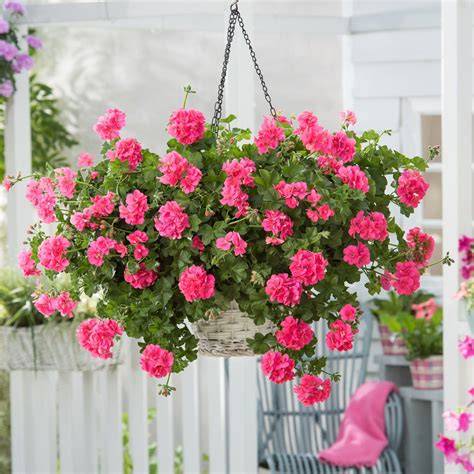
How to Plant Trailing Geraniums: Hanging Basket Guide
| Aspect | Advice |
|---|---|
| Sunlight | Full sun to partial shade |
| Watering | Moderate; allow compost to dry between waterings |
| Soil/Compost | Good quality, well-draining, peat-free |
| Fertilizer | Balanced during growth; high potassium when flowering |
| Overwintering Zone | Zones 9-11 for perennials |
Overwintering note: They survive in unheated spaces when allowed to go dormant and should be brought out after frost risk passes. Propagation by cuttings is common but seed propagation offers cost advantages for large-scale production.