If you’re in the market for a riding mower, you have options-and some important decisions to make. Mid-mount or front-mount? Side discharge or rear discharge? Collection system, mulching kit, both or neither?When we talk with you about what you need from your next mower, you ask a few important questions about your property, desired results, mowing habits (frequency) and preferences, so we can steer you down the right path to a product that will meet your expectations.First, we’ll tackle the questions. Then, we will walk through the difference between side-discharge and rear-discharge decks, including how each configuration works and the benefits you’ll gain regardless of which you choose.
What to Consider-Mowing Priorities
What type of property do you plan on mowing? This is a driving factor in the mower deck design you should select. For example, landscape contractors mowing large swaths of grass on highway medians have different goals than the homeowner caring for an irrigated lawn that includes landscape beds to maneuver around. Commercial landscapers maintaining HOAs or retail properties are held to clients’ standards. They must deliver quality to justify the cost of services, meaning no clippings left behind or clumps of grass sitting on the lawn.
How often do you mow the lawn? During the peak growing season, turf seems to inch up overnight and often requires mowing every five days, or three times every two weeks. Do you like to keep up with a fast-growing lawn, willing to mow whenever needed so the grass doesn’t get too long? Or do you prefer a less-is-more approach and commit to mowing weekly, but no more than that?
What mowing obstacles do you manage? Consider driveways, walkways, fence lines, landscape beds, outdoor living spaces, play areas and any other mow-around obstacle. For example, cemeteries must maintain neat grounds while keeping clippings off headstones and monuments, while maneuvering along walkways. Are you mowing a rural space with lots of land-the main obstacle being the time required to complete the job? What is the topography? Do you irrigate the lawn? All these factors determine whether a rear-discharge or side-discharge deck is best for you.
What are your mowing priorities? You have a need for speed. Is your goal to mow the lawn as fast as possible? Or, is a manicured finish most important? Do you prefer to collect grass clippings, or would you rather cut the grass more often and leave them on the lawn? Are you covering lots of ground? Does your property require a specific mowing pattern to move around and along obstacles? Ultimately, what do you want to get out of your mower, the cut and experience caring for your property?
Is a Side-Discharge or Rear-Discharge Deck Best?
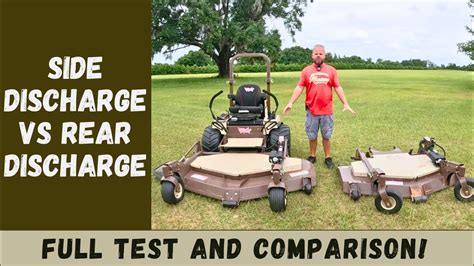
Comparing side-discharge and rear-discharge decks is like comparing apples to oranges. While the majority of the parts are the same, there are some defining differences. These mower discharge configurations are designed for different types of jobs and mowing “personalities,” so to speak. Let’s break down the benefits of both discharge configurations here. Both are available in front-mount or mid-mount styles.
Side-Discharge Decks
First, the technical details. Side-discharge mower decks include three cutting blades that push clippings out the opening of the deck, typically on the right side. Grass is cut multiple times while rotating in the deck before it exits. This way, you can choose whether or not to allow clippings to disperse on the lawn.
Because of the way side-discharge decks move material, they require more horsepower to operate than rear discharge. Arguably, your mower works a bit harder than it otherwise would with a rear-discharge deck. Here are a couple of other points to consider, too:The discharge is always on the right side, which means you must mind the mowing pattern, otherwise walkways, driveways and landscaped areas could require blowing off clippings. However, one convenient feature is a side-discharge restrictor kit that allows you to briefly close the opening while mowing to prevent dispensing clippings onto a patio, for example.
Because of the triple-blade, high-horsepower action before clippings are dispersed out the side discharge, the result is a fine cut that does not leave behind large clumps. Generally, you can get away with mowing a taller lawn without collecting clippings.
Side discharge pro: Fastest way to deal with clippings. Side discharge cons: Sends grass clippings and debris into unwanted places. Side discharge cons: Larger clippings are messier and decompose slower. Side discharge also can shoot rocks and debris, and may require safety measures around people and pets.
Mulching is better for turf health when conditions allow - it returns nutrients, reduces thatch when done correctly, and eliminates clipping disposal. Bagging produces a cleaner visual result and is the right choice when growth is too heavy for mulching or when clippings can’t be left on the surface. This is a common misconception. Grass clippings are mostly water and break down quickly - they don’t contribute meaningfully to thatch. Thatch is primarily caused by the accumulation of roots, stems, and stolons.
Rear-Discharge Decks
The goal of a rear-discharge deck is to cut the grass once and get it out of the way - out the back of the deck - as quickly as possible. Dedicated rear-discharge decks are designed for this purpose, which allows these decks to mow through taller, thicker grass without the risk of “bogging down” or clumping. The trade off is that longer clippings will be more noticeable behind the mower.
On a front-mount rear discharge, blades in the deck counter-rotate, pushing material backward. The same action occurs on a mid-mount with rear discharge, except there is an additional spreader blade on the back of the mower that helps lay down clippings in a uniform pattern effectively eliminating clumping and windrowing. They will always disperse clippings out of the back of the machine. Generally speaking, this means mowing more often, or at a taller cutting height, will be necessary to avoid leaving behind a heavier layer of clippings.
Rear-discharge decks allow you to mow in any direction at any time. In areas requiring mowing in a circle with a side discharge, you can get the job done more efficiently with a rear discharge without the extra work of blowing clippings out of beds or off walkways. Side or Rear Discharge? We've Got You Covered.
Sometimes, there is no right answer. Side- and rear-discharge mowers are specially designed to manage different types of mowing tasks. Both deliver a high quality of cut, comfort and are engineered to withstand rugged environments. When you work with a Grasshopper servicing dealer, experienced staff can walk you through choosing the best mower for you: side or rear discharge. Most mower operators pick a cutting configuration and stick with it all season long. That approach works fine for simple conditions… but Northeast grass is rarely simple.
MULCHING, BAGGING, OR SIDE DISCHARGE: Mulching uses a specialized blade and deck baffling to recut grass multiple times before depositing fine clippings back into the turf. Mulching is better for turf health when conditions allow - it returns nutrients, reduces thatch when done correctly, and eliminates clipping disposal. Bagging produces a cleaner visual result. Side discharge is one of the most standard systems you’ll see.
Mulching is better for turf health when conditions allow - it returns nutrients, reduces thatch when done correctly, and eliminates clipping disposal. Bagging produces a cleaner visual result and is the right choice when growth is too heavy for mulching or when clippings can’t be left on the surface. This is a common misconception. Grass clippings are mostly water and break down quickly - they don’t contribute meaningfully to thatch. Thatch is primarily caused by the accumulation of roots, stems, and stolons.
Mulching decks chop up grass clippings and return them to the lawn, while side-discharge decks expel clippings to the side. If you’re mowing wet grass, side discharge at reduced ground speed is the best option; the better strategy when possible is simply to wait. Some John Deere decks support convertible configurations - switching between mulch, bag, and discharge modes with a kit swap. Follow the one-third rule: never remove more than one-third of the grass blade in a single cutting.
From what they are telling me the side discharge mowers are the ones that actually leave a better finish on the lawn than the rear (which is now the opposite of all the above)... With a rear discharge mower... it may 'disperses' the grass better behind it not clumping etc... but the grass is left on the cut lawn. Side discharge on the other hand throws the grass to the side... In both situations the grass is being thrown into the grass you are cutting next and thus it is not left on the nicely cut grass.
When it comes to mowing your lawn, the way you manage your clippings matters. Side discharge, rear discharge, and mulching decks each offer different benefits. All depending on your lawn type, maintenance routine, and personal preference. This guide will walk you through each method, the pros and cons, and how to decide which cutting system fits your needs best.
Method #1- Bag Your Clippings
The first method we will mention is the second most common method for handling grass clippings among homeowners. Look, bagging lawn clippings is simple. Install a bagging system on your mower, and all you need to do is find a place to dump the clippings. Most people don’t know this, but there is a 3rd lawn mowing option, and that is mulching the grass.
Mulching mowers chop grass clippings into tiny pieces which quickly break down into the lawn. Mulching mowers have closed decks, while converted mowers have chute covers that keep the grass inside the mower deck until they’ve been chopped up. This table details the pros and cons of mulching your grass clippings: Mulching Pros Mulching Cons ✓ Returns nutrients to your lawn ✓ Faster than bagging ✓ Clippings look cleaner when mulched compared to side discharge ✓ Safer than side discharge ✗ Not ideal for tall or wet grass ✗ Need frequent cleaning ✗ Tall grass strains the mower ✗ Mulching is slower than side discharge ✗ Doesn’t cut as cleanly as side discharge
Let’s go over these points in detail. Pros of Mulching Lawn Clippings ✓ Returns nutrients to your lawn: The main benefit of mulching grass clippings is that you’re returning nutrients to your lawn every time you mow. The experts at Michigan State University Extension say that returning grass clippings to your lawn can cut down on fertilizer use by as much as 1 pound per 1,000 square feet every year. That’s a lot of free nutrients! ✓ Faster than bagging: Another reason to mulch your lawn clippings is to cut down on mowing time. It’s not the fastest way to deal with grass clippings while you mow, but it’s faster than emptying or replacing your grass catcher bag when you bag your clippings. ✓ More aesthetically pleasing: If you need to leave clippings on your lawn, mulching them is the better option in terms of aesthetics - at least, when it comes to the clippings themselves. Smaller clippings blend into the lawn and don’t sit on top of the grass, so your lawn looks cleaner than if you side discharge. ✓ Safer than side discharge: Lastly, mulching your lawn clippings is safer than side discharge. While mowing, any rocks and debris can get under the mower deck. With side discharge, this debris can get flung out at high speeds. The closed mower deck required to mulch lawn clippings makes this less likely to happen. See Related: How to Improve Your Lawn With Mulch
Cons of Mulching Lawn Clippings ✗ Can’t mow wet or tall grass: You can’t mow and mulch clippings if your grass is wet or too tall. ✗ Need frequent cleaning: Mulching mowers are more prone to building up gunk underneath the mower deck, so they need to be cleaned more often. ✗ Tall grass strains the mower: Mowing tall grass with the intention of mulching puts strain on the mower. ✗ Mulching is slower than side discharge: Compared to side discharge, mulching is slower. You have to give the mower time to cut up the grass clippings and drop them onto your lawn. If you go too fast, you may end up with an uneven spread of grass clippings on your lawn.
What is Side Discharge and Why Should I Do It? A lawn mower with side discharge takes the grass clippings and expels them out of a side port or chute as you cut your grass. Usually, these grass clippings are ejected several feet away. This table shows the pros and cons of side discharge: Side Discharge Pros Side Discharge Cons ✓ Faster mowing times ✓ Good-quality, clean cut even on tall and wet grass ✓ Even distribution of grass clippings ✓ Stripes better than mulching ✗ Can shoot clippings into unwanted places ✗ More likely to shoot debris ✗ Grass clippings look messier and won’t decompose as fast
Now, let’s dive deeper into these bullet points. Side Discharge Pros ✓ Faster mowing time: The most compelling reason to switch to side discharge is just how fast it is. You don’t have to worry about bagging or distributing your mulched lawn clippings evenly, as everything is spewed out of the mower. All you need to do is mow. ✓ Provides a nice, clean cut: Next, side discharge results in a cleaner cut, even if your grass is tall and overgrown or after a rain shower. The force required to expel the grass clippings is strong enough to dislodge wet and long lawn clippings. The cleaner cut of a side discharge mower is also better for lawn stripes. ✓ Even distribution of grass clippings: Lastly, side discharge distributes the grass clippings more evenly as long as you keep mowing at a steady pace. You might need to take a rake to your clippings once in a blue moon. Otherwise, the clumps of grass might choke your lawn, resulting in brown spots. Side Discharge Cons ✗ Shoots clippings everywhere: The number one disadvantage is how the grass clippings can get into places they shouldn’t be. There are ways to prevent - OCDC, chute blocks, or simply changing mowing direction. Note: Some areas will fine you for littering. Lawn clippings can also be dangerous to motorcyclists when left on the road. ✗ Shoots rocks and dangerous debris: Side discharge can also chuck out rocks and other debris several feet away at fast speeds. Close the lawn to pets and people while you mow. ✗ Makes your lawn look messier: Grass clippings stand out on your lawn more and may decompose slower than mulch. Is Mulching Better Than Side Discharge? It depends on your wishes, time, and effort. If you have a large yard, overgrown grass, or wet turf, side discharge may be more attractive. If you have a small yard, frequent mowing, and want turf health benefits, mulching may be better. The good news is that many modern mowers can do both or even bag, and attachments exist to add functionality.
When to mulch vs. when to side discharge: Large yard space, overgrown grass, wet turf, little time favor side discharge. Small yard space, frequent mowing, concern for turf health, more free time favor mulching. The good news is that you don’t have to choose between just mulching or side discharge. Most modern lawn mowers can do both - some can even bag, too. You can also buy attachments (usually mulching kits) to add that functionality to your current mower.
If you are looking the perfect mower, take a look at our reviews of the best lawn mowers on the market: Best Lawn Mowers, Best Mulching Lawn Mowers, Best Lawn Mowers for Big Yards, Best Lawn Mowers for Small Yards.
FAQs about Mulching vs. Side Discharge
Should I even leave clippings on the lawn? Both mulching and side discharge are excellent ways to grasscycle. Grasscycling can return nutrients back into the soil for your grass to use. If you’re worried about grass clippings worsening thatch production, then we have good news for you. Grass clippings break down too fast for them to significantly contribute to lawn thatch. When should I not leave clippings on the lawn? Your lawn is sick, there’s too much clippings, newly-seeded turf, excess thatch, weeds, children or pets, or clippings won’t reach the soil. You can read more about these concerns in the guide above.
What else can I do with lawn clippings? Compost them, use them as mulch elsewhere in your garden, curbside composting, or bag and dispose where allowed. The lists of states with restrictions are noted in the text above. Hire a Lawn Care Pro for a Clean Cut Mulching and side discharge both have their strengths and weaknesses. One of their main differences is the amount of time it takes to complete a mowing session. Side discharge is fast, while mulching is slower (but more helpful to your lawn).
Note: Mulching is better for your lawn’s health, but side discharge is a much faster way to take care of grass clippings. However, sometimes you just won’t have enough time to mow your lawn properly even if you side discharge.
FBI Issues Warning After Water System Attacks — Secure Your Accounts Now
Ultimately, the best mowing setup depends on your lawn design, the size of your garden, and how you like to mow. The guide above helps you decide between side discharge, rear discharge, and mulching based on your priorities, yard size, and maintenance routine.