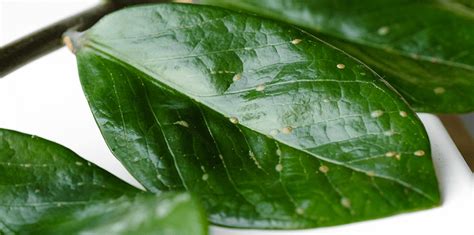
Scale insects are small, piercing-sucking insects that often go unnoticed on indoor plants. The adult forms can be attached to leaves, petioles, and stems. Since the insects are often overlooked, the first signs may be yellowing or wilting leaves that may eventually drop. Leaves may also be covered with a clear sticky substance called honeydew. Honeydew is the insects’ excrement consisting of partially digested sap and may coat the floor and other objects beneath the plant as it spatters down from above. A sticky floor beneath a susceptible plant is a telltale sign that infestation is underway. Under humid conditions, a black mold, called sooty mold, may grow on the honeydew making the leaves look dirty. Closer inspection will reveal small cottony or dome-shaped shells attached to stems and leaves. When pried off with a knifepoint, they may be hollow underneath or house adults and/or eggs. Scale can be differentiated from parts of the plant by scraping. Scale insects have a simple life cycle of egg, nymph (crawler), and adult. Indoors, eggs can be laid any time under the protective shell. The eggs hatch and the crawlers seek out new feeding sites. This crawler stage is when scale is easiest to control. When the crawlers settle, they insert their mouth parts into the plant and begin feeding on the plant's sap. The protective shell develops soon after feeding begins and the insect loses use of its legs.
Identification: Two main groups
Scale insects are sap-sucking pests that anchor themselves into the vascular tissues of leaves or stems. There are two main groups: armored scales (hard scales) and soft scales. Armored scales have a hard, waxy cover that is not part of the insect body and do not excrete honeydew, while soft scales produce honeydew and have a more rounded, convex body covered by a waxy or cottony layer. Armored scales are generally smaller (1/16 to 1/8 inch) and often blend with bark, making them easier to overlook, whereas soft scales are typically larger (up to 1/4 to 1/2 inch) and more likely to be noticed via honeydew and sooty mold.
Armored scales lay eggs under the protective cover and often have numerous species (e.g., San Jose scale, oystershell scale, euonymus scale). Soft scales are usually oval or dome-shaped and can be found on undersides of leaves and stems, producing abundant honeydew that attracts ants and fosters sooty mold. Examples include brown soft scale, cottony cushion scale, and Lecanium scales, among others. Some scales, like magnolia scale, can be quite large and show dramatic color changes as they mature.
Common appearances by group
- Armored scales: hard, flat covers; shapes range from circular to oystershell; covers may resemble plant bark or a small crust; no honeydew produced.
- Soft scales: dome-shaped or rounded; waxy or cottony coverings; produce honeydew; leaves and surfaces may be sticky and attract mold and ants.
In general, adults may appear as circular, elongate, or oval discolorations or bumps on bark, leaves, or fruit. Immature scales (crawlers) are often yellow to orangish and mobile, while settled adults become stationary and their legs and antennae are reduced or absent. Males, when present, are usually winged and much smaller, often overlooked.
Lifecycle and signs of infestation
Scale insects have a life cycle of egg, crawler (nymph), and adult. Inside the dome-like shell, eggs may hatch, producing crawlers that wander to find feeding sites. The crawler stage is the most vulnerable to control measures. As they feed, they insert mouthparts into the plant and begin siphoning sap; the protective shell develops soon after feeding begins and molts occur, often leaving the insect legless as an adult.
Symptoms of infestation include yellowing or mottling of leaves, canopy thinning, leaf drop, twig dieback, and the presence of honeydew and sooty mold. A sticky film on leaves, floors, or objects beneath the plant is a telltale sign; black sooty mold may cover leaves where honeydew is abundant. Close inspection reveals scale shells or crawlers, especially along leaf undersides and along stems.
Management: prevention, monitoring, and control
- Remove insects by hand if caught early, using a discarded toothbrush or cotton swab with isopropyl alcohol.
- Use insecticidal soap formulated to kill insects while minimizing plant damage; monitor plants frequently and treat when crawlers are noticed.
- Apply superior horticultural oils (ultra-refined oils) that suffocate the insects; follow label directions to avoid damage to sensitive plants. Oils are typically effective against both adults and crawlers and are less likely to harm beneficial insects.
- Utilize chemical insecticides labeled for indoor use; pyrethrins are commonly effective and less toxic than broader-spectrum options. Test on a small plant part first and follow label directions.
- Regular inspection and isolation of new plants helps prevent introducing scale indoors. Bringing plants indoors in fall increases risk, whereas infested plants summered outdoors may benefit from natural enemies.
There are also biological and cultural tactics: encourage natural enemies such as parasitic wasps and predatory beetles, maintain good plant health with proper irrigation and nutrition, manage ants which can protect scale by protecting their honeydew resources, and reduce habitat disturbance that benefits scales. When dealing with large plants, soil-applied systemic insecticides can provide season-long control, but effectiveness varies by scale type, and some species may be resistant or require alternative strategies. Dormant oil applications in late fall or before bud-break can kill overwintering stages of some scales, while repeated crawler-targeted treatments are often necessary for others.
Because scales are immobile for much of their lives and closely resemble plant tissue, accurate identification is important to determine the most effective timing and method of control. Crawlers are the primary target stage for control; mature scales are protected by their waxy coverings and are less susceptible to contact insecticides. Double-sticky tape on branches during crawler emergence can help determine crawler presence and timing for treatments. Honeydew monitoring with water-sensitive paper can help gauge infestation severity and treatment effectiveness.
Natural enemies and integrated strategies
Scales are preyed upon by tiny parasitic wasps and various predators such as lady beetles, lacewings, and predatory mites. Ant control is crucial since ants protect honeydew-producing scales from natural enemies. Habitat management, including planting flowering species to support beneficial insects, can enhance biological control. If ants are abundant, selectively control them and use barriers like sticky wraps around trunks to reduce scale populations. Pruning and sanitation, such as removing badly infested branches, can also slow spread. In some cases, removal and replacement of infested plants may be the most practical solution, especially for invasive species.
When pesticides are necessary, apply when crawlers are active or during the dormant season when juveniles overwinter. Use a combination of tactics: targeted contact sprays for crawlers, dormant oil applications, and strategic systemic insecticides where appropriate. Always verify label guidance, test on a small area first, and consider the potential impact on beneficial organisms.
Key takeaways
- Scale insects fall into armored (hard) and soft scales, with distinct coverings and behaviors; soft scales excrete honeydew, while armored scales typically do not.
- Early detection focuses on crawlers; once scales are protected by their coverings, they become harder to control with contact pesticides.
- Management combines observation, cultural practices, natural enemies, and carefully chosen pesticides timed to crawler activity or dormancy.
Scale insects are sap-sucking pests that can affect a wide range of indoor and outdoor plants. By understanding their appearance, life cycle, and the most effective times to treat, you can implement a comprehensive management plan that emphasizes prevention, monitoring, and targeted control.