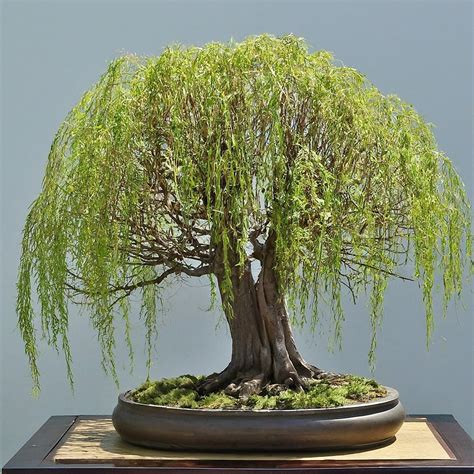
The fast growing weeping willow is native to China and cultivated in Japan, but now grows all over the world to heights of 70 feet, thriving near rivers and streams. It has drooping branches and long yellowish twigs which hang down almost to the ground. The leaves are long and narrow. In spring, the silvery or yellow catkins give the weeping willow a very attractive appearance. The fluffy white blossoms of the pussy willow resemble silk, and they soon give forth young shoots the color of green jade.
Placement and Seasonal Requirements
Willows prefer a sunny place during the growing season, but might need semi-shade during the hottest weeks. This is an outdoor, deciduous bonsai, and will do best if allowed a dormant period. During the growing months, you should only bring it indoors for short periods in order to keep it healthy. A Bonsai can be viewed best when it is placed approximately three to four feet high (eye level), such as on a table, wall or bench. A Bonsai can and should be brought into the house on special occasions and displayed in a prominent place. Your Bonsai should not remain inside for more than a few days at a time, as the atmosphere is detrimental to the health of your tree.
The weeping willow species need winter protection when they are planted in containers. Keep an eye on your bonsai tree to ensure that it is well protected from extreme temps throughout the winter. A cold frame or shed will go a long way to provide adequate protection as long as the roots have been insulated well. In the late fall, the leaves will fall off your weeping willow, the trunk will turn brown and the tree will go dormant. Don't panic if your tree looks dead during the cold winter months.
Watering
Willows like moist soil and often grow close to ponds, lakes and rivers. Willows need ample water, your mix should hold a lot of water. On hot summer days the willow needs huge amounts of water and must be watered several times a day. Never let the soil dry out. You can even place the pot in a shallow bowl filled with water during hot days, in order to avoid drought damage. Water less in winter but keep the rootball slightly moist. A tree with the right amount of water will have crisp, healthy looking leaves. Trees that have received too much or too little water will have droopy leaves.
In areas that experience extreme heat, the weeping willow bonsai must be placed in a well-shaded area and must be provided with adequate water during extended dry spells. Willows are slightly drought tolerant, though you should never allow it to completely dry out as it does best in moist, cool conditions; its native habitat is usually near ponds, streams, and lakes where cool, moist conditions are the rule rather than the exception. You can even place the pot in a shallow tray filled with a layer of gravel with water added.
Soil and Potting Media
The soil the willow is in looks very fine. Most bonsai are grown in an open more coarse media. If this tree were mine, I would look into repotting in spring. But I would not repot until after I had come up with a better media than the fine "mud mix" that you have it in at present. The soil should retain enough water but at the same time offer good drainage. Willows prefer a slightly alkaline environment, you can add a little pumice or lime stone gravel to your soil mix.
There are many, many different mixes that people use that work. The "classic" modern media is a blend of Akadama, pumice and lava. Some do not like using imported Akadama, the "Japanese dirt", because of the expense and carbon footprint of shipping "dirt" around the world. These people will use pumice or a synthetic substitute as the main component of their mix. Expanded shale (haydite), calcined clays (clay fired to a brick like hardness) Diatomaceous Earth (DE), perlite, composted pine bark, composted fir bark, sifted to remove fines - peat, and many other ingredients.
Sifting for uniform particle size is key to improving all bonsai media. Your mix should have particles as uniform as possible in size. For small and medium size pots, particles 2 mm to 4 mm is a good size range. For larger pots, 3 mm to 5 mm. Window screen used to keep out mosquitoes is good to eliminate fines if you don't have a set of sieves.
A free draining soil mix, is a mix of often 3 types of soil that gives the plant lots of air, and lets the water drain away. What do you mean by a "free draining soil"? I have had great success over the last 4 years with my new soil mix. 1/3rd crushed leca balls and 2/3rd chopped coconut fibres. It keeps some of the water for the hot summer days but also give you great aeration, and I have never had finer feeder roots. Keep in mind! That my climate here in the south west of Norway is probably quite different from what you have, so if you want some more drainage add more leca, and maybe some akadama.
Repotting and Root Care
Willows have strongly growing roots which fill the bonsai pot very quickly. Therefore it can be necessary to repot willow bonsai every year when the buds begin to swell. You can prune the roots strongly to make room for new root growth. Avoid repotting your weeping willow during heat waves. Repotting should be done in mid-summer. It is best to make larger willow bonsai because the hanging branches and leaves need enough room.
When repotting, your bonsai should be thoroughly watered. The soil, and to encourage a more compact root system, to be repotted every four or five years. Along with all of its soil, should be removed from the pot. Most fourth of the tree's root mass should be removed. The soil away, then pruning back the roots. Prune back more than one fourth of the tree's root mass. Can be placed back in its original pot or into another. Screen placed over the drainage holes. Placed in the bottom of the pot for drainage purposes. Is placed the new fresh soil. Enough to elevate the tree to its previous height in the pot. Be filled in with fresh soil. Under the root mass in such a manner as to avoid leaving any air pockets.
Pruning and Styling
Timing of pruning is the trick with willows, at least that is what I have read. Pruning this bonsai each season will promote lots of healthy growth the following year. In winter cut off excess shoots which have emerged from the trunk or in other unwanted positions. Shorten the remaining branches leaving only one or two buds in order to replace the long hanging twigs with new growth in the following year. In summer trim back the new shoots repeatedly. Wire new shoots beginning in June to bend them down in a hanging position. Take care to remove the wire in time so that it won't bite into the bark. Older branches can be pulled down with guy wires in spring.
The shoots need to be wired downwards all the time because they tend to grow upwards to reach the willow's genetically predetermined height. The shoots need to be wired downwards all the time because they tend to grow upwards to reach the willow's genetically predetermined height. It grows to much every year for the space i have to grow my tree's.
Propagation
Willows are easily propagated from cuttings. They will even root in a glass of water.
Pests and Diseases
Common pests to weeping willows are caterpillars, scales, and aphids. Willow borer, aphids, scale, caterpillars, gall makers, gall mites, rust or canker can bother the willow bonsai. Use a specific pesticide and in severe cases ask a professional gardener for advice. Diseases the same as any other tree.
Fertilizing
Apply solid organic fertilizer every six weeks or use a liquid fertilizer every two weeks during the growing season. Fertilizing is also necessary if your bonsai is to remain healthy and beautiful. Liquid fertilizer will do fine and is available at most garden centers. That fertilizers be used at half their recommended strength. Be applied at least once a month except during winter.
Size, Display and Cultural Notes
It is best to make larger willow bonsai because the hanging branches and leaves need enough room. A delightful mini Weeping Pussy Willow tree. Branches arch straight down making a beautiful display in all seasons. Since the Chinese like numerous blossoms on a branch, the many buds of the pussy willow make it a favorite flower for Chinese New Year. Chinese enjoy such signs of growth, which represent the coming of prosperity.
| Care aspect | Recommendation |
|---|---|
| Placement | Outdoor, sunny with summer semi-shade |
| Watering | Keep moist; water several times/day in heat; tray method ok |
| Soil | Moist-retentive yet free-draining; akadama/pumice/lava or leca/coco mix |
| Repotting | Often yearly for young trees; prune roots; avoid heat waves |
| Pruning | Seasonal pruning; wire shoots in June; shorten in winter |
| Pests | Caterpillars, scales, aphids; use specific pesticides if needed |
It can be beautiful but their care and styling is not particularly easy. The fast growing weeping willow is native to China and is widespread in the northern hemisphere. The trees can grow 20 m (65ft) tall and become 80 to 200 years old when they grow under favorable circumstances. Bonsai is the reproduction of natural tree forms in miniature. Its origin in Japan and China where it has been practiced for centuries. A Pussy Willow Bonsai is a living miniature tree and not a house plant; therefore, your bonsai must be maintained in a cool/cold environment during the winter season.