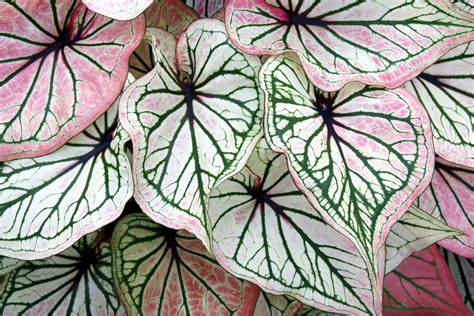
Caladiums love hot, humid growing conditions and need an evenly moist potting mix or soil while they are actively growing. They will go dormant seasonally and grow from bulb-like corms. The white varieties only form their white leaves when there is enough light. If your plant is too dark, the leaves will discolor. As beautiful as these plants are, they are just as sensitive to environmental influences and even to themselves, the plants pose a danger. This chapter will be about the most common deficiency symptoms.
Understanding curling and bending stems and leaves
The most common cause of kinked caladium stems is the weight of the leaves. Due to the fact that the stems indoors often get very long and the leaves also reach corresponding sizes of sometimes more than 20cm, the leaves get to a weight, which in some cases can no longer be carried by the plant. As a result, the stems bend and the leaves can no longer be fully supplied with water and nutrients.
What can you do about caladium stems that are snapping off? To prevent bending stems you can support the plant in its growth. For this you can simply use branches from the garden center or from outside, to which you fix the stems of the plants. In addition, make sure that the plant is always supplied with sufficient amounts of water to ensure the stability of the plant.
What do you see? The leaves are limp and the stems droop, often with a direct bend visible. What is the cause of yellowing Caladium leaves? Yellow leaves are mainly caused by a lack of nutrients. However, plants can also become discolored if watering cycles are too long. What can you do about yellow Caladium leaves? The leaves are usually beyond saving, accordingly you can cut them off.
Leaf margins, tips, and sun exposure
Caladium leaves have dried out areas on the leaf margins and tips. What is the cause of dry Caladium leaf margins and leaf tips? Dry spots on the leaves of your caladium are usually an indication that the plant is in a too dry location. The plant needs higher humidity. Try either to increase the humidity around the plant, e.g. by using a humidifier or try to keep the humidity within your little jungle a little higher by having more plants in the immediate surrounding. You can also cut off heavily dried leaves with a clean pair of scissors or knife, so that the plant can put more energy into new leaves.
What is the cause of brown spots on Caladium leaves? Brown spots in the middle of the leaves usually indicate sunburn. How can you prevent and fix brown spots on leaves? Once the plant has burnt spots, you can’t undo them. You should give the plant a location where it gets plenty of light but no direct sunlight. Especially harmful is the location with direct sunlight, if you spray the leaves with water and the water droplets catalyze the sunlight like a magnifying glass. Again, only cutting off the burnt leaves will help to bring the power of the plant into new leaves.
Watering, drafts and temperature effects
What is the cause of limp Caladium leaves? The caladium plant probably has a location with cold drafts or has not received enough water. How can you prevent and fix droopy leaves? If you can rule out drafts in your location and exposure to cold air, it is most likely that your caladium has not received enough water. Depending on how far this stage has progressed, you may still be able to save the plant by watering it properly now. If the leaves look limp even 24 hours after watering, they are probably beyond saving and you can cut them off.
What is the cause of curled up Caladium leaves? The caladium plant has sometimes stopped in its development. This happens mainly when the location was chosen unfavorably and the plant was too cold during its development. What can you do about curled up Caladium leaves? To prevent curled leaves the location should be draught free. In my case, especially the Caladium leaves curled up, which were in the direct draught or which were generally cold during the development of the plant. So try to pay attention to the temperature and ideally the leaves will recover. If the old leaves remain curled, you can cut them off. If you have adjusted the basic conditions, the new leaves should unfold again.
General health and dormancy considerations
Yellow leaves can be caused by a variety of issues, but most often, they are caused by soil that is too dry, or even soil that has been kept wet for too long. I hope you've enjoyed this post on Caladium problems. Do you have any Caladiums? Comment below. Drooping, is this just natural part of the plants life, is it a perennial plant? Do I just cut it back?
Caladiums naturally go dormant in the winter months. Your plant looks to be ready for its winter rest. If a new caladium leaf has been growing for weeks, reached full size, developed strong color - but still refuses to open, this is usually confusing and frustrating. In my case, this leaf took nearly a month to grow. The size was already complete, the color was fully developed, and the plant itself showed no signs of stress. Yet the leaf remained tightly curled from the moment it emerged. What made this situation clearer was what happened next: the plant continued growing and started pushing out the next leaf. This matters, because it tells us something important. The plant itself did not stall or decline. The growth cycle continued normally. The issue was limited to this specific leaf, not the entire plant. Over time, I’ve seen this pattern repeat, especially with pink and light-colored caladium varieties. When the days leading up to leaf unfurling are cloudy, dim, or lacking sufficient humidity, some leaves never complete the unfurling process - even though they continue to grow in size and color.
Curled leaves and unfurling window
Leaf unfurling in caladiums is not a gradual, open-ended process. It happens within a short window, and once that window passes, the leaf usually does not recover. In most cases, the critical period is the 3-7 days before the leaf would normally open. During this time, the leaf is already formed, but still flexible enough to flatten and stabilize. This stage is far more sensitive to environmental conditions than the earlier growth phase.
If humidity is too low, nights are too cool, or light levels drop during this short period, the plant may delay unfurling. But it does not delay indefinitely. Once conditions remain insufficient for long enough, the plant effectively abandons the unfurling process. The leaf continues to exist, may even continue gaining color, but stays curled. The plant then redirects energy toward the next leaf instead of revisiting the previous one. This is why timing matters more than averages. A plant can receive adequate light and care overall, yet still produce a permanently curled leaf if the unfurling window coincides with several dim, cool, or low-humidity days.
What is not about this issue: leaves that curl downward after already opening, edge or margin curling on otherwise flat leaves, or curling caused by short-term stress on fully expanded leaves. These patterns are usually related to ongoing environmental stress and require separate treatment.
What do you see? What is the cause of yellowing Caladium leaves? In our latitudes, the caladium plant needs winter dormancy, which is initiated towards autumn. What can you do? You can’t stop hibernation. The plant will lose its leaves sooner or later.