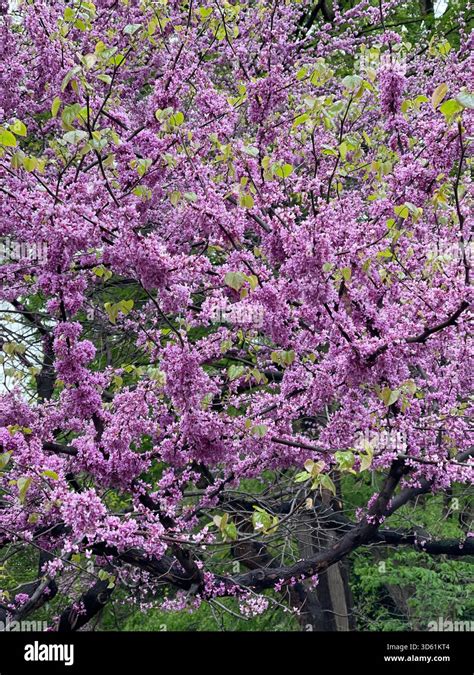
Easter Redbud (Cercis canadensis), also known as redbud or Judas tree, is abundant in the southern two-thirds of Ohio, with scattered distribution in the northern one-third of the state. It heralds the arrival of spring with its showy, lavendar-pink flowers that typically open in April, long before the foliage emerges.
This ornamental tree is rapidly growing and usually multitrunked in the wild, having a vase shape with a rounded crown that reaches about 20 feet tall and 20 feet wide at maturity, when found in the open. As a member of the bean family, eastern redbud is also related to honeylocust, kentucky coffeetree, black locust, and wisteria, as well as other types of redbuds. The bean family, or Fabaceae, is also known as the legume, pea, or pulse family, and may go by the alternative scientific family name of Leguminosae.
Eastern redbud prefers deep, moist, organic, well-drained soils, but adapts to many less-than-favorable soils of either acidic or alkaline pH as long as they are not wet. It grows most rapidly and flowers most prolifically in full sun if adequate moisture is available during the heat of summer, but it is often found in partial sun to partial shade in nature.
Trunk canker is a serious disease of eastern redbud and is evident as sunken depressions in the bark of large branches or trunks, which often begin to heal before the tree eventually dies. Verticillium wilt and root rot are two additional, serious pathogens that affect the roots often due to wet soils but become evident as entire branches rapidly die.
The floral buds of eastern redbud are not red during their winter dormancy, but rather they are dark brown. The blossoms are appealing in part because the foliage has not yet emerged in early spring. By winter, the clustered, flattened fruits are brown to beige and serve as an excellent identification feature.
Cercis spp. (redbud) are popular ornamental trees grown for the prolific clusters of pea-like flowers, attractive heart-shaped leaves, and brilliant fall color. The vase-shaped, spreading or weeping structure lends beauty and elegance to any landscape. This versatile landscape tree can be used in a woodland setting, mixed border, native garden, as a street tree, or specimen. The pollinator-friendly flowers, which last several weeks in spring, attract a range of early season beneficial insects.
Flowers, Foliage, and Varieties
Flowers: In early to mid-spring, prolific clusters of small pea-like flowers occur along the branches ahead of the foliage. The flowers come in various shades of white, pink, magenta, lavender, or purple.
Foliage: As redbud trees finish flowering, the foliage begins to emerge. Attractive heart-shaped leaves up to 5 inches wide occur in shades of green, blue-green, burgundy, dark purple, yellow, orange, apricot, or variegated. Color: Green foliage, pink flowers, yellow fall color. Named varieties can have chartreuse, gold, orange, bronze, burgundy, or dark purple foliage. Flowers can be pink, red, white, lavender, or magenta.
Although Cercis canadensis, the eastern redbud, and its several varieties are widely planted, they typically do not fare as well in our western gardens and show much less tolerance of our soils and dry summers than does C. Oklahoma Redbud (Cercis canadensis var. Western redbud).
Redbud flowers are one of the most distinctive features in spring, and the tree’s heart-shaped leaves add seasonal interest throughout summer and into fall. In the wild, this native tree inhabits the eastern and central United States, from New York to Florida and from Texas to Michigan, and it can adapt to various landscapes when cultivated.
There are numerous redbud cultivars available today, and each one has qualities unique to it when compared to the straight species. For example, ‘Forest Pansy’ presents red-purple leaves with vibrant new growth; ‘Hearts of Gold’ offers vigorous yellow foliage; ‘Rising Sun’ features vibrant golden orange new growth; ‘Royal White’ provides snowy white flowers; and ‘Appalachian Red’ offers neon-pink/magenta flowers. These cultivars vary in mature size and habit, from upright and compact to weeping forms with cascading branches.
The ornamental appeal extends to weeping varieties such as Lavender Twist, Ruby Falls, Vanilla Twist, and Golden Falls, which combine pink or white flowers with variegated or color-shifting foliage. Some cultivars, like ‘Merlot,’ are prized for deep purple-pink flowers and shiny foliage that holds up in heat. Other selections, such as ‘The Rising Sun,’ stand out for bright orange-peach new growth that matures to yellow, orange, and chartreuse across the tree.
Native to China and Japan, Chinese redbud has a compact shrubby habit with multi-stemmed growth. The bushy habit is suitable for shrub borders and mass plantings. Variants like ‘Avondale’ have dark rose-purple flowers and glossy leaves that turn yellow in fall.
In addition, there are varieties with weeping forms producing striking feather-like silhouettes. The new growth on these cultivars can be rich burgundy, turning to green or variegated patterns, providing a dynamic, year-round display. The leaves of many cultivars shift to yellow, green, or burgundy across seasons, enhancing seasonal color contrast.
Care, Planting, and Landscape Uses
Redbud trees are shallow rooted with an extensive root system, which can aid erosion control but may cause issues if planted too close to foundations. They grow best with at least 4 to 6 hours of direct sun, with more light yielding better flowering and foliage color. A site 8 to 25 feet away from buildings is recommended, depending on mature size, to prevent damage to structures.
Planting steps include loosening the soil, amending for drainage, digging a hole 2 to 3 times as wide as the root ball and at a depth that accommodates settling. For bare-root trees, soak roots 6 to 24 hours before planting. Place the tree so the base of the trunk is level to slightly higher than surrounding soil, backfill halfway, water thoroughly, then finish backfilling and mulch. Mulch 3 to 4 inches around the base to retain moisture and suppress weeds.
Watering is crucial in the first growing season; mature trees become drought tolerant once established, needing little supplemental water in areas with summer rainfall. Provide extra water during prolonged heat and dry spells if leaves wilt.
Fertilization is typically unnecessary; pruning should preserve the natural shape, removing dead, diseased, or damaged branches as needed. In late winter or early spring before flowering, lower branches can be pruned to raise the canopy and reveal more of the trunk.
Pest and disease pressures vary by cultivar and conditions. Common concerns include aphids, borers, caterpillars, Japanese beetles, leafhoppers, scale, and treehoppers. Proper site selection and maintenance help minimize problems and maintain vigorous growth and flowering.
Redbuds suit a range of landscape uses: woodland settings, mixed borders, native gardens, street trees, or specimen trees. They are shade-tolerant and adaptable to a variety of soil pH and moisture conditions, though they dislike overly wet or overly dry soils. They also show tolerance to Juglone, the allelopathic compound produced by Black Walnut trees, which can influence plant selection nearby.
Visual and Seasonal Interest
The lavender-pink pea-like flowers burst along bare branches in spring, opening before leaves appear, which creates a striking contrast against the winter bark. The foliage emerges as clusters of heart-shaped leaves, offering green, blue-green, burgundy, or variegated colors that may shift to yellow or orange in fall. Fall color ranges from bright yellow to burgundy, depending on the cultivar.
Seed pods remain on the tree after flowering, providing winter interest for identification. Overall, redbuds deliver multi-season appeal with early spring blooms, attractive foliage, and notable fall color, making them a versatile choice for many landscapes.
Table: Selected Redbud Varieties and Features
| Variety | Flower Color | Foliage | Habit | Notable Quality |
|---|---|---|---|---|
| Forest Pansy | Pink-Magenta | Red-Purple | Upright | Vibrant new leaves fade to green |
| Hearts of Gold | Pink | Yellow | Erect; medium | Consistently yellow foliage |
| Rising Sun | Gold-Orange | Green | Upright | Vivid orange new growth |
| Royal White | White | Green to Blue-Green | Compact | Large profusion of white blooms |
| Lavender Twist | Pink-Lavender | Green | Weeping | Rosy lavender flowers; cascading form |
- Redbud trees can be used as street trees, focal specimens, or in native or woodland-themed gardens.
- They offer early-season nectar for pollinators and create a multi-season point of interest with flowers, foliage, and fall colors.