Voids left in the turf due to sports field conditions are quickly filled by aggressive, opportunistic weeds that can thrive in less than ideal soil conditions. Next assess the severity of the weed problem by determining how many weeds are present then decide if there is enough weed pressure to warrant action. Make adjustments in your cultural management program to ensure you are mowing, watering, fertilizing and aerifying properly to improve turf health and density as well as overseeding on a routine basis.
Under NYS Law Chapter 85, Laws of 2010 (Child Safe Playing Fields Law), all schools and day care centers must comply with restrictions on pesticide use. The law restricts use of pesticides to products containing active ingredients listed as exempt under 25(b) of the Federal Insecticide, Fungicide, & Rodenticide Act (FIFRA). The pesticides must also include inert ingredients that are eligible under 4a of the 25(b) FIFRA exemption. The only pre-emergent herbicide with EPA exemption status is corn gluten meal (CGM). CGM must be applied in early spring before weed seeds emerge. In the spring, CGM should be applied when the crocus flowers are in bloom and before forsythia shrub blossoms emerge. Many annual weed seeds germinate when soil temperatures reach 55°F-the same temperature that triggers flowering of forsythia shrubs. Be aware that adding the recommended rate of 20 lbs./1,000 sq. ft. of CGM will result in a substantial nitrogen addition of 2 lbs./1,000 sq. ft.
The post-emergence herbicides that qualify under the EPA exemption of 25(b) FIFRA work primarily as defoliants that knock down the leaf and stem tissues of plants in contact with the herbicide. The majority of herbicides listed are non-selective, and will defoliate all vegetation in contact with the product. However, herbicides containing the active ingredient iron HEDTA are selective against broadleaf weeds. Fiesta Turf Weed Killer contains a higher concentration of iron HEDTA compared to Ortho Elementals Lawn Weed Killer. Table 3 lists pesticides containing active and inert ingredients that are considered exempted from 25(b) FIFRA and are not subject to federal registration requirements because their ingredients are considered by the EPA to be demonstrably safe for the intended use. To qualify for use under the NYS Chapter 85, Laws of 2010, a pesticide must contain active ingredients listed as exempt under 25(b) FIFRA and inert ingredients listed as eligible under 4a “Inert Ingredients of Minimal Concern.” All inerts listed under the pesticide label must be eligible under the exemption. Disclaimer: Please read pesticide labels prior to use. The information contained here is not a substitute for a pesticide label. Safety is always a priority when using any pesticide including herbicides. If you have the option to use herbicides as a management tool and conditions warrant the use of a herbicide, keep in mind that you must be a NYS certified pesticide applicator.
Weed Life Cycles and Key Concepts
There are 2 major weed situations that impact field quality and function: annual weeds like crabgrass, annual bluegrass (Poa annua) and knotweed and perennial broadleaf weeds such as plantain, clover, dandelion, ground ivy and chickweed. Weeds can be divided into categories based on life cycles. Annual weeds complete their life cycle in less than one year and reproduce by seed. Winter annuals have a life cycle opposite from summer annuals. Biennial weeds live for two years. Perennial weeds are usually more difficult to control than annual weeds. A selective herbicide controls certain plant species without seriously affecting the growth of other plant species. Nonselective herbicides kill plants regardless of species and are used on a spot-treatment basis in the lawn or along driveways and sidewalks. Preemergence herbicides are applied to lawns prior to weed seed germination and do not actually prevent weed seed germination; they control weeds during germination but must be absorbed by the root or shoot to inhibit growth.
Preemergence herbicides form the backbone of weed control programs. Postemergence herbicides are applied directly to emerged weeds and are often systematic or translocated within the plant. Both formulations can be applied as granular or liquid products. Many preemergence herbicides are available in granular formulations, which can be easier to apply. Postemergence herbicides can be applied as spot treatments or as broad applications, depending on the weed pressure.
Timing, Weather, and Growth Stage
Preemergence herbicides must be applied before weed seeds germinate; timing is crucial since different weeds germinate at different times. A general rule is to apply preemergence before soil temperatures reach 55°F for summer annuals and before 65-70°F for certain other contexts, with irrigation necessary to activate most products. Postemergence herbicides are most effective on actively growing weeds and are less effective when weeds are stressed by drought or heat. For cool-season grasses, fall applications often provide better control as weeds are actively translocating to underground storage structures. Fall can also be a more effective window for many broadleaf weeds due to translocation to roots and rhizomes.
GDD (Growing Degree Days) information helps determine when tough weeds will emerge. For example, crabgrass emergence can be modeled with 50° GDD, where 25% of emergence occurs by 560 GDD, 50% by 800 GDD, 75% by 1100 GDD, and 100% by 1700 GDD. Annual bluegrass seedheads can be predicted similarly, with growth regulators like mefluidide offering control when applied within the appropriate GDD window. Weeds differ in their responses, so understanding their biology informs timing for preemergence and postemergence strategies.
Herbicide Groups and Their Uses
Preemergence herbicides form the backbone of weed control in established turfgrass. They primarily control annual grasses (crabgrass, goosegrass, annual bluegrass) and some annual broadleaf weeds when applied prior to germination. Postemergence herbicides target emerged weeds and may be foliar-absorbed, systemic, or contact-based. A single selective preemergence or postemergence herbicide is not available to control all weeds, so a combination approach is common. Atrazine, Dimension, Surflan, Prodiamine, and many others are listed with specific turfgrass compatibility, application timing, and limitations (including restrictions on newly seeded areas, slopes, and ornamentals). Always refer to current product labels for rates and restrictions.
Herbicide formulations vary: liquid formulations with water, sprayable emulsions, or dry granules. Granular formulations are often easier to apply with spreaders, whereas liquids may require dilution and spray equipment. When applying herbicides, it is essential to mix only the amount needed, apply evenly, avoid overlap that could injure the turf, and store products according to label directions. Read labels carefully for specific crop tolerances, grazing restrictions, and rotation restrictions after application.
Cultural Practices as First Line of Defense
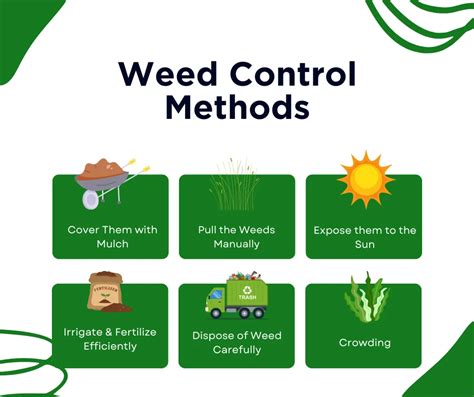
The impact of proper cultural practices on a lawn weed control program cannot be overemphasized. Properly maintained turfgrasses are more competitive with weeds than those that do not receive good cultural practices. Weeds do not easily invade turfgrasses that are properly fertilized and watered and mowed at the correct height and frequency. The first line of defense against weeds is to follow cultural practices that promote vigorous turfgrass growth and development. Weeds compete for sunlight, water, nutrients, and space and can harbor pests and diseases; hence, improving turf health reduces weed establishment.
Management of mowing, irrigation, fertilization, aeration, and overseeding is critical. Mowing at the correct height and frequency shades weed seeds and reduces seed production. Sharpening mower blades minimizes turf damage and subsequent weed invasion. Proper irrigation promotes deep, infrequent watering to encourage deep root growth, while preventing overly wet conditions that favor goosegrass and other problematic species. Thatch management, aeration, and soil compaction relief are essential for allowing roots to access air, water, and nutrients and for reducing weed pressure in compacted or poorly drained soils.
Special Considerations for New Turf and Overseeding
Newly seeded or sprigged turfgrasses are less tolerant of herbicides, and preemergence herbicides should not be applied to newly seeded turf. Postemergence herbicides may be used with caution after a few mowings, but rates should be reduced and application timing considered to avoid stressing seedlings. A general rule is to apply postemergence herbicides at half the recommended rate after three to four mowings to allow seedlings to establish and tolerate the chemical better. Season and growth stage influence herbicide tolerance, as well as weather conditions. Temperature thresholds should be respected to avoid injury, especially with sensitive cool-season grasses in warm conditions.
Overseeding and delaying postemergence treatments after reseeding can improve seedling establishment. In warm-season grasses, some products may be inappropriate or restricted, and certain label cautions apply when seeding near treated areas. Always ensure the turf has recovered from winter dormancy and greened up before applying preemergence herbicides for best results. When using 3-way herbicide combinations, consider the spectrum of control required for the field and consult product labels for compatibility and rotation considerations.
Practical Guidelines and Field Practices
Inspect fields by walking and scouting for broadleaf weed populations to determine if control is necessary. Set reasonable expectations: you may manage with 20-30 weeds, and spot-treat may suffice. For some fields, one herbicide application every 2-3 years can keep broadleaf weeds in check. Successful weed management involves an integrated approach: high-quality turf, timely cultural practices, and targeted chemical controls when necessary.
Before using any herbicide, address underlying causes of weed encroachment such as compaction, poor drainage, improper irrigation, or inadequate fertilization. Nonselective herbicides can harm desirable turfgrass and should be used with care, particularly around ornamentals, water features, and areas where turf meets landscape plants. For home lawns, always follow the product label and local regulations, and consider consulting a state extension weed specialist for region-specific recommendations.
Weed Control Time-lapse
tags: #herbicides #for #grass #control