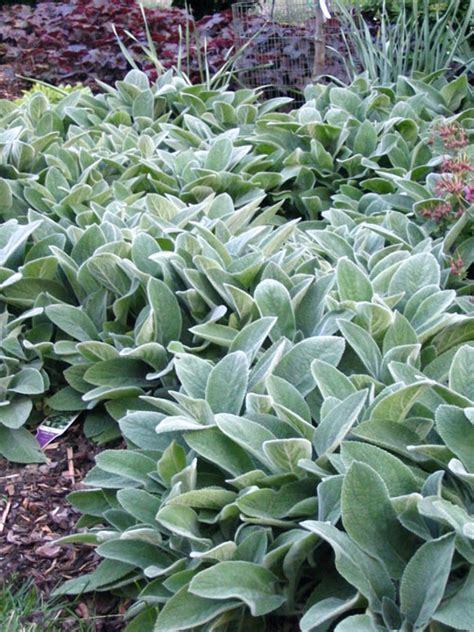
Lamb’s Ears is the perfect example of plant over planter (and we mean the person doing the planting not a cute little pot). So widely grown and cultivated that it seems to be a native of almost everywhere. Actually, it is native to Northern Turkey, the Southern Caucasus Mountain region and Southern Iran where it grows on rocky hills and scrub areas. In other words, it is a weed. Which is exactly the quality it makes apparent in a rationally planned garden. Like many weeds we adopt, it does its own thing. This makes it important to use it the right way in your garden and not try to make it something it isn’t.
For instance, it isn’t the border plant to end all border plants. The potted plants are so cute and they look so nice when you line the driveway with them, but this is a mistake. Why? Because they aren’t going to stay there. Now don’t get me wrong, I don’t mean they are going to sneak off in the middle of the night or anything as clandestine as that. What they do is grow outward from the center and leave a nice bare spot in the middle. This usually starts happening after they finish blooming.
While Lamb’s Ears can take partial shade, they can’t take excess water, which makes them a poor choice for planting near a lawn. So what are they good for? Pure pleasure. Let them be free and they will spread their seeds and grace the garden with their downy softness and tall graceful purple flower heads. Here a Lamb’s Ear and there a Lamb’s ear, almost everywhere there will be a Lamb’s ear, and you will be glad you let them have their way. Blanket your garden with Lamb’s Ears. They are soft and fuzzy just for Ewe.
Some may wonder why an Herb Company grows Lamb’s Ears. While there are a few folkloric references to herbal uses for Lamb’s Ears, like to staunch wounds (thus the old name woundwort) and as a washcloth, it has a home here because of its association with the medicinal herb Betony. Both are in the genus Stachys and we tend to collect as many members of any herbal genus as possible. We don’t always like all the different species, but Lamb’s Ears found a permanent, yet variable, spot in our gardens.
Just a note about other varieties of Lamb’s Ears that do not bloom; they are slow. We did trial these years ago in the hope that they would be a better border plant or perennial addition to the garden. But, we weren’t too impressed. Our original clumps are still in the garden. Lamb’s Ears (Stachys byzantina) are a fixture in most sunny borders, where they serve as superb edgers, providing contrasting silver-gray color and a fuzzy, velvety-soft texture that is irresistible to gardeners (and children).
Also called Woolly Betony, Lamb’s Ears belong to a large genus of plants in the Mint family that includes upwards of 300 species of annual and perennial herbs. They prefer full sun and well-drained soil. Established plants will tolerate drought, which makes them a terrific choice for hot spots in the garden that tend to be dry. Plant them at the feet of Tall Bearded Iris, Peonies, Roses, and Eryngium, or use them at the edges of cottage or pollinator gardens. The soft, attractive foliage of lamb’s ear (Stachys byzantina) and its low, spreading habit make this a popular addition for the ornamental garden throughout much of the temperate world.
There are several cultivars of this herbaceous perennial in the mint family (Lamiaceae) native to the Middle East that offer unique characteristics. The woolly, lance-shaped leaves grow in dense rosettes 4-6 inches tall, with flower spikes up to 2 feet tall. Although evergreen in mild climates, the leaves will die back to the ground in harsh winters. The plants spread by creeping stems that root as they grow outward, forming a sprawling mat. In early summer, long-lasting flower spikes grow above the foliage. These start out erect but often flop over as they grow taller and heavier. In the species, the small flowers are arranged in verticillasters (false whorls) and are mostly hidden by the calyces, but ‘Cotton Boll’ is sterile and the flowers have been modified into fuzzy clusters.
Since the flowers are not showy, many people choose to remove the flowering stems which detract from the foliage as soon as they form. Deadheading also improves plant vigor and leaf regeneration. ‘Cotton Boll’ is easy to grow in well-drained soils in full sun in cool climates and light shade in hot climates. In too much shade, the foliage doesn’t dry out quickly, and when it remains moist is susceptible to rot and leaf spots. ‘Cotton Boll’ performs better in humid areas than the species, although excessive moisture may result in crown meltout. Like the species, this cultivar is drought tolerant and hardy in zones 4-8. In a multi-year evaluation study by the Chicago Botanic Garden to ornamental traits, disease and pest resistance, cultural adaptability and winter hardiness, ‘Cotton Boll’ received a rating of 4 out of 5, as did the species and most other cultivars of S. Like the species, ‘Cotton Boll’ has few pests and is not eaten by deer or rabbits. It will also grow near black walnut or other trees that produce juglone. Because it is sterile, it can only be asexually propagated. Use ‘Cotton Boll’ lamb’s ear in masses as a ground cover or in smaller groups to provide contrast in color, texture, and height with other perennials. The velvety foliage combines well with both hot and cool colored blooms of other plants. It works well planted around roses and as an edging for borders or to soften the edge of a pathway.
Along the walkway around the classroom and in other places around the grounds of Hilltop Gardens and Nature Center, the evergreen, lamb’s-ear, also known as wooly lamb’s ear or Donkey’s Ears, grows prolifically! A staple groundcover for many gardeners, Stachys byzantina is a species of flowering plant from the Labiatae family. Native to the countries of Armenia, Turkey, and Iran, it grows in most temperate climates and has naturalized in some areas. This perennial plant is known for its wide, rounded, soft, fuzzy leaves with a silvery, grayish-green color, used as an ornamental in themed “silver plant” gardens or as a ground cover. Its short, thick foliage grows in dense bunches and will eventually blanket an area. In late spring or early summer, some varieties send up to 18-inch-tall spikes with lavender blossoms whose light fragrance is a favorite of pollinators, especially bees. A favorite in children’s gardens, kids love to touch the soft, velvety leaves.
Lamb’s-ear prefers dry conditions in full or partial sun but will still grow in more shaded areas. It is hardy in Zones 4-8. It is quite easy to grow from cuttings in well-drained soil. Too much water or even a hard rain can make it mushy and loose. The plant spreads by new roots touching the soil and through self-seeding. Deadheading the plants can help a gardener retain control over spreading. Used to dry, arid climates, no additional fertilizer is needed to help it thrive. The plant can become invasive if ignored, especially in warmer climates, and may be difficult to eradicate. Keeping dead or damaged leaves plucked and stems deadheaded can keep the growth looking in top shape clear into late fall. Divide the plants every two to four years by digging and removing entire plants. These can be cut into smaller clumps and transplanted to a new location.
It is a wonderful addition to rock gardens or planted as border. Plant it around other plants with bright blooms. The contrast will bring out bloom color and create a restful atmosphere. The rosettes are beautiful additions to summer floral arrangements. With care, rosettes may be dried by hanging upside down in a cool, dry place for use in fall wreaths and door hangings.
If you wish to cultivate a specific species, start plants from seed eight to ten weeks prior to your area’s frost-free date. They can take as long as a month to germinate, so be patient! Some cultivars, like “Cotton Boll” are sterile and will not produce flower stems. Another interesting cultivar, “Primrose Heron” has yellow leaves in the spring and pink flowers. “Striped Phantom” sports variegated leaves. “Silver Carpet” is a cultivar that has a stunning silvery appearance under moonlight!
Folk medicine used the plant to heal wounds. On the battlefield it was used to stop blood flow and speed coagulation. It has antibacterial, antiseptic, and anti-inflammatory properties. It became a bandage for cuts or bruises. Lamb’s-ear flowers in late spring and early summer; plants produce tall spike-like stems with a few reduced leaves. The flowers are small and light purple. Lamb’s-ears are herbaceous perennials, usually densely covered with gray or silver-white, silky-lanate hairs. They are named lamb’s ears because of the leaves' curved shape and white, soft, fur-like hair coating. Flowering stems are erect, often branched, and tend to be 4-angled, growing 40-80 cm tall.
Grow lamb’s ear in moist but well-drained soil in full sun to partial shade. Forming a low-growing mound of attractive foliage, topped in summer with flower spikes growing up to 1m in height, it’s perfect for the front to the middle of a border, and is commonly used as ground cover. It also works well in pots, where its leaves act as the perfect foil for different coloured plants. Plant it along a border front or walkway, or it may also be grown in containers.