When you drive by a golf course or someone else’s home, do you admire the patterns mowed in their lawn? Some people mow their lawn in rows, while others do so in spirals. What about you? Do you have a favorite mow pattern that you use every time, or do you like to change things up? What pattern you mow on your lawn comes down to personal choice. However, there are a few things to keep in mind when you’re choosing a mowing pattern. How you mow affects the health of your lawn as well as the way your lawn looks. In this article, we’ll go over your different options for mowing patterns. We’ll also discuss the pros and cons of each type of pattern, as well as general tips for healthy lawn mowing.
Basics of mowing patterns
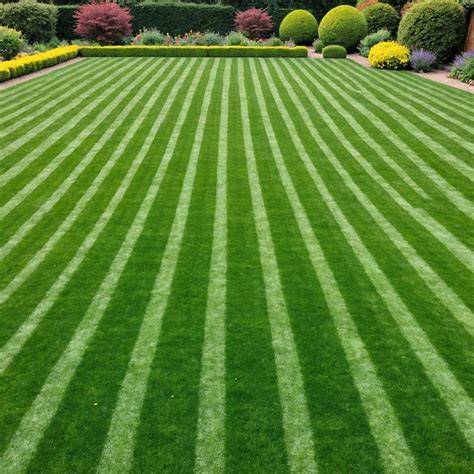
Rows and spirals are the two basic methods for mowing patterns in your lawn. There are also variations on each pattern. Mowing in rows creates uniform lines on the lawn. To create stripes in the lawn, you typically mow in straight rows up-and-down the yard. Mowing in spirals can work better for circular or irregularly shaped lawns. For open lawns, you can start at the edges and work your way in. For lawns with a focal point, you can start by mowing around that and then work your way out. To save time and help keep the grass healthy, you want to avoid mowing over the same spot twice. Keep this in mind when planning out your mowing patterns. When it comes to turns, if you have a zero-turn mower, you’ll have a much easier time with precision. For those without zero-turn mowers, however, you won’t be as precise. This can make it more difficult to achieve perfect mowing patterns on your lawn. To avoid compacted soil and worn-down grass, you should change up your lawn mowing patterns instead of mowing the exact same way each time.
No mowing pattern is better or worse than another. Rows and spirals require the same amount of work, as well as the same number of turns, so neither one is better than the other. It’s mostly a matter of personal preference. Do you like the look of rows or spirals? Rows generally work better than spirals for owners of riding mowers without the ability to make tight turns. However, boxy spirals can still work even if your mower isn’t very maneuverable. Just keep in mind you might not be able to get a perfect spiral in the middle without a zero-turn mower. Another thing to keep in mind is that rows require you to alternate mowing directions, while spirals don’t. This doesn’t necessarily mean that spirals will wear out your lawn, but it does mean you probably won’t have an evenly mulched lawn. It is good for your grass to leave clippings on the lawn, though, so if you bag clippings while mowing in a spiral it’s best to spread them back on the lawn later.
Practical mowing tips
Maintain your equipment. This includes keeping your mower blades sharp and free of rust. Dull and rusty blades make mowing more difficult and can damage the grass. When blades become dull and damaged, they tear grass blades instead of cutting them neatly. The direction you mow is what determines the light or dark-colored stripes you see. Grass that is facing you causes shadows, making it appear darker, while grass turned away reflects the sun, causing a lighter effect. Mow more often to keep grass manageable. A good rule of thumb is to mow weekly. Don’t be afraid to get creative. Mow when the grass is dry.
As you plan your mowing patterns, you want to keep grass health in mind as well as appearance. Pick a mowing height for your grass, then cut it frequently enough that you only need to take off 1/3 of the total height each time you mow. Remember that different types of grass have different ideal mowing heights. Zoysia, for example, does best if you mow it between ¾ and 2 inches. Cutting your grass at the taller end of the ideal mow height, or even an inch higher, will make it easier to see stripes on the lawn. Mulch your clippings instead of bagging or raking them. That saves you a step since you won’t be doing the extra work of taking clippings off the lawn. Change mowing pattern. As we’ve already mentioned, varying your mowing pattern helps prevent soil compaction. When soil is compacted, it’s much harder for grass roots to get the water and nutrients they need. In the end, as long as you regularly tend your lawn and follow best practices for healthy mowing, the pattern is up to you.
Five popular mowing patterns for health and aesthetics
The Classic Stripes: This is the pattern that brings the ballpark feel to your backyard. The striping effect is created by light reflecting off grass blades bent in different directions. How to do it: Start by mowing a strip around the entire perimeter of your lawn. Then, mow across the lawn in a straight line. At the end of a row, lift the mower deck, turn 180 degrees, and mow in the opposite direction right next to your previous pass. Overlap the wheel tracks slightly to ensure you don't miss any spots. Why it's healthy: Alternating directions encourages the grass to grow straight and strong, ensuring even access to sunlight for every blade.
The Checkerboard / Diamond: Ready to take your stripes to the next level? The checkerboard pattern is a true showstopper and is surprisingly easy to create. How to do it: First, mow the entire lawn with classic stripes (Pattern #1). When you’re finished, simply mow the lawn a second time, creating another set of stripes at a 90-degree angle to the first set. For a diamond pattern, simply mow your stripes on a diagonal axis instead of parallel to the sidewalk. Why it's healthy: This double-cutting method provides maximum variation, preventing the grass from developing a “grain” or leaning in one direction.
The Spiral: Perfect for lawns with lots of curves or obstacles like trees and garden beds, the spiral pattern is efficient and effective. How to do it: Start at the outer edge of your lawn and mow the perimeter. Continue mowing in a continuously tightening circle or square, working your way toward the center of the lawn. It’s like a giant, grassy snail shell! Why it's healthy: This pattern avoids the repetitive back-and-forth turns that can stress the grass and soil, especially at the edges of your lawn.
The Single Diagonal: A simple yet highly effective way to mix things up. Mowing on a diagonal axis can make your lawn appear larger and provides a fresh look. How to do it: Instead of starting parallel to the driveway or house, start at one corner of your lawn and mow diagonally across to the opposite corner. Continue this pattern across the entire yard. Why it's healthy: For most homeowners who only mow vertically or horizontally, a diagonal pass is a much-needed change that prevents ruts and soil compaction.
The Rotational Plan (The True Pro Method): This isn’t a single pattern but rather a strategy. The absolute best thing you can do for your lawn is to not use the same pattern every time you mow. How to do it: Create a simple schedule. The first week, mow with vertical stripes. The next week, mow with horizontal stripes. The third week, mow on a diagonal. The fourth week, mow on the opposite diagonal. Why it's healthy: This is the ultimate technique for lawn health. By constantly changing the direction of the cut, you ensure the grass grows upright, the roots grow stronger, and the soil remains loose and uncompacted.
Practical design and maintenance tips
Creating these patterns can be a fun and rewarding part of your lawn care routine. If you want a flawless, professional look, consider a zero-turn mower for speed and maneuverability. A good starting point is planning the grass pattern on paper, then marking the first stripe with string. With practice, mowing straight lines without string becomes easier-just pick a point in the distance and mow toward it. Sharp, clean cuts are essential, so never cut more than 1/3 of the grass blade when mowing. If necessary, mow more often to achieve this condition. The mower deck should be disengaged for cleanup passes, and you can run the full-width rollers over every other stripe to etch the pattern. For enhancing contrast, a light mist of water over the turf before showing off the pattern can help reflect light and deepen the stripes. Always alternate the mowing direction every two weeks or sooner, and avoid any grain in the grass, which can affect its health. Also, changing the pattern reduces wear from tire marks and improves overall turf quality.
If you’re considering equipment upgrades, a zero-turn mower can make precise patterns more achievable and reduce mowing time.
To keep things efficient and healthy, remember: pick a mowing height suited to your grass type, aim for removing only about one-third of the blade, mulch clippings, and shoot for regular, not excessive, mowing especially during heat stress. The patterns themselves are a matter of preference, but the goal remains the same: harness light, shade, and growth habit to create a beautiful, healthy lawn.
How to Mow a Lawn CORRECTLY
Healthy lawn, beautiful patterns: a quick recap
For simple designs, you can mark off the first stripe using a piece of string. The key is to mow a straight line and then use it as a guide for the rest of the stripes. With practice, mowing straight lines without string will be easier - just pick a point in the distance and mow toward it. Never cut more than 1/3 of the grass blade when mowing. If necessary, mow more often to achieve this condition. Make sure the mower blades are very sharp to assure a clean cut as dull blades tear the grass and stress it. To assure turf health, mow as little as possible when grass is under heat stress. Mowing patterns and designs can be simple (straight lines or checkerboard grass patterns), or something more complex (diamonds or bullseye lawn stripes). Let your imagination be your guide. You can also consider a decorative border after completing the pattern to tidy up turnaround areas.
And if you’re looking for a new mower-perhaps a zero-turn to make lawn mowing faster and give you more maneuverability-Richardson Saw & Lawnmower can help.