The world’s coffee belt spans the globe along the equator, with cultivation in North, Central, and South America; the Caribbean; Africa; the Middle East; and Asia. When Earth’s climate warms, the optimal areas for coffee cultivation may shift or shrink, threatening livelihoods across many tropical nations.
Optimal conditions and the science of terroir
The optimal temperature range of the Coffea arabica tree-the source of about 70% of the world’s coffee-is 64°-70°F, a condition most consistently found in upland elevations of tropical countries. Arabica coffee’s optimal temperature range is 64°-70°F (18°C-21°C). The world’s coffee growing regions depend on a combination of climate, topography (elevation), soil composition, and shade-from which the concept of terroir emerges. Terroir influences flavor profiles, with some regions producing distinctive characteristics even within the same species.
When coffee beans ripen too quickly due to higher temperatures, quality can degrade. Above moderate temperatures, fruit development and ripening accelerate, potentially reducing bean quality. Coffee is an understory plant by nature, often thriving in light shade, while production can be higher in sunny locations but requires more water and fertilizer.
Major global growing regions
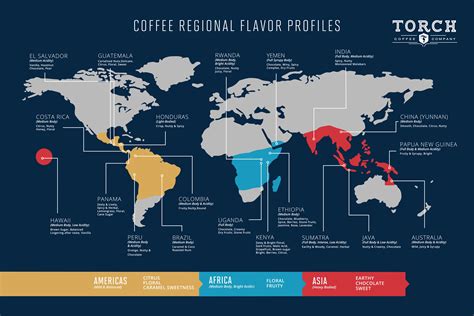
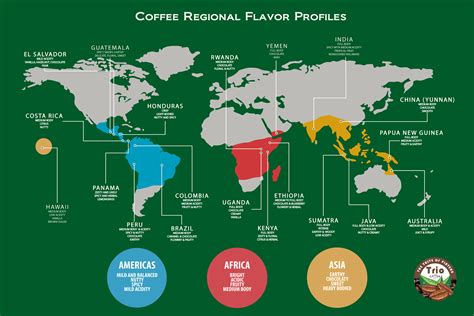
Globally, there are three primary coffee growing regions-Central and South America, Africa and the Middle East, and Southeast Asia-located around the Bean Belt along the equator. Central America, with Costa Rica highlighted for its aromatic and balanced coffees, sits at the top of the belt. South America includes Brazil, Colombia, and others, with Brazil historically the largest single producer. Africa contributes through countries like Kenya, Ethiopia, Tanzania, Rwanda, Burundi, and Uganda, offering distinctive, fruity, floral profiles. The Middle East features Yemen as a historic producer, while Southeast Asia includes Indonesia (Sumatra, Java, Sulawesi) and Vietnam, a major exporter known for robusta dominance and diverse flavor profiles.
Brazil’s southeastern regions have long provided near-ideal conditions for arabica and robusta, with large-scale production contributing about a third of the world’s supply. Colombia is renowned for its balanced, aromatic coffees and year-round production due to varied elevations. Kenya presents a unique grading system and a reputation for quality processing and drying, contributing a bright and nuanced cup profile. Ethiopia, the birthplace of Coffea arabica, preserves the highest genetic diversity and offers high-altitude, slow-maturing beans with fruity, spicy, and floral notes.
Indonesia, particularly Sumatra, Java, and Sulawesi, produces distinct, full-bodied, earthy coffees; Sumatra is famed for low acidity and deep chocolate notes. Vietnam stands as the world’s second-largest producer, with a heavy emphasis on robusta and a growing share of high-quality coffee from its diverse regions. The Ivory Coast is known for robusta production as well as arabusta, a hybrid of arabica and robusta.
Across these regions, flavor is shaped not only by genetics and processing but also by altitude, climate, soil, and microclimates-collectively described as terroir. While coffees from the same country can vary, general regional flavor tendencies help explain why geography is often said to be a flavor factor.
Climate change: impacts and adaptive strategies
Climate change threatens coffee through reduced suitable farmland, higher pest pressures, and disease outbreaks. The IPCC Fifth Assessment Report (AR5) predicts possible reductions in suitable areas for coffee cultivation by 2050, with notable losses projected in Brazilian states like Parana, Minas Gerais, Sao Paulo, and Goias, as well as in Guatemala, Costa Rica, Nicaragua, El Salvador, Honduras, and Mexico. Kenyan production could shift upslope due to rising minimum altitudes. Insect pests such as the coffee berry borer (Hypothenemus hampei) are expected to increase with warming, potentially raising pest generations, dispersion, and damage. Fungal rust-agroclimatic conditions like higher temperatures and heavy rainfall-also threatens crops in Central America.
To build resilience, researchers advocate shaded plantations to preserve biodiversity and reduce heat stress, and genetic improvement to develop heat-tolerant strains. Ethiopian coffee, with its rich genetic diversity, remains a key reservoir for adaptation. Some regions may experience partial gains in suitable land, but overall the trend under warming is negative for many bean belts. As climate changes unfold, smallholder farmers-who often rely on coffee as a primary income-face mounting risks and may require support for adaptation strategies.
Growing coffee in home landscapes and small-scale contexts
Coffee can be grown in suitable microclimates beyond traditional farms, including zones 10B-11 in home landscapes, with careful attention to shade, soil, and irrigation. Coffee trees can reach up to 50 feet, but in cultivation they are often pruned to 4-6 feet for practicality. Arabica tends to decline with warming, while robusta offers greater heat tolerance and lower maintenance-making it a practical alternative in warmer microclimates. For best results, select healthy trees in 1-3 gallon containers, about 2-4 feet tall, and plant in rich, well-drained soil with slightly acidic to neutral pH. Mulch helps conserve moisture, suppress weeds, and stabilize soil, while keeping a mulch-free zone near the trunk protects the plant from rot and pests.
In orchard or landscape settings, ensure at least 8 feet of clearance from structures to accommodate growth and airflow. Coffee plants require a consistent irrigation, pruning, and fertilization regime. Pests such as stem borers, leaf miners, mealy-bugs, scales, and mites, as well as fungal diseases, pose challenges, but an ecologically healthy garden helps reduce these pressures. Harvesting coffee cherries occurs when they redden; after harvest, cherries are pulped, fermented, washed, and dried before roasting. Roasting methods vary widely, from stovetop to oven to dedicated roasters, and home roasting offers a direct link to fresh-brewed coffee.
Understanding the global map of coffee
When you map coffee origins, you see the Bean Belt-an expansive, continuous zone spanning the tropics where conditions favor growth: cool to warm tropical climates, sufficient rainfall, and regular shade. Single-origin coffees emphasize a strong sense of place, contrasting with blends that combine multiple origins to create balanced profiles. The flavor landscape across regions-from Ethiopian heirloom varieties to Brazilian milder profiles, Colombian sweetness, Kenyian brightness, and Indonesian earthiness-illustrates how geography shapes taste.
- Where coffee grows: the global belt along the equator with diverse terroirs.
- Key regions: Central and South America, Africa, Middle East, and Southeast Asia.
- Adaptation: shading, genetics, and microclimates as responses to warming.
Why Single-Origin Coffee Is So Expensive | So Expensive | Business Insider
Practical notes for readers and enthusiasts
For readers interested in tasting and sourcing, remember that regional flavor profiles are influenced by terroir, processing methods, and blending practices. If you’re growing coffee at home, prioritize climate compatibility, shade, soil quality, and water management. For regions facing climate stress, consider shade-grown systems and genetic diversification to safeguard future production and preserve livelihoods for smallholders.