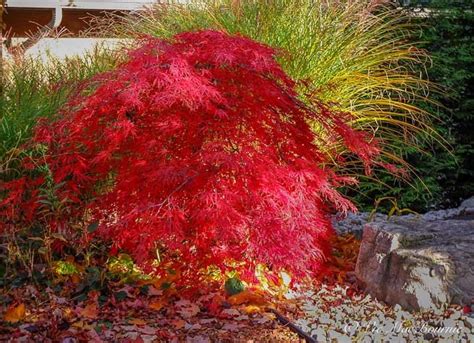
Omure Yama Japanese Maple is primarily valued in the landscape for its highly ornamental weeping form. It has light green deciduous foliage. Omure Yama Japanese Maple is an open deciduous shrub with a strong central leader and a rounded form and gracefully weeping branches. This is a relatively low maintenance shrub, and should only be pruned in summer after the leaves have fully developed, as it may 'bleed' sap if pruned in late winter or early spring. Omure Yama Japanese Maple will grow to be about 15 feet tall at maturity, with a spread of 12 feet. It tends to be a little leggy, with a typical clearance of 2 feet from the ground, and is suitable for planting under power lines.
This shrub does best in full sun to partial shade. You may want to keep it away from hot, dry locations that receive direct afternoon sun or which get reflected sunlight, such as against the south side of a white wall. It prefers to grow in average to moist conditions, and shouldn't be allowed to dry out. It is not particular as to soil pH, but grows best in rich soils. It is somewhat tolerant of urban pollution, and will benefit from being planted in a relatively sheltered location. Consider applying a thick mulch around the root zone in winter to protect it in exposed locations or colder microclimates. Omure Yama Japanese Maple makes a fine choice for the outdoor landscape, but it is also well-suited for use in outdoor pots and containers. Because of its height, it is often used as a 'thriller' in the 'spiller-thriller-filler' container combination; plant it near the center of the pot, surrounded by smaller plants and those that spill over the edges. It is even sizeable enough that it can be grown alone in a suitable container. Note that when grown in a container, it may not perform exactly as indicated on the tag - this is to be expected.
Best grown in moist, organically rich, slightly acidic, well-drained soils in full sun to part shade. Grows well in sandy loams. May be grown in full sun in the northern parts of its growing range, but prefers some part afternoon shade in the southern parts (including St. Louis) of its growing range. New foliage may scorch in full sun locations in hot summers areas, particularly if soils are not kept consistently moist. Mulch helps retain soil moisture and keep roots cool. Site in locations protected from strong winds. Avoid hot and dry sites. Fertilize in spring before leaves emerge. Pruning is best kept to a minimum, but if needed should be done in late fall to mid winter.
Acer palmatum, commonly called Japanese maple, is a deciduous shrub or small tree that typically grows to 10-25' (infrequently to 40') tall. It is native to Japan, Korea and China. General plant form is rounded to broad-rounded, often with low branching. Each palmate green leaf (2-5" long) has 5 or 7 but less frequently 9 pointed toothed lobes. Small reddish-purple flowers in umbels bloom in mid spring (April). The flowers are rather attractive close up, but are not particularly showy from a distance. Flowers are followed by samaras (to 3/4" long) in pairs. Samaras ripen in September-October. Fall color includes shades of yellow, red-purple and bronze. Cultivars (often grafted) are quite variable.
Genus name is the Latin name for a maple tree. Specific epithet is in reference to the palmate nature of the leaves. Each leaf has several lobes (typically 5-7) that all originate from one point looking like an open hand with outstretched fingers. ‘Omurayama' is a weeping form of Japanese maple. It is not part of the dissectum group (generally low-spreading shrubs). It typically grows in an upright, rounded, cascading form to 8-10' tall over the first ten years, eventually maturing to 10-15' tall and as wide. Young plants are mostly upright. They develop a cascading form with maturity as the slender branches become pendulous near the tips. Palmate leaves (to 3" long) are deeply cut into seven lanceolate lobes each having toothed margins and pointed tips. Foliage emerges light green with orange tinted margins in spring, matures to a rich green in summer and finally turns bright red, orange and gold in fall.
Japanese maples are generally grown for their attractive foliage and shape. Specimen/accent or group around the home or yard or periphery of the border. Good sun-dappled understory tree. Woodland garden margins. Screen. This cultivar is noted for it's upright, weeping form. Like a Weeping Willow tree. I obtained this as a small, 1 gallon plant from Harold Johnston of Tallassee, AL. in 96'. I wanted something unusual and he suggested 'Omure yama'. I planted it into the landscape around 99'. I first noticed it starting to weep in the summer of 2002 but it still has a lot of growing to do before it shows it's full weeping potential. It seems a little slow but they say a watched pot never boils. I have seen a few planted at other nurseries and they were not staked. The resulting plants did not have the form that I am seeking out. They were a little bushy. I want a strong central leader and a full weeping crown. I therefore stake mine. It is also noted for it's crimson/gold fall color. I don't think this cultivar does as well as some others in a container so I have plans of lining my grafts of this out in the field and maintaining a stake for as long as it takes to develop a weeping form with a strong central leader.
My Omoruyama died on me last year for no apparent reason. I cut it off just above the graft and left the root in the ground. Lo and behold I have four new shoots. They are growing from above the graft point so I am hoping they will be Omoruyama. I have staked them to encourage them as four 'leaders' and wait to see what will happen. Mine is much smaller and has two trunks, which I've also staked. Acer palmatum 'Omure yama' - Washington Park Arboretum, Seattle, accessions 1940. This is such a gorgeous and elegant cultivar, especially in the spring and fall. Unlike the photo in Vertrees, my Omure Yama wants to so sideways more than upwards (even with assistance probably provided in Vertrees' photo). Wada {1938}. Usually reliable glowing fall colour.
Pic #1 Sept. I intend to put it in a full sun location. Don't know whether it can withstand the summer heat in philadelphia suburb. Does anyone have any experience growing this cultivar in full sun? I'd like some feed back. My main Omure yama is in one of the hottest places in my garden (109˚ last summer), and while it's not exposed to direct sunlight all day long, it does get around 6 hours per day. It's never shown leaf burn, which I find amazing, and it's tolerated intense sunlight and heat very well. Mine does get an ample amount of water during the summer, however, which probably helps. Good luck. garden. Ooooh. Pretty. Now that cultivar just migrated from the short list to the short-short list. Wow. yes cirque, thanks for posting.
That second pic shows (at least IMHO) nice pruning. I found it interesting that this year, our Omure yama had more yellow to its fall color than orange. How long did it take for your tree to start displaying the "weeping" effect? I am beginning to wonder whether or not there are two forms of Omureyama, because I have come across some that are almost pure yellow and gold and some that are bright orange and red. Even this tree is very inconsistent or there are a couple of strains out there. Thanks Matt. Please let us know what you find. It there are two strains I want them both!! This is one of my absolute favorites! Have you ever figured this out? Do you think it could just be a sun exposure thing? I have a few trees that turn more reds and oranges in the fall if planted in full sun but if planted in the shade you get more yellows. I'm trying to decide where to plant my Omureyama and I'd like to get the oranges for fall because I don't have many oranges in fall. I'm wondering if this means I'm limited to a sunny location which would be much harder to find on my property. I haven't come to a conclusion on this one. I believe you are correct about the sun exposure on this cultivar (as well as others); sun revealing more reds and shade more yellows. I still have my suspicions about there being some mislabeling or strain issues with this one as well as many other old cultivars. You have just reminded me to post mine. It will be here tomorrow morning. Yours looks like it has settled very well Xi. Oh lovely - please do post yours when it arrives, D, I'm looking forward to seeing it! I think I want to see if I can train the two main branches upwards so it has more room to cascade - it's only about 25cm tall at the moment so I think getting some height would be helpful before letting it do its thing. Definitely Xi. Those leave are lovely, aren't they D?