Succulents are drought-tolerant plants that store water in their thick leaves and stems. They can be found in an endless array of eye-catching foliage shapes and textures and are relatively low maintenance plants. There are some essential things to consider when cutting away a piece of a succulent plant. When considering your cutting, it is crucial to assess your main plant for size and maturity. The more mature a succulent plant is, the more tolerant it will be of having a cutting pruned away. You can take a larger piece of the plant away from a more established plant than you would be able to from a smaller plant.
Propagating succulents is a fun and inexpensive way to expand your garden. Plus, there are several ways to do it, and more and more people have attempted to do it in water. Propagating with stem cuttings is a fun and easy way to accumulate your succulent collection or recycle decorative cuttings after an event or party. If you wish to grow outdoor garden plants over winter, we suggest that you take your cuttings after the plant’s bloom period is over. Use a sharp, clean scissors to gently snip around 2 to 4 inches of cutting with at least 1-2 leaves from a healthy portion of the stem, then carefully cut ¼ inches just below the node. You can remove some bottom leaves to further expose the stem. Once the cutting callus over, fill the jar up with water and put it in the jar. If the succulent cutting is too small, we suggest that you cover the jar with plastic wrap and poke a hole in it so you'll be able to stick the stem through it.
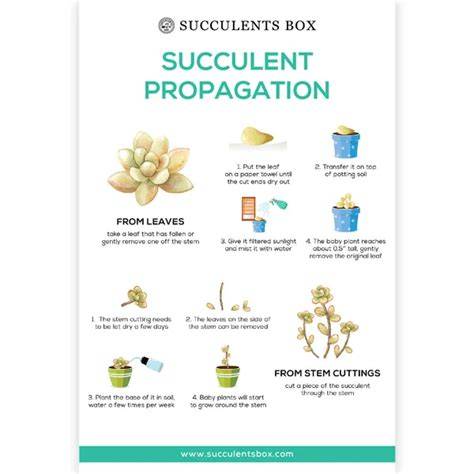
Usually, it can take from 2-6 weeks for roots to sprout, depending on your climate and environment. Although propagating succulents using leaves take much longer compared to stem cuttings, this technique has a higher chance of success to propagate. Gently grasp a plump, healthy leaf between your thumb and forefinger (bottom leaves are strongly recommended), then move it from side to side. DO NOT simply pull the leaf away from the succulent, this will most likely leave a part of the leaf and will result in not being able to form any roots or new leaves. We recommend picking mature and healthy leaves (bottom leaves) since they have better chance to survive. Small and young leaves often do not have enough nutrition to support newly grown roots.
After selecting a healthy leaf to propagate, lay them on an empty tray to for some time to callus over. DO NOT skip this part as it will decrease your chance to successfully water propagate your leaf. Additionally, this step will help you determine if the leaf is indeed a healthy one to propagate or not. If the leaf is healthy, it should not die without any water very quickly. Pick a glass vessel depending on the size of the leaf that you’ll propagate. Once your leaves callus over, it is now ready to put it in the vessel you’ve prepared. Fill the jar with water and then use the food wrapper to wrap around the bottle cap. Poke holes on the plastic wrapper and put the leaves in. Let the curved side go flat down. Do not let the leaves touch the water. The growth cycle might take 2-6 weeks to start. It is highly recommended to check your leaves periodically to prevent the water from drying out. You may also want to change the water if it gets too dark or brown to see how the roots form.
If you want to transfer or transplant your succulents from water to soil, it’s highly recommended to wait until the cutting has at least an inch-long root or the mother leaf has started to dry out, then allowing it to air-dry on a paper towel for about a day or two. Once the roots have dry out, gently burrow your succulent into an unfertilized cactus soil and put it in an area where they can only get bright and indirect light. From here, it is advisable to give your succulent a regular watering schedule.
Want to attempt doing water propagation yourself? You’ll need some succulents first! If you found this article interesting, share it with your succulent loving friends! And get a free plant when your friends make an order. Learn more about how to nurture and enjoy many gorgeous succulents and clever decoration tips with our newsletter. In this post, I'll show you the techniques I use to propagate succulents from leaves. Your succulent's genus and species will determine what kind of cutting you can take. Aeoniums, on the other hand, only work with cuttings, which means you can't propagate them with just a leaf. In other words, every variety of succulent is different-so if you're not sure what will work, experiment (like I did) and see what happens!
To take a leaf for propagation, just gently twist the leaf off the stem. Make sure it's a clean pull, leaving nothing on the stem. Every time I've broken off a leaf just before the stem, it's always died-so make sure you get all the way down to the stem. If you aren't keen on removing a leaf from your own plant, no worries! You can cut off the top of the succulent, or you can cut off a new offshoot. Once you've taken your cutting or leaf, it's important to let it dry out a little bit before you do anything else. If the leaf or cutting doesn't get a chance to scab over, it'll absorb too much water the first time you water it, and drown. It's totally fine if the cutting starts to shrivel up a little. While full-grown succulents don't need to be watered every day, leaves and cuttings do.
If you're working with leaves, set them on top of the soil, making sure their ends don't actually touch the soil at all, and water them each time the soil dries out. Unlike leaves, cuttings do need to be put in the soil. Once you get going with propagation, it's easy to end up with a whole tray of leaves and cuttings and forget when you started each one. I use the Cheerful Plants app to keep track of them with a quick photo and the date, then snap progress photos as roots and babies show up. It takes some time for new rosettes and roots to form on succulent leaves and cuttings. If you notice that a rosette is growing on your leaf, but no roots, don't stress 🙂 This is normal. The leaf is providing all the nutrients the baby succulent needs to grow. As it gets larger it will start to put off roots as it "searches" for water.
If some of your cuttings or leaves die, don't worry-more than half of my first batch didn't make it. Some won't grow as much as their siblings, while others will put off a bunch of roots, but no leaves. Most succulents take several months to grow to “normal” size-while some may take as long as a year. Once you start to see roots, cover them with soil. This way they will stay cool and have access to water. You don't need to do anything with the mother leaf. As the baby succulent gets larger, the mother leaf will begin to shrivel up and die. Once this happens, continue to provide plenty of water for the baby succulent. While they can technically be repotted anytime, I recommend waiting until the new baby is at least an inch in diameter or more. It's also best if the baby has a deep root system. After the baby is in its new home, make sure you're watering it enough to keep growing.
Succulents are some of the easiest houseplants to propagate because there are several ways to do it. Today we’ll show how one succulent can be turned into many (even a dozen or more!). Propagation is also a helpful way to care for your succulents because pruning is a necessary part of houseplant maintenance. Propagation is the process of growing new plants from parts of an existing plant, such as its leaves, stems, roots, or seeds. You can propagate just about any houseplant at home, although the techniques vary depending on the plant. Popular methods include water propagation (where you can watch new roots grow in water) and soil propagation (when new roots develop directly in a pot of soil). Sedums, sempervivums and echeverias are among common succulent groups suitable for water or soil propagation.
Propagating succulents in water is possible, but it goes against the growing conditions these plants naturally prefer. For best results, start your leaves and cuttings in shallow planting trays or small containers filled with potting mix. 1. Prepare your planting containers or trays. 2. Pour a small amount of RootBoost Rooting Hormone into a dish. 3. Work one cutting at a time. Moisten the leaf base or the cutting stem, then dip it into the dish of rooting hormone. Cover the leaf base or stem thoroughly. 4. Insert leaves or stems carefully so the rooting powder stays in place. For leaves, insert the base at an angle - barely below the soil line. Place curved leaves so they curve upward. 5. Don't water until roots begin to form. Then water well and let the soil dry out before you water again. Rooting time varies significantly, but most succulent leaf and stem cuttings should root within two to three weeks. 6. Replant your new succulents from trays to small containers once roots have established. Use the same type of potting mix that you used before.
Most mature succulents prefer full to partial sun, but protect new plants from harsh, intense rays. More light can intensify succulent colors, but too much light can cause fading and sunburn. As your plants mature, you can transplant your succulents to larger pots, combination planters or garden homes. Succulents tolerate heat and drought well, but regular watering keeps water-conserving leaves and stems plump, beautiful and firm. Always let the soil dry out well, then water deeply and thoroughly. By learning how to root succulent cuttings and leaves, you can step up your succulent plantings and share your extras with family and friends.
Succulent propagation is best done in the spring and summer, during the plant’s active growing season. It can be successfully done any time of the year, but results may take longer in the fall and winter. So don’t fret if you are starting your propagation out of convenience or when your succulent needs pruning. The process takes a few days upfront and then several weeks of waiting (and occasional watering) until new growth develops. Water your mother plant and wait about 3 days before cutting anything. Succulents store water in their leaves, and giving them one last drink beforehand helps fill them up with moisture and nutrients for the “journey” ahead.
In practice, many enthusiasts report that water propagation can yield dozens of new plants from a single specimen, with variations in growth depending on the method chosen. You can see different outcomes between the stem-cutting, leaf-propagation, and air-propagation approaches, each offering distinct rosettes, roots, and baby plants. When you’re ready to move from water to soil, ensure roots are established and gently transition into well-draining cactus soil, providing bright indirect light and a consistent watering schedule.