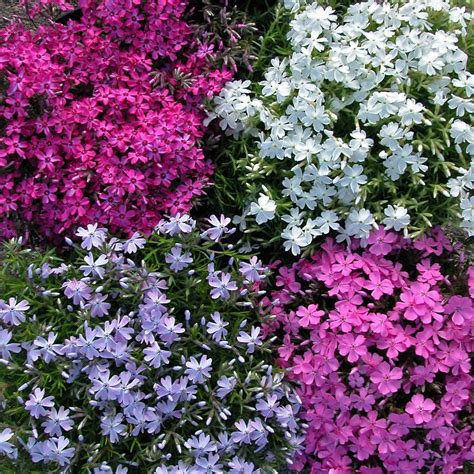
Known by several names, including Moss Phlox, Carpet Phlox, Mountain Phlox, and Moss Pink, this perennial spreads like a colorful carpet across slopes, garden edges, and rocky areas. This cold-hardy perennial brings dazzling swathes of pink, purple, red, white, and blue blossoms to life just when you're craving color most - from early to mid-spring. Its needle-like foliage stays fresh and green throughout the growing season.
Popular color varieties and their character
1. A fiery delight, Scarlet Flame sets the garden ablaze each spring with bold magenta-red blooms. Its fragrant flowers draw pollinators, while the evergreen, needle-like foliage forms a dense, mat-like groundcover.
2. A pure-white spring carpet, Snowflake is like a fresh blanket of snow that never melts. The lightly fragrant blooms glow in the sun, making this variety ideal for brightening shady corners, mixing with pastel Tulips or Daffodils, or pairing with vibrant pink or purple Phlox for striking contrast.
3. One of the most popular Phlox varieties, Emerald Blue dazzles with soft lavender-blue blossoms that cover its dense mat of evergreen foliage each spring. The fragrant flowers are butterfly magnets, and the pastel tones are perfect for cottage gardens or naturalized drifts.
4. With rich, velvety purple flowers accented by darker eyes, Purple Beauty offers depth and drama in spring landscapes. Its evergreen, fine-textured foliage hugs the ground tightly, creating a lush, weed-suppressing mat.
5. Charming two-tone petals of rosy-pink and white stripes make Candy Stripe a playful favorite. This cheerful variety creates a peppermint-candy carpet in spring, irresistible to butterflies and bees.
Why Creeping Phlox is a garden workhorse
Creeping Phlox is one of the most versatile groundcovers you can grow. It is an attractive, easy-to-grow North American-native groundcover that is completely covered in fragrant flowers when it blooms in the early spring. The flowers appear in candy-colored shades of pink, purple, blue, and white, and the plant grows about 8 inches tall, forming a delightful carpet of color perfect for the front of borders, slopes, or rock gardens.
When the plant is not in bloom, Creeping Phlox still looks good, sporting bright green, needle-like foliage that adds texture to your garden. It is hardy from zones 3-9 and grows best in full sun or light shade with moist, well-drained soil. Once established, it holds up well to drought and needs little care, though wet soil can cause it to sulk.
Culture and care guidelines
Site Selection: Choose a sunny spot - Creeping Phlox thrives in full sun but tolerates light shade. Well-drained soil is key.
Soil Prep: Amend soil with compost or sand if drainage is poor.
Planting: Space plants 12-18 inches apart to allow them room to spread. Set plants at the same depth as in their containers.
Watering: Keep the soil lightly moist during the first growing season. After establishment, the plant is drought-tolerant.
Fertilizer: Apply a balanced, slow-release fertilizer in early spring as new growth emerges.
Pruning: After flowering, lightly shear back the plants to encourage denser growth and to keep the mats tidy.
Winter Care: Creeping Phlox is evergreen in most mild-winter regions. In colder zones, foliage may bronze but will green up again in spring.
Growth habit and landscape uses
Creeping Phlox is a low-growing, sun-loving herbaceous perennial with a dense, spreading, mat-forming habit. It forms a thick mat up to 3 ft wide and about 6 inches tall, with evergreen needle-like foliage. The blooms form loose clusters of tubular 3/4 inch flowers in shades of pink, lavender, reddish-purple, and occasionally white, creating a spectacular spring display.
Garden uses include rock gardens, edgings, foundation plantings, ground covers in sunny areas of woodland gardens, slopes, native plant gardens, or naturalized areas. Insects and diseases are generally minimal; powdery mildew is less common than with other phlox species, though spider mites and nematodes can pose problems under certain conditions. Deer typically avoid creeping phlox, though rabbits may browse.
Selected varieties from the new generation
Part of the new generation of creeping phlox, several cultivars bring extended bloom and compact habit:
- Jagger: starts blooming in spring and continues through the summer, with rich purple flowers and a compact, mounding shape to 12 inches tall and wide.
- Candy Stripe: bright pink star-shaped flowers with crimson eyes and white stripes, tiny needles remain forest green year-round.
- Crimson Beauty: forms a carpet of crimson flowers bursting into bloom in early spring.
- Drummond’s Pink: dark evergreen foliage provides a stark contrast to bright pink flowers.
- Emerald Blue: masses of deep blue blooms in early spring, foliage remains evergreen and textural when not in bloom.
- Fort Hill: lightly scented pink star-shaped flowers with evergreen foliage, ideal for rock gardens or edging.
- Purple Beauty: deep purple flowers with a pleasant fragrance, an excellent choice for sunny borders.
- Red Wing: crimson flowers with darker centers at close range along borders and walkways.
- Ronsdorfer Beauty: compact plant smothered in bright pink flowers with a red eye in spring.
- Angelina: lavender-pink flowers over weeks in spring and early summer, 8 inches tall and 12 inches wide; a fun upgrade from older varieties.
Phlox species overview
Phlox subulata (Creeping Phlox) is a low-growing, sun-loving herbaceous perennial known for a thick carpet of color in April and May. Leaves are needle-like and evergreen in many climates. Other phlox species include Phlox divaricata and Phlox stolonifera (woodland phlox for partial shade), Phlox paniculata (tall English phlox, full sun), and Phlox drummondii (annual phlox).
Practical tips for Virginia and similar climates
The ideal planting window in Virginia is early spring (March to April) when temperatures are cool and plants are actively blooming. Watering after establishment, pruning after bloom, and enjoying a weed-suppressing mat through years are reliable benefits in hot summers and mild winters. For slopes, rock gardens, and borders, creeping phlox serves as an effective, low-maintenance ground cover that remains attractive year-round.
Design notes and visual ideas
Pair emerald-blue and Snowflake with pastel tulips for delicate contrast, or create a bold bed with Scarlet Flame and Purple Beauty for dramatic spring color. Use Candy Stripe along pathways to invite butterflies and bees, while Fort Hill adds a gentle fragrance to borders. The evergreen foliage provides texture and winter interest in milder climates.
PETITTI Phlox Spotlight | How to Grow Creeping, Woodland, and Summer Phlox
- Choose bright sun for best bloom
- Provide well-drained soil with occasional compost
- Plant 12-18 inches apart to allow spreading
- Water sparingly after establishment
- Prune after flowering to maintain mat-like form
In short, creeping phlox delivers effortless charm, a spring spectacle, and year-round greenery that brightens any slope, border, or rock garden with a carpet of color.