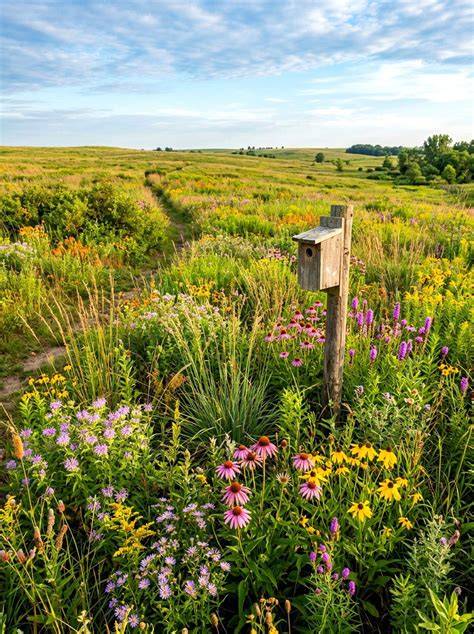
Blazing star, or Liatris spicata, is a robust perennial that produces an upright central stalk from a rounded woody underground corm. Foliage is long, narrow and either glabrous or peppered with sparse hairs. The largest basal leaves are almost 1/2” wide and 10” long. Blades become progressively smaller as the stalk rises. Blooming begins at the top of the flower stalk and progresses downward. The floral display commences in mid-summer and lasts for 3-4 weeks. This species adapts easily to sunny gardens with average soil. Plants are used most often to inject a strong vertical Accent or as Groupings or Mass plantings for Wildlife Gardens or Perennial Borders.
Liatris is a joyful, summer-blooming perennial that you may also know by the name blazing star. I was lucky to inherit a few blazing star plants in our foundation gardens when we moved into our home, and I was completely fascinated by them right from the start. You may also know this easy-to-grow herbaceous perennial by the common name “gayfeather.” The grass-like foliage emerges quietly in the late spring and then tall spikes of showy purple stalk blooms burst upward in July. Liatris really is pure joy in flower form. I’ve divided and transplanted my liatris plants quite a few times and have consequently learned quite a bit about gardening with this energetic perennial flower. Liatris is summer-flowering perennial plant native to the Eastern United States and Canada. You can find liatris varieties with bright purple blooms as well as white and they grow to about 1-3 feet tall in clumps about 1-2 feet wide at most.
While most of the excitement of growing liatris happens in peak summer heat, during early to late July, one of the things I love most about it is the winter interest it provides in my garden. Other than its native growing areas, there are many other places where liatris will thrive in a perennial garden setting. Gardeners living in USDA hardiness zone 3-9 can add this happy, upright plant to perennial borders or meadow gardens with great success. To plant the corms, dig a small hole about two to three inches deep, and place the corm in the hole with the pointed or sprouting side facing up. You’ll want to plant the corms about 12-18″ apart to give them space to grow and mature. If you buy your blazing star as a potted perennial, or if you’re lucky enough to have a neighbour split their liatris and give you a clump to propagate, simply dig a hole in your garden that will be big enough to fit the root ball.
Blazing star is an incredibly drought-tolerant plant, but it does show signs of dehydration when it’s had a little too much sun and not enough water. After a few very hot, dry days, you’ll start to notice the flower spikes drooping just a bit and that’s your sign to water your gardens. If liatris is showing signs of needing water, then everything else definitely does as well. Liatris prefers full sun and well-drained soil, but will tolerate part shade quite nicely. If you have an area of your garden that is quite shaded and dull for part of the day, liatris will brighten it right up. Liatris is quite pest resistant and you won’t find a lot of destructive insect activity on your plants, but they will be very attractive to pollinators in your area. One pest that you may need to watch out for is rabbits, who seem to find liatris leaves and stems to be absolutely delicious.
Any plants that I have growing near our bunnies’ usual path to the area under the large boxwood shrub seem to get nibbled on a regular basis, however the plants that are a little removed from that area by just a few feet are left alone. Liatris looks beautiful paired with other summer blooming perennial flowers like purple coneflower, black-eyed Susan, hostas, and lavender. Because liatris blooms in mid-to-late summer, another strategy is to use it to fill in the gaps in your garden between the time after spring flowers like salvia, alliums, and daisies are in bloom, and when the fall blooming asters come into play.
In the broader context, Liatris-a genus with many species and cultivars of blazing stars-thrives in full sun and well-drained soil. These extremely showy plants are a welcome addition to the landscape. Their long-blooming flowers attract hummingbirds and butterflies. Blazing stars are easy to grow and low-maintenance. They thrive with 8+ hours of full sun and grow best in average-quality, dry to medium-moisture well-drained soil. When selecting companion plants, look for other species that complement each other and share common growing conditions. If you’re ready for a dazzling floral show, read on to learn more about an array of colorful companion plants for your blazing star.
Foundational companions by ecological niche
This plant is sometimes called foxglove (not to be confused with true foxgloves of the Digitalis genus). It blooms in the spring with loose spikes of trumpet-shaped white flowers. The flowers are very attractive to bees, and this plant would be an excellent choice for a pollinator-friendly garden. As a companion for a blazing star, the white beardtongue flowers would be a nice compliment to the purple of the blazing star. Beardtongue is native to the eastern and southeastern United States, growing in average-quality, well-drained soil. Neither Liatris nor beardtongue tolerates wet, saturated soil conditions.
Beebalm attracts hummingbirds, bees, and butterflies with its scarlet red flowers. Beebalm, or scarlet bee balm, is a perennial wildflower native to the eastern United States. This plant produces vibrant scarlet red flowers each summer. Wild bergamot (Monarda fistulosa) is a similar plant with pale purple flowers. The tubular flowers grow in rounded clusters that hummingbirds find irresistible. Beebalm is an easily-grown member of the mint family and has fragrant leaves. Deer and rabbits generally avoid this plant. Beebalm grows best under full sunlight with medium-moisture, well-drained soil. This plant will naturalize easily and spread by self-seeding and rhizomes.
Rudbeckia spp. There are a few different species and commercially available cultivars of black-eyed Susan. Any variety of black-eyed Susan can be a companion for blazing star plants. Black-eyed Susan is generally considered a short-lived perennial or biennial wildflower. Black-eyed Susan flowers come in a wide assortment of yellow, bronze, orange, and red. R. hirta, for example, has simple, bright yellow flowers with prominent dark centers. R. hirta ‘Cherry Brandy’ is a cultivar with deep red flowers, and R. maxima is a species native to the southeastern United States with large yellow petals and an elongated central disk.
Blue fescue is a small ornamental grass that forms dense clumps of thin blue-green blades. It blooms in early summer, but the flowers are not especially showy. Blue fescue is primarily grown for its decorative foliage. As a companion plant for blazing stars, fescue can be located in the foreground with the taller Liatris in the background. The fescue is semi-evergreen, staying green throughout the winter in warmer climates. This plant may not perform well in the intense summer heat.
This milkweed is a must-have for butterfly gardens and serves as a host plant for monarch butterfly caterpillars. Butterfly milkweed is a “must” for every butterfly garden. Many different milkweed species exist, but Asclepias tuberosa is a very garden-friendly species native to the eastern and southeastern United States. Butterfly milkweed stays relatively small, typically reaching only about 2 to 2.5 feet tall. Butterfly milkweed can bloom anywhere from late spring through mid-summer. Plants produce dense flattened clusters of bright yellow-orange flowers. Butterflies, bees, and other pollinators love the flowers.
Common bluestar is native to the central United States, growing in meadows and open woodlands. It grows best in direct sun but also tolerates partial shade. Grow it in average-quality, medium-moisture, well-drained soil. As a companion plant for blazing star, common bluestar would likely bloom earlier in the season, immediately followed by blazing star. Common bluestar produces loose, rounded clusters of pale blue, star-shaped flowers. The plant’s foliage forms a large, rounded clump reaching 3 feet high and about 3 feet wide. At peak bloom, plants will put on a very attractive floral display, producing many flower clusters across the entire plant spread.
Echinacea spp. There are several species of Echinacea and a great number of Echinacea hybrids, most originating from the native species E. purpurea. Coneflowers make a good companion plant for blazing star because they all thrive in similar conditions. Coneflowers are often pink or purple, but there are varying shades of these colors, plus white flowers. They are long-blooming and produce flowers throughout the summer months. The flowers are large and very showy, attracting many butterflies and pollinators. In the fall, the mature seedheads attract hungry birds, especially goldfinches.
Additional companions by color and texture
With its cheerful yellow flowers, coreopsis can spread through self-seeding and rhizomes. Coreopsis spp. There are many species of coreopsis, both annuals and perennials, and any would make a nice addition to the perennial garden when planted alongside blazing star. Most coreopsis have cheerful single yellow flowers, dramatically complimenting the purple spikes of Liatris. Coreopsis plants tend to bloom later in the season, from mid to late summer into early fall. Coreopsis does best in full sun with dry to medium-moisture, well-drained soil. Insect pollinators and beneficial predatory insects visit the flowers. Rabbits sometimes eat the leaves.
False blue indigo is a beautiful shrub-like perennial wildflower. It is native to the prairies and meadows of the eastern United States. False blue indigo can be started from seed but takes a while to reach flowering maturity. A mature false blue indigo plant resembles a small, rounded shrub, with attractive foliage throughout the growing season. Flowers bloom in mid to late spring and attract butterflies and bees. The tall, bold spikes of pea-like purple flowers are stunning, making this plant a centerpiece of the spring landscape. The large and prominent spikes of pale purple-blue flowers of the great blue lobelia would be a standout feature of a summer garden that includes this plant. Planted alongside the spring-blooming blazing star, this plant comes into flowering just as the blazing star is finishing.
Great blue lobelia grows best in full sun but tolerates light shade, especially in warmer climates. Grow it in moist soil with space to form large clumps. If you are growing lobelia with blazing star, select a dryer location for your blazing star and a wetter location for the lobelia. Because these two plants have different water needs, they probably shouldn’t be grown as immediate neighbors. Also known as anise hyssop, lavender hyssop is an attractive member of the mint family. It has fragrant leaves and is not bothered by deer. The flowers have a long blooming period, lasting throughout the summer months. Grow lavender hyssop in full sun or light shade. Soil should be dry to medium moisture and well drained. Growing alongside blazing star, this plant makes a solid companion. The fragrant leaves help deter browning mammals, and the flowers will begin blooming just as the blazing star flowers are starting to fade away.
When growing New England aster alongside blazing star, ensure ample space for each plant to grow. The first thing you should know about New England aster is that it can grow large. This bushy perennial grows both tall and wide, spreading freely by ground-level rhizomes. The second thing you should know about New England aster is that it is a spectacularly beautiful plant. If you are growing New England aster with blazing star, give each plant plenty of space to grow. Asters will spread quite rapidly, and you don’t want it to shade your Liatris. Both grow well in full sun and average-quality, well-drained soil.
Allium spp. If you’ve always thought that onions were just for eating, you may be surprised to learn that many ornamental varieties of onion plants exist. They typically have thickened, long, tubular, or hollow leaves that smell oniony. Rabbits and deer don’t like onion smells and won’t usually eat them. The flowers are beautiful, spherical, and usually bedecked in shades of purple. Grow any allium in full sun. These plants must have well-drained soil because the bulbs can easily rot in wet environments. While you can grow onion plants from seed, they are most easily grown directly from a mature bulb which can be purchased or divided from existing colonies.
Purple poppy mallow is an easy-to-grow perennial native to the central United States. This plant thrives in full sun and would be a beautiful companion for blazing stars and other taller flowering perennials. Grow it in dry to medium-moisture, well-drained soil. Purple poppy mallow blooms in late spring, a similar time as Liatris flowers. These low-growing plants can form beautiful masses as they spread. Grow them along borders where they can sprawl and drape over the edges.
Also called field pussytoes or prairie everlasting, these tiny flowers are slightly different from your average showy wildflower. This plant is native to much of eastern and central North America and is a host plant for the American Painted Lady butterfly caterpillar. Plants grow best in full sun but will also tolerate partial shade. Pussytoes form a dense mat of vegetation, making a great ground cover. The basal rosettes are comprised of fussy leaves that look pale silvery green. In early to mid-spring, taller flower stalks emerge, topped with fuzzy white flower clusters that attract butterflies and early-season pollinators. This unique xeriscape plant makes a good companion for Liatris in similar growing conditions.
Rattlesnake master is a unique and rather unusual plant. The leaves are long and narrow, edged with sharp spines, and form an upright, silvery-green basal rosette. In late spring through mid-summer, tall flowering stalks appear from the centers of mature rosettes. The flowers are spherical and pale greenish-white, looking more like a spiky orb than a traditional flower. Rattlesnake master would be a good companion for Liatris because they look very different from each other yet grow in similar conditions. Be sure to give each plant plenty of room to grow as they will both naturalize and, over time, will spread into larger and larger clusters. Rattlesnake master can be grown from seed or diving smaller offsets.
Rose verbena is a low-growing perennial wildflower that makes a good ground cover and nicely compliments taller plants growing nearby. Rose verbena has deeply cut geranium-like leaves and slightly fuzzy leaves and stems. Flowers bloom throughout the summer and attract butterflies. Rose verbena would look wonderful in a rock garden or along any perennial border. Because of its small size, it can also be grown in containers or hanging baskets. Give it a location with full sun and low to medium-moisture well-drained soil. This plant is native to the southeastern United States in drier sandy soils.
Design and management considerations
Stems flopping or breaking is usually caused by excess nitrogen, insufficient sun (<6+ hours), or overcrowding. Solution: Reduce or eliminate fertilizer, relocate if shaded, and thin companions to restore airflow. No flowering after Year 1 indicates poor drainage or excessive moisture. Check soil after rain-if puddling persists >4 hours, regrade or install French drains. Also verify planting depth: liatris corms should be buried 2-3 inches deep-not shallower (drying out) or deeper (rotting). Yellowing lower leaves plus stunted growth signals Fusarium wilt or aster yellows. Remove affected plants immediately (do not compost). Rotate companions-avoid planting aster-family species (Echinacea, Rudbeckia, Coreopsis) in that spot for 3 years.
Can I plant liatris with ornamental onions like allium? Yes-but choose late-blooming alliums (Allium christophii, A. giganteum) that finish by early June. Early alliums (A. schoenoprasum) die back by May, leaving bare soil that invites weeds and erosion around emerging liatris foliage. Is liatris deer resistant? Do companions need to be too? Yes-liatris is rarely browsed due to its coarse, slightly bitter foliage. Pair it with other deer-resistant natives: coneflowers, goldenrod, butterfly weed, and Russian sage. Avoid tempting species like phlox, lilies, or daylilies nearby.
Can I grow liatris in containers with companions? Only in large, insulated pots (minimum 16-inch diameter, 14-inch depth) with gritty potting mix (2 parts cactus mix + 1 part coarse perlite). Limit companions to one dwarf species-e.g., ‘Zagreb’ coreopsis or ‘Goldsturm’ rudbeckia-to avoid root competition. Container-grown liatris needs winter protection in Zones 5 and colder (move to unheated garage or wrap pot in burlap).
Do I need to divide liatris regularly like hostas? No. Liatris corms multiply slowly and rarely require division. Only divide every 5-7 years if clumps become sparse-flowering or show signs of congestion (weak stems, reduced bloom). Divide in early spring, using a sharp knife-replant corms immediately at original depth. Will liatris self-seed and take over my garden? Unlikely. Most cultivated liatris (especially L. spicata cultivars like ‘Kobold’ or ‘Floristan’) are sterile or produce minimal viable seed. Even straight species set seed infrequently unless cross-pollinated by multiple genotypes-a rarity in home gardens. If you see seedlings, they’re easily pulled or transplanted.
Ultimately, “what to plant with liatris” is less about decorative adjacency and more about rebuilding miniature prairie ecosystems-one thoughtful pairing at a time. By choosing companions rooted in shared ecology-not just catalog appeal-you support stronger plants, richer soil, and resilient pollinator networks. Start small: group three liatris spikes with two coneflowers and a tuft of little bluestem. Observe how bees move between them, how rain sheets off their leaves, how winter stems hold snow differently.
- Choose foundational natives that bloom slightly earlier or later than liatris to extend nectar flow.
- Pair with warm-season grasses to provide texture and soil health benefits without crowding liatris.
- Incorporate drought-tolerant perennials and milkweeds to support pollinators and monarchs.
- Avoid moisture-loving or shade-preferring species that invite root rots and competition.
- Practice careful planting timing and soil management to maximize establishment and long-term vigor.