Pepper plants (Capsicum annuum) have “perfect” flowers, meaning that the flowers have both female and male reproductive parts. This allows for self-pollination, with the pollen from the anthers falling on the adjacent stigma of the female part of the flower. The flowers need to be shaken to help release the pollen.
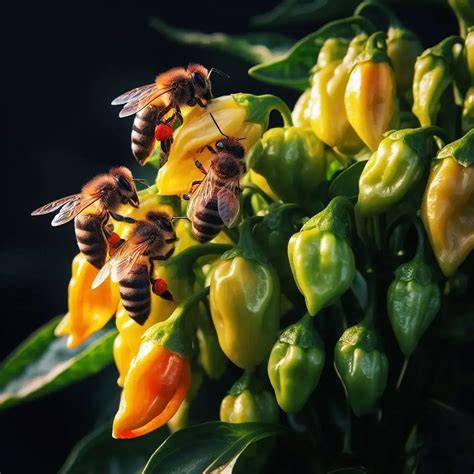
Bees are among the most important pollinators of crop species, even helping to improve fertilization rates for self-pollinating species such as tomatoes and peppers. Pepper flowers produce nectar and are attractive to a range of insect pollinators including honeybees, solitary bees, bumble bee species, and alfalfa leaf cutting bees. Studies have shown that insect pollination of greenhouse-grown peppers can help increase fruit weight, fruit quality, seeds per fruit, the speed of maturation, and the percentage of large and extra-large fruit when compared to self-pollinated plants.
One study showed that bee-pollinated flowers produced fruit with a seed set of 40 to 50%, while self-pollinated flowers had seed set rates of 26 to 28%.
Pollinators in greenhouse pepper production
Bumble bees, mostly Bombus impatiens, are used in greenhouse production systems more commonly than honeybees because their life cycle and colony characteristics are more compatible with greenhouse settings. Bumble bee colonies are usually small, about 300 bees, compared to honeybee colonies, which can be as large as 30,000 bees. Bumble bee colonies can be contained in boxes that are easy to transport and place in greenhouses. In addition, bumble bees are very efficient pollinators and can remain active during periods of cold weather and low light better than honeybees, and bumble bees are less aggressive than honeybees, making them safer for workers to be around.
Short visits to the flower, of approximately 12 seconds, are sufficient, with one to two visits per flower providing the highest level of pollination. Bumble bees focus on foraging on the most readily available plants, usually visiting flowers early in the morning when pollen is released (anthesis) and flowers are most receptive to fertilization. The bees prefer flowers that produce the most nectar and have the highest level of stigma receptivity.
Greenhouse environmental factors and pollination
It has been shown that the materials used to cover greenhouses can affect the intensity and quality of light entering the greenhouse. Glass, plastic films, and rigid plastic panels vary in total light transmission, the selective transmission of different wavelengths of light in the photosynthetically active region (PAR) and near-infrared, and the ability to block UV-A and UV-B wavelengths. The materials can also affect the house’s temperature, humidity, and vapor pressure deficit levels. Some studies have shown that these differences can result in changes in the quality of tomato fruit and potentially affect the level of fruit cracking. Materials that result in higher temperatures and higher humidity levels may increase the likelihood of fruit cracking during the summer months. A house’s airtightness or leakiness can also affect the stability of temperature and humidity conditions, with fluctuating temperatures and high humidity conditions more likely to contribute to increased cracking.
Figure 3. One to three colonies are usually sufficient for the pollination of 16,000 ft2 (1,500 m2) of greenhouse-grown peppers. With too many bees (too few flowers per bee), bumble bees will leave the house to forage outside or repeatedly revisit the same flowers, which can cause damage and lead to blossom drop. So, growers should start with the smallest number of bees needed for the space to prevent over-pollination activity. Early in the flowering stage, it may be necessary to periodically confine the bees to their box until more flowers become available. Bees return to the hive at night; the box entry holes can be closed to prevent the bees from exiting the hives, and sugar water or honey solutions can be provided to keep the bees fed while they are confined.
Colonies should be placed off the ground in a location facing but “downwind” from the plants. Peppers need nighttime temperatures between 55 and 70 °F (13 to 21 °C) for pollen production, and daytime temperatures should not exceed 90 °F (32 °C) for adequate pollination. Temperatures over 90 °F can result in flower abortion and damage developing broods of bees. Hives should be placed in a shaded location within the house to prevent overheating. Relative humidity levels should be between 50 and 80%. If humidity levels are too low, the pollen will not adhere to the stigma. Bees use UV light to help keep them oriented in their environment, so using UV-excluding greenhouse covering materials can interfere with the bee’s ability to maintain good orientation. It is preferable to use cover materials, such as glass, ridged acrylic, and polyethylene films that allow the transmission of UV wavelengths. Most rigid polycarbonate materials and PVC films block UV light transmission, resulting in bees becoming disoriented in the house. Some polyethylene films may include UV blockers meant to increase the usable life of the material, but this will also be problematic for bees. Using supplemental lighting in the winter can also be detrimental to the longevity of bumble bee colonies.
Pollinator management and pesticide considerations
Bees used as pollinators in greenhouses need to be protected from pesticides that can be lethal or harmful to bees. Weakened bees forage less and are less effective at pollinating. Growers should try to avoid the application of pesticides that are harmful to bees during the pollination period. If possible, apply pesticides through the irrigation system rather than with foliar sprays to limit bee exposure. The use of less harmful products is preferred, and if applications are needed, they should be made at night when the bees are less active and most likely to be inside the hive.
Hand pollination and alternative pollination methods
Some growers, during times of stress or in windless greenhouses, use hand pollination to ensure fruit set. Pollination transfers pollen from the anthers to the stigma, and pollen is fairly sticky and composed of tiny grains with projections that adhere to surfaces. A tiny artist's paintbrush or cotton swab can be used to transfer pollen from flower to flower, swirling inside the flower to gather pollen and then rubbing onto the end of the stigma. If pollen adhesion is difficult, dipping the brush or swab in a bit of distilled water first can help. To avoid cross-pollination when growing multiple types of pepper plants, switch out the paintbrush or swab between plants.\n
In outdoor settings, breezes or wind can also pollinate peppers, and tapping or shaking the plant can cause pollen to fall. When flowering plants are outdoors, various insects pollinate the flowers by spreading the pollen from flower to flower. Pollination, Quality & Yield: Although it is known that fruit set and yield are related to the bearing capability of the plant, researchers in different parts of the world have found significant increases in fruit weight, fruit size, and seed number in greenhouse-grown hot peppers pollinated by bumble bees. Pollination recommendations note that in windless greenhouses, insect activity is generally required to facilitate both self- and cross-pollination in pepper crops. While it is possible to use honey bees in greenhouses, they do not like the still air and tend to try to escape to forage outside. Commercial availability of bumblebees (Bombus impatiens) is now fully established in many regions.
- Bees and peppers: nectar production and pollination roles.
- Colony characteristics enhancing greenhouse pollination efficiency.
- Environmental controls in greenhouses affecting pollination success.
Releasing the Bees
tags: #how #are #peppers #pollinated