Roses are like people in that they are subject to a number of ailments and diseases. Some of these are temporary, some are persistent. Some are curable, others are not. Some are viral, some are bacterial, some are fungal. As Seattle’s spring bring us changeable weather, the foliage on our roses often does weird things, changing colors, shriveling, dropping, all of which lead us to think that some dreaded pathogen has invaded our garden. Serious diseases seldom manifest themselves in the spring, so panic is premature. ARS Consulting Rosarians can usually tell you what the trouble with your leaves is not, rather than what it is. Possibly the most widespread rose “disease” and the easiest to cure is mineral deficiency. In addition to the “big three” - nitrogen, phosphorous, and potassium - roses also need small amounts of so-called “micro-nutrients”, calcium, magnesium, sulfur, boron, zinc, copper, manganese and iron. These are often, but not always, included in both organic and chemical fertilizers, but you should read the label to confirm.
Our next disease is easier to recognizes and identify - most of the time. This is crown gall, caused by a bacteria, specifically Agrobacterium tumefaciens. This typically appears on the crown/bud union of a plant, but may also manifest itself on the roots, or, as in the accompanying image, on the canes. These galls are generally caused by infections in the soil getting into cuts in the roots or lower canes. There is no cure for crown gall; once it gains access it infects the whole plant, and may be spread by untreated pruners or other tools. However, all is not lost. Many rosarians have managed to keep the disease at bay by removing the gall and treating the infected area with a bleach solution. A more stringent regimen is recommended by an online source: “Remove the infested plant and prune out gall tissue. But wait! There’s even better news. I have had crown gall on two roses for over 15 years, and both are still going and growing strong, so don’t be too quick to dispose of an infected plant, as some rosarians suggest.
Let’s digress here for a moment and consider what I would call the “language of pesticides” as it relates to roses. First of all, any pesticidal product, whether homemade or commercial, organic or chemical, an insecticide, fungicide, or miticide, has one of two modes of action: contact, which covers the foliage at the time of spraying but does not enter and remain in the entire plant, and systemic, which does. Commercial pesticide manufacturers use a wide array of verbs to describe their products in their advertizing and promotion. Three of these frequently found are prevent, control, eradicate. “Prevention” is clear; it is the first line of defense in disease control, spraying or treating your plants before they show signs of disease. “Eradication” means complete removal and is possible with some pathogens and will be discussed later. “Control” however, is a very relative term. Does it mean preventing it from spreading, keeping it at an “acceptable” level, or just a word they use because you can’t define or explain it with regard to plant health?
A promotional blurb for Garden Safe [Organic] Fungicide 3 states: “Controls rust, powdery mildew, spider mites and listed insects”. The active ingredient in Fungicide 3 is Neem oil, not just ordinary Neem oil but “Clarified Hydrophobic Extract of Neem Oil”. The National Pesticides Information Center says of this product: “Azadirachtin is the most active component for repelling and killing pests and can be extracted from neem oil. The portion left over is called clarified hydrophobic neem oil.” Control indeed!
Rust is one of the least pernicious diseases we encounter on our roses. For one thing, it seems to be selective, targeting certain varieties - often repeatedly - but not others. Secondly, I have not found it to be contagious, certainly not to the extent of black spot. In the Pacific Northwest it does not present long term harm to the plant by causing leaf drop or foliage deformity. And finally, it characteristically occurs on the bottom side of the leaves, so you can ignore it if you choose.
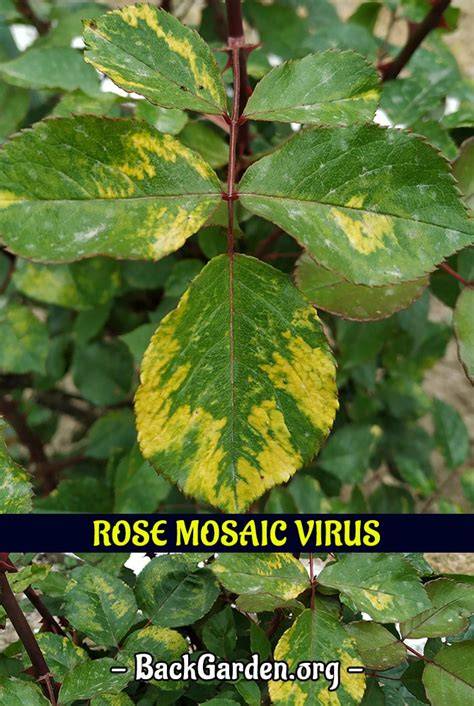
This look may be desirable on your dieffenbachia but not on your roses. It is a viral pathogen known as Rose Mosaic Virus. It is similar to, but not necessarily caused by, Prunus Necrotic Ringspot Virus and Apple Mosaic Virus, two diseases of stone fruit. The variegation and discoloration may look different on different leaves and different roses, but the chlorotic banding should still be recognizable. This virus is spread through infected rootstock, and about 20 years ago it was rather prevalent. Much like crown gall it may or may not affect the health of the plant, and is not contagious.
Powdery Mildew is a fungal disease that affects many different types of plants. It seems to thrive in moist, humid conditions like we get in late summer and autumn. It will curl and deform the foliage which can lead to reduced photosynthesis if left untreated. It is very easy to identify, and hence its chief drawback may be the unsightly look it gives to your rose garden. A number of rosarians have reported success using neem oil on powdery mildew. At least three rose diseases manifest themselves through spots on the leaves: black spot and downy mildew, both of which will be discussed later, and anthracnose.
Anthracnose is caused by the fungus Sphaceloma rosarum and is most often seen during cool and moist weather of spring and autumn. In contrast to black spot, anthracnose spots tend to be rounder and, as they age, develop a white center. Botrytis (gray mold) is primarily a disease of grapes and other food crops, but the fungus, botrytis cinerea, does show up on roses. It characteristically appears on petals and buds as large, rotten-looking brown spots that soon develop into gray mold. It is fostered by cool wet conditions so air circulation and proper irrigation techniques are encouraged. There is no cure for botrytis and the disease can spread so affected plants should be removed. Texas A&M Agrilife Extension recommends preventive organic fungicides such as Actinovate or PlantShield and chemical products like Daconil or Medallion.
We come now to the first of the “big three” of rose diseases, those that can cause serious and permanent harm to your plants. Black spot is the bane of rose growers throughout the United States in damp climates like ours. Dr. David Slezak of the University of Wisconsin estimates that there are c. a dozen strains or “races” of black spot, all of which can migrate, mutate, and build up resistance to fungicides. We can fight black spot and hopefully keep it at bay, but we can never eliminate it from our environment. I’m sure we’ve all had it at one time or another, so there should be no problem recognizing it. The leaf drop caused by black spot reduces a plant’s ability to photosynthesize food. If left untreated over time it will weaken the bush and cause the decline of rose production. There are a variety of ways to prevent and to treat black spot. Purchase disease resistant varieties. Avoid wetting the foliage. Black spot thrives on ambient water, from above and below. Use a fungicide! The best way to combat black spot is to prevent it. If I were to choose an organic product it would probably be potassium bicarbonate, which is fairly widely available. Any number of chemical fungicides, if used regularly, will prevent black spot. To eradicate black spot (at least temporarily) spray every couple days with a chemical fungicide.
Often confused with black spot (at least temporarily) is Downy Mildew. Temporarily, because downy will completely defoliate a plant in a matter of days rather than months. Why it is called downy is a mystery, since it anything but soft and fluffy. “Peronospora sparsa, an oomycete (a fungus-like organism more closely related to algae than to fungi), causes the disease.” It originates primarily in the greenhouses and growing fields of rose suppliers and needs a window of high humidity - 80% and above - and temperatures in the 60° - 80° range to manifest itself. Since the disease is characteristically already in the plant when you buy it, preventive spraying is pretty much useless. The only known fungicidal product known to work against downy is Fosetyl-Al, most commonly sold under the trade name Aliette, but also available in Monterey Garden Phos, containing potassium salts of phosphorous acid which are a component of Fosetyl-Al.
Much on the minds of rose breeders, the academic community, rose growers of all stripes and the gardening press of late is RRD, Rose Rosette Disease. There is no preventative, treatment, or cure for RRD and it is devastating private and public gardens in the eastern two-thirds of the United States. The virus is a member of the emaraviradae family and its only known vector is the eriophyid mite, Phyllocoptes fructiphilus, a minuscule creature that, according to Utah State “cannot be seen without a 20x hand lens or greater magnification”. They are small enough to be carried by the wind, and can also move from to plant on their own. As with all rose diseases, RRD’s symptoms appear as noticeable changes in the plant’s foliage. Here the leaves become deformed, crinkled, and brittle in a witches broom proliferation of small shoots, characteristically red in color. Now for some good news. No cases of RRD have been found in either Oregon or Washington; all purported appearances of the disease have been discredited and found primarily to be herbicide damage.
An article by Dr. Tony Liberta in the 1994 ARS Annual warned of the dangers of RRD and concluded with these words: It appears now that the scientific and rose growing communities have become sufficiently aware of the threat posed by RRD to prevent the “epidemic” that might have developed had it gone unheeded.” Unfortunately this warning went pretty much unheeded for the next 20 years. Roserosette.org states: “This disease has been reported since the early 1940s but only in 2011 did research demonstrate that it is caused by a virus, aptly named the Rose Rosette Virus (RRV). Diagnosis of RRD prior to 2011 was primarily done based on observed symptoms and the presence of the eriophyid mite that is believed to be the vector of RRV.”
Cause Several viruses are associated with the range of symptoms of rose mosaic, including prunus necrotic ringspot virus (PNRSV), apple mosaic virus (ApMV), arabis mosaic virus (ArMV), and strawberry latent ringspot virus (SLRSV). The disease does not spread naturally and has no known insect vector, but grafting transfers it to healthy plants. Transmission of ArMV and/or SLRSV could occur by Dagger nematodes but this has not been extensively studied. Viruses can be in the rootstock or scion or both and may not show symptoms. 'Madame Butterfly', 'Ophelia', and 'Rapture' are highly susceptible. Some report the disease does not spread; others indicate it may spread very slowly over many years. Root grafting between infected and healthy plants can also spread the disease. Symptoms Symptoms may range widely depending on time of year, temperature, and type of virus(es) infecting the plant. Characteristic symptoms include chlorotic line patterns (zigzag pattern), ringspots, and mottles in leaves sometime in the growing season. There may also be yellow net and yellow mosaic symptoms. Symptoms often are evident in spring and early summer but may not be on leaves produced in summer. Vein-banding may be on leaves in long hot periods. Flower distortion, reduction in flower production, flower size, stem caliper at the graft union, winter survival, and early leaf drop, and increase susceptibility to cold injury have all been reported. Remove and destroy infected plants. Reference Golino, D.A., SIM, S.T., Cunningham, M., and Rowhani, A. 2011. Evidence of root graft transmission of two rose mosaic viruses, prunus necrotic ringspot virus and apple mosaic virus in rose rootstocks. Rose mosaic virus may be a complex of more than one pathogen including Apple mosaic virus and Prunus necrotic ringspot virus. Virus infection causes yellow, white, or brownish lines, bands, rings, vein clearing or yellowing, oak-leaf patterns, or blotches on leaves. Roses infected during propagation can be symptomless until after they are planted and begin growing in landscapes. Infected plants may grow more slowly, produce delayed or fewer flowers, and become more susceptible to frost damage. There is no cure or treatment in landscapes for eliminating the viruses that cause rose mosaic disease. Replace infected roses if their performance is unsatisfactory. Purchase and plant virus-indexed plants, roses that have been tested and certified to be free of known rose viruses. Consult Pest Notes: Roses: Diseases and Abiotic Disorders and Rose Virus and Virus-like Diseases for more information. Virus symptoms in rose foliage. The pesticide information on this page may become out of date as products and active ingredients change or become unavailable. Some of the pesticides listed are only available for use by licensed pesticide applicators. Photo by: R.S.
The most common virus disease of roses is rose mosaic, which may cause leaves to show yellow lines, rings, mottles, or netted patterns. These symptoms usually are seen in the spring on part or all of the plant and may not be present at other times. Rose mosaic viruses are not spread by insects or pruning tools but can be transmitted between plants by grafting or budding. The agent which causes rose spring dwarf is also probably a virus. Symptoms of this disease are mainly seen on new growth in the spring. The new leaves are also distinguished by a yellow net-like pattern along the leaf veins. This chlorosis may also be seen on new leaves in the fall. Branches sometimes grow in a zigzag pattern.
Roses are one of the most popular ornamental flowering shrubs grown worldwide. In the United States, the total wholesale production of roses accounts for $204 million annually (USDA 2015). Rose mosaic virus disease is one of the most economically important diseases among viral diseases affecting roses, because a single symptomatic leaf can result in the rejection of complete shipments for wholesale or retail rose producers and can increase the cost due to the need for re-planting with healthy roses for landscapers and homeowners (Paret et al. 2014).
Diagnosis and management emphasize using certified virus-free stock, removing and destroying severely infected plants, and preventing spread through careful sanitation and, where possible, heat therapy during propagation. There is no universal cure for mosaic viruses in established landscapes; instead, best practices focus on prevention, quarantine of new stock, and strategic replacement with virus-tested cultivars. Replace infected plants if their performance is unsatisfactory, and purchase virus-indexed stock to minimize future outbreaks.
- Assess symptoms and compare with common rose diseases to distinguish mosaic symptoms from fungal or bacterial issues.
- Remove heavily infected plants, and sanitize tools to prevent potential spread from pruning.
- Use certified virus-free plant material and maintain rigorous nursery hygiene when propagating roses.
- Monitor for vector activity and environmental conditions that favor fungal diseases, applying appropriate, label-approved treatments as needed.