The Genus history and botanical description provided outline the Phalaenopsis as a well-known, easily adaptable orchid group with a monopodial growth habit and a lip that is often a focal point in its flower structure. From its origin in Blume’s taxonomy to modern hybridization, Phalaenopsis has evolved from a perceived difficult culture to a beginner-friendly, versatile genus with long-lasting flowers and a broad geographical distribution.
Taxonomic background and origin
The Genus History traces Phalaenopsis from its establishment by Dr. Karl Ludwig Blume in 1825 to European cultivation in the 1830s, with early misidentifications and subsequent reclassifications. Phalaenopsis was named for its moth-like flowers, derived from phalaina and opsis. Over time, numerous species and synonyms accumulated, with segmentations into sections and subgenera reflecting evolving taxonomic viewpoints. Today, the World Checklist recognizes about 61 species with several natural hybrids, though taxonomy continues to evolve as new forms are described.
Plant and flower architecture
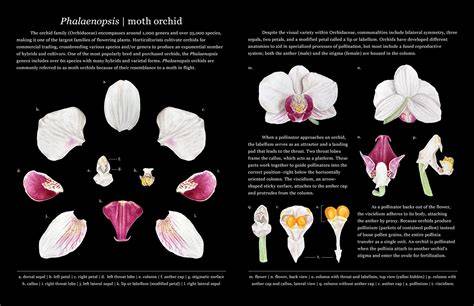
Phalaenopsis is epiphytic, generally possessing short stems with a few to many leaves arranged closely on the stem. The leaves are typically fleshy and leathery, and the inflorescence is lateral, arising near the base and bearing from a few to many flowers. The flowers are showy and long-lasting, with three sepals and three petals and a three-lobed lip joined to the column foot. The lip often bears antenna-like appendages and varies widely in shape. The column is relatively short to elongate, with a prominent foot, and the pollinia are two, waxy, and on a fairly long stipe. The genus serves as a connecting link in flower structure between other Sarcantheae members and Vanda, distinguishing itself by its monopodial growth and the absence of a distinct spur at the lip base in many species.
Phalaenopsis species are distributed across Assam to the Andaman Islands, Malaya, Indonesia, Borneo, the Moluccas, and the Philippines, with centers of diversity such as the Philippine Islands and Borneo hosting many species and natural hybrids. This distribution reflects preferences for shaded, humid environments with relatively stable temperatures, rather than extreme diurnal fluctuations. The genus contains a broad spectrum of forms, including species in Subgenus Phalaenopsis, Esmeraldae, Stauroglottis, Polychilos, and various sections such as Phalaenopsis, Zebrinae, and Amboinenses, each with characteristic traits that influence breeding and cultivation.
Mount lip anatomy and significance
In Phalaenopsis, the lip (labellum) is a key floral structure that often exhibits antenna-like appendages and plays a critical role in pollination, though cultivated forms frequently diverge from wild pollination strategies. The lip is three-lobed and connected to the column foot, which, together with the surrounding petals and sepals, forms a symmetrical or slightly irregular floral silhouette. While the lip can be visually dominant, the “mount lip” concept in cultivation refers to understanding lip morphology in the context of overall flower form and symmetry, especially in white and pink hybrids that dominate modern breeding programs.
Habitually, Phalaenopsis flowers are produced along a rachis which may be unbranched or branched. In some species, flowers open sequentially along the spike, while in others they open simultaneously. The pale, often white or pink petals with a contrasting lip color are characteristic of many modern cultivars, including those with larger lips created through selective breeding. The lip’s integration with the column and its appendages contribute to the distinctive moth-like appearance that has given rise to common names for the genus.
Cultivation and cultural cues for mounting and display
Phalaenopsis cultivation favors moderate to high humidity, filtered light, and stable temperatures. While many hobbyists increasingly mount Phalaenopsis on slabs or mounts to emulate their natural epiphytic lifestyle, mounting requires careful attention to watering, air circulation, and mounting media to avoid overwatering or root decay. When mounted, plants typically dry more quickly between waterings, necessitating more frequent irrigation and humidity management compared with potted plants. A mounted Phalaenopsis can be displayed hung or tabletop, and mounts should be chosen for durability and longevity to support multiple years of growth.
Watering mounted orchids should be done with tepid water, ideally in the morning to allow ample drying time before evening. Misting is beneficial for humidity, but roots should receive most moisture rather than leaves. For mounting, secure the plant with moistened sphagnum moss or coconut fiber around the roots, and use a gentle securing method such as orchid-safe ties or fishing line-never crush the roots. If remounting becomes necessary, sterilized tools should be used to separate roots and prevent disease transfer.
Blooming behavior and environmental cues
Phalaenopsis species generally bloom at various times of the year, with some sections showing more defined seasonal peaks. White and pink forms often respond to cooler day-night temperatures with enhanced flowering, while long-day conditions may reduce flowering duration but not necessarily prevent it. Cultivation in cooler night temperatures (65F) can stimulate flowering and instigate new inflorescence stalks, producing multiple blooms across a season in some species. Summer-blooming members may be less sensitive to temperature shifts, maintaining more continuous flowering in warm conditions.
Practical notes for growers
- Light: Moderate to bright, but not direct sun; approximately 1000 foot-candles is often adequate with shade cloth as needed.
- Temperature: Night 65F, day 80F, with mature plants tolerating higher day temperatures; seedlings may tolerate slightly warmer ranges.
- Humidity and air movement: Higher humidity and good air circulation help reduce fungal and bacterial issues common in mounted setups.
- Watering: Mounted plants require daily or near-daily watering depending on environment; ensure excess moisture drains away to prevent root rot.
- Fertilization: Provide balanced nutrients appropriate for orchids, focusing on phosphorus-rich formulations when actively flowering to support spike development.
Phalaenopsis has become a staple in cultivation for beginners and seasoned growers alike, in part due to its forgiving nature, long-lasting flowers, and compatibility with mounting. Its evolving taxonomy and broad geographic adaptability continue to inspire breeders to develop new lips, shapes, and color patterns, including the emergence of “big lip” forms and peloric mutations, which challenge conventional flower morphology while expanding the aesthetic and horticultural possibilities of the genus.
Effects of Pollinating My Phalaenopsis - Day 6
tags: #phalaenopsis #mount #lip