When I first started looking into grow lights for my indoor plants I felt totally overwhelmed. Kelvin, lumens, E27, IP, lux, and whatever this thing is: μmol/s. Some grow lights also tell you the CRI or Colour Rendering Index. Nm stands for nanometers, which measures the wavelengths of the light produced. Plants require light in the 400 to 700 nm range to photosynthesize, known as PAR (Photosynthetically Active Radiation).
The pinkish glow of “neon pink” grow lights, sometimes called burple or blurple, reduces the visible mix to mainly red and blue spectrums. It’s the red and blue spectrum that benefit plants the most to support growth, however not everyone likes that pinky glow. It also makes green foliage appear a dark brownish colour and plants do still benefit from the missing colours. Plants use more of the blue and red spectrum, and less of the yellow and green.
Key spectral concepts for plant growth
As a general rule, LED grow lights should be at least 30cms away from plants. You’ll often see 60cm to 1 metre recommended. The younger the plant the further away it should be from a grow light. The higher the output of your grow light, the further away it should be. The supplier can normally recommend the distance for each bulb. For example, Sansi recommends 30cms to 1.5 metres for their 24 watt LED grow light. You should also take the plant’s light tolerance into account. The type of light matters also. Houseplants in general tend to be more tolerant of fewer hours of light, with 6 to 12 hours being sufficient, provided the light source is strong enough during that time, but will grow better provided with more.
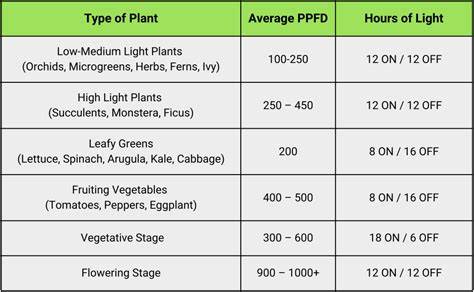
How long a grow light should be on depends on how many hours of 'good light' a plant also gets from natural sources. Yes, you can run grow lights day or night, but having grow lights mimic daylight hours will give you better results. About 12 to 16 hours light with a rest period of at least 8 hours darkness is an ideal balance for most indoor plants. Plants need both light and darkness but how much of each they need varies by species. To grow, photosynthesis has two biochemical processes, light reaction and dark reaction. Keeping lights on 24/7 can cause stunted growth or plant tissue to die in some plants.
Light quality, quantity, and timing
Another factor that helps determine the distance a grow light should be from plants, is the beam angle. Beam angle means how wide an area the light covers (without a shade). A wider beam angle is a good option for using in lamps and desktop lights, as it can go closer to plants, around 30 to 120cms away. Lux tells you how intense a grow light is, which helps you know how close or far away your grow light should be from your plants. Lumens and lux both refer to light intensity as it is perceived by our eyes. Kelvins measure the colour temperature. The higher the Kelvin, the whiter or more blue the light becomes. A lower Kelvin will be more yellow, orange or red. A cloudy sky measures around 6,000K. Direct Sunlight is 4,800K. Light bulbs below 2000K would appear similar to candlelight, are dimmer and more yellow. 2000 to 3000K is a soft white with a yellow appearance like you might use in a bedroom or lounge. 3100 to 4000K is better for task lighting like kitchens and offices. 4600 to 6000K is closer to the blue-white light of daylight, where bright illumination is needed, or when you want something lit naturally similar to the way it would be outside.
Can you use LED grow lights with power point timers? Yes, if your grow light does NOT come with a built-in timer, you can usually get yourself a power point timer, also called a plug-in timer, and set when your lights turn on and off automatically. These start around $10 and are easy to find at hardware stores like Mitre 10 or Bunnings. If the light you’re looking at is a bulb rather than a plug-in light, then the fitting matters. The E in E27 means Edison Screw and the 27 tells you the diameter (27mms). E27 gives you the biggest range of lamps and other light fittings compatible with your grow light. The list of available lamps that fit E27 grow lights changes all the time, especially with the cheaper lighting that retailers don’t have as permanent stock items. Lumens measures visible light from a light source and tells you the intensity of the light. One lumen equals one candle. One foot candle (FC) is 10.76 lumens. More lumens isn’t always better. The brighter the light is, the higher the lumens. With fluorescent lights wattage was a good way to judge brightness. A 100 watt florescent is brighter than a 60 watt. But with LEDs lower wattage can produce more light than a higher wattage fluorescent. A better guide to help you judge brightness is the PPFD. Most suppliers don’t tell you the PPFD for a light, however you will often be given the PAR. PPFD and PPF are measured in micromoles. Watts alone won’t tell you how much power a grow light will use, as how energy efficient the light source is also factors into energy use. LED lights are much more energy efficient than other light sources. One 60 watt bulb left on for 24 hours will cost around 20 cents per day depending on your rates.
What to measure and why
The first set of numbers is the Minimum for Maintenance (MM). For most indoor settings, aim for at least the Good Growth level. Note that FC varies based on the type of light source. The chart below is based on sunlight requirements. Also keep in mind this guide gives you the average requirements per species. Yes and no. Provided it’s a new generation LED, at the higher brightness and intensity you might use to light a shop or for task lighting like a kitchen, then yes, some LED lights can be enough to grow low-light plants like seedlings, Peace Lily, ZZ and other low-light tolerant species. Use the Plant Species Lighting Guide above to get an idea of low-light tolerant plants.
Optics, IP ratings, and safety
Optics direct light towards your plants, increasing light intensity. Imagine optics a bit like a hose. Turning the nozzle can change both the area the water covers and also how strong the spray is. Turn one direction and you might get a very fine spray that covers a broad area. Turn the other way to get a single jet with much stronger water pressure that wets a smaller area. Optics work in a similar way to change the coverage (beam angle), and intensity of the light. LEDs with no optics would have a broad 180 degree beam, light up more plants, but with weaker light intensity. Primary optics reduce the beam angle, with 90 degrees being common. Secondary optics create a narrower beam, focusing the light to a smaller beam angle, meaning more light reaches the plants, and the light reaches further down. Wide beam angles are more popular to cover more plants from further away, such as for greenhouses.
IP stands for Ingress Protection which basically tells you What can get in? A light’s IP rating will give you 2 numbers, such as IP20. The first number tells you the protection against solids. The rating for liquids goes from 0 to 8. The highest liquid rating of 8 means the light can be submerged under water deeper than a metre and for long periods of time, also called 'water-proof'. Grow lights for indoor use tend to be rated from IP20 to IP40. That’s a 2 to 4 for protection against larger solids only, and 0 protection against water. Keep in mind grow lights need airflow. Safety first: Always turn lights off at the wall BEFORE touching a bulb. Even a bulb rated waterproof should not be touched if the electricity is on. If a bulb is waterproof, the last number in the IP rating will be a 6 or above. 0 has no special water protection. 6 can withstand high-pressure, heavy sprays of water (this would be the rating you’d need for above a shower). The IP rating for water, does not relate to humidity or moist environments. When using any bulb in a high humidity environment, ensure there is adequate airflow. If you are concerned your bulb is wet, turn off the power in the house before handling.
I do sell grow lights but I am not an electrician, so do recommend you get professional advice when choosing lights for different uses. It’s a common myth that LEDs can’t damage plants. This comes from comparing fluorescent lights to LED lights. However LED grow lights still produce some heat. Not typically enough to cause damage to plants, but running hot can still damage the light itself. LED grow lights are normally designed so heat exits to the back or top of the light, away from plants. If you have your plants too close to your LED grow light, you may see yellowing or browning on leaves. How close is 'too close' depends on your plant’s tolerance for bright light, which is why there isn’t one rule for all lights or all plants. Follow the distance guide the supplier tells you, or start at least above 30cms away from plants, then adjust from there according to your plants individual needs.
Product context and historical perspective
A grow light is an electric light that can help plants grow. Grow lights either attempt to provide a light spectrum similar to that of the sun, or to provide a spectrum that is more tailored to the needs of the plants being cultivated (typically a varying combination of red and blue light, which generally appears pink to purple to the human eye). Outdoor conditions are mimicked with varying colour temperatures and spectral outputs from the grow light, as well as varying the intensity of the lamps. Depending on the type of plant being cultivated, the stage of cultivation (e.g. Grow lights are used for horticulture, indoor gardening, plant propagation and food production, including indoor hydroponics and aquatic plants). The inverse-square law governs how intensity falls with distance, a serious hurdle for indoor growers, and many techniques are employed to use light as efficiently as possible. Reflectors are thus often used in the lights to maximize light efficiency.
Today, the most widely used lights for professional use are HIDs and fluorescents, while LED technology has been introduced to provide spectra tailored to plant needs. Metal halide lights are regularly used for the vegetative phase of plant growth, as they emit larger amounts of blue and ultraviolet radiation. With the introduction of ceramic metal halide lighting and full-spectrum metal halide lighting, they are increasingly utilized for both vegetative and reproductive growth stages. High-pressure sodium lights are also used as a single source of light throughout the vegetative and reproductive stages. In recent years LED technology has been introduced into the grow light market to produce specific wavelengths of light. NASA has tested LED grow lights for their high efficiency in growing food in space for extraterrestrial colonization. A large number of plant species have been assessed in greenhouse trials to ensure plants have higher quality in biomass and biochemical ingredients. The diodes used in initial LED grow light designs were usually 1/3 watt to 1 watt in power, but higher wattage diodes such as 3 watt and 5 watt are now commonly used. For highly compacted areas, COB chips between 10 watts and 100 watts can be used, though heat dissipation can affect efficiency. LED grow lights are often priced higher, watt-for-watt, than other LED lighting, due to design features that help them be more energy efficient and long-lasting, and they frequently include cooling systems to maintain performance.
In sum, the modern choice among indoor growers blends spectral control, energy efficiency, and practical considerations like distance, beam optics, and environmental conditions to optimize plant growth across species and stages.
- Evaluate spectral needs ( PAR range 400-700 nm ) and plant species requirements.
- Assess light quality metrics (PAR, PPFD, PPF, CRI) and color temperature (Kelvin).
- Set appropriate distance and beam optics to maximize coverage and intensity.
- Consider IP rating, safety, and airflow in humid environments.
- Choose compatibility with timers and power solutions for consistent photoperiods.