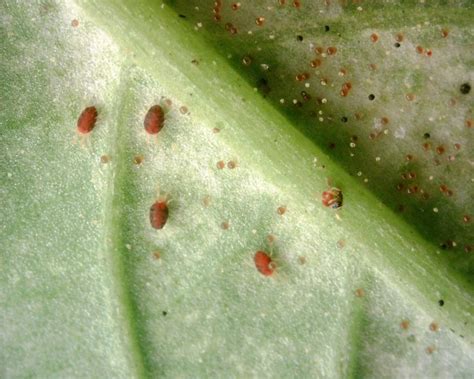
Spruce spider mite (Oligonychus ununguis) is an arachnid pest notorious for causing extensive damage to coniferous trees, particularly spruce trees. The primary host for the spruce spider mite is spruce trees, particularly the Colorado blue spruce. The spruce spider mite is a widespread pest found across the United States and Canada. Adult spruce spider mites are oval and generally measure less than 1/50th of an inch in length, making them very difficult to see without magnification. One distinctive characteristic of the spruce spider mite is its ability to produce silk-like webbing. This webbing can sometimes be spotted on the needles and branches of infested trees, especially with a large mite population.
Identification and early symptoms
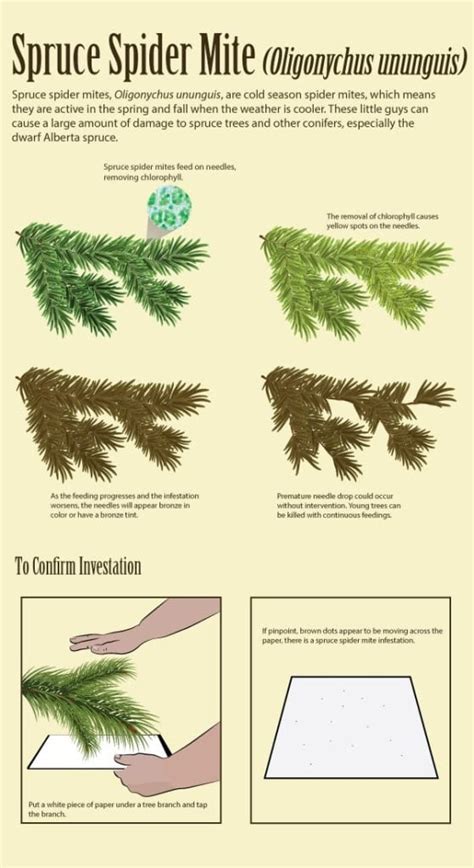
The first indication of spruce spider mite damage is an off-green color, mottling, or stippling of the needles; damaged needles turn yellow, bronze, or mottled as feeding continues. They pierce plant tissues with their mouthparts and suck the fluids within, leaving a pattern of light-colored spots on needles. Fine silk webbing may also be present, especially in severe infestations. A simple detection technique is to place a white piece of paper underneath branches and gently shake or tap; mites will fall onto the paper if present. In mild cases, periodic water hosing can help reduce populations, but care must be taken to reach undersides of needles where mites often reside.
Life cycle and biology
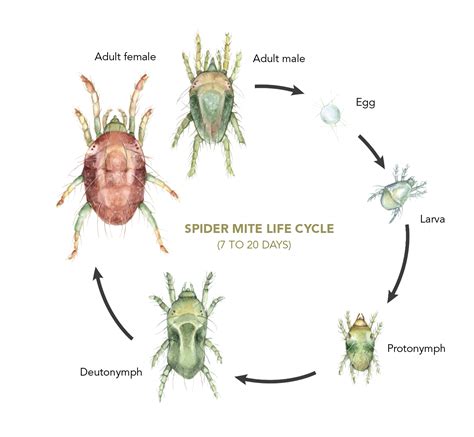
The life cycle of the spruce spider mite consists of four primary stages: egg, larva, nymph, and adult. Eggs overwinter on host trees, particularly on the undersides of needles, and hatch as temperatures rise in spring. Larvae are six-legged, and after feeding they molt into nymphs, which resemble miniature adults but are not yet sexually mature. Deutonymphs molt into adults. The spruce spider mite has a reverse dormancy pattern compared to many other mites. The entire life cycle from egg to adult can take as little as two weeks under optimal conditions, varying with temperature and other environmental factors. There are 7-10 generations per year in many regions.
Spruce spider mites are cool-season mites that primarily attack spruce trees but also infest other conifers such as fir, hemlock, pine, and arborvitae. They overwinter as eggs in bud scales or on needles and bark, and hatch in spring; young mites are pale green and darken as they mature. Adults are green to brown with eight legs, while the young have six legs. The mites feed by puncturing plant tissue and sucking fluids, causing speckling and discoloration on needles. In severe cases, twig dieback and needle drop can occur.
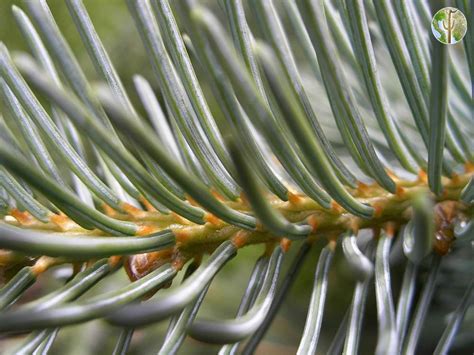
Additionally, eggs are small (orange to red in overwintering), and hatch timing often aligns with bud break in spring. On some hosts, eggs may overwinter at the base of needles or beneath buds, enabling rapid population increases when conditions warm.
Host range and damage
While the spruce spider mite prefers spruce, it also feeds on arborvitae and other conifers such as Douglas fir, Fraser fir, hemlock, juniper, pine, and larch. Feeding causes stippling, yellowing, and bronzing of needles, often beginning with older inner needles. In heavy infestations, heavy needle drop and branch dieback may occur, leaving unsightly or dead areas on the plant. Fine silk webbing may cover needles, particularly with large populations.
Because the mites are tiny (about 0.5 mm or 1/50 inch) and active mainly in cooler seasons, detection requires careful inspection and sometimes magnification. A healthy tree is generally more resilient to mite pressure, underscoring the importance of early detection and monitoring.
Monitoring and detection strategies
- Regular inspections in spring and fall when mites are most active. Look for stippling on needles and fine webbing.
- Monitor by tapping branches over a sheet of white paper to see if mobile mites fall off.
- Check for beneficial mites and insects, which can help suppress mite populations.
- Note that spraying with broad-spectrum insecticides can kill natural enemies and worsen outbreaks; preserve beneficial predators when possible.
Beneficial enemies include predatory mites, lady beetles, lacewings, and minute pirate bugs. If beneficials are present, they often provide effective biological control, and indiscriminate pesticide use can disrupt this balance.
Integrated management and control options
Strategies 1-3 and 5 are strictly organic, though all approaches should follow label directions and be appropriate for the specific site and tree.
- Regular washing with a strong stream of water dislodges mites and eggs from foliage; perform early in the morning when mites are less active. Repeat for 3-4 consecutive days if necessary.
- Insecticidal soaps or horticultural oils can suffocate mites and their eggs with thorough coverage, especially on undersides of needles. These options are generally less harmful to beneficial insects than traditional miticides.
- Neem oil disrupts mite life cycles, and pyrethroid-based pesticides kill on contact; these can be used later in the season when mite populations decline, if needed.
- Dormant oil sprays in mid-winter smother overwintering eggs; these are especially useful following severe fall infestations.
- Miticides (acaricides) may be required for severe infestations; apply in spring or fall when mites are most active, and rotate among chemical classes to reduce resistance development.
When using any pesticide, ensure product effectiveness against spruce spider mites and consider rotating chemical classes to maintain efficacy and preserve natural enemies. A targeted, timing-based approach-focusing on eggs in spring and fall when populations surge-tends to be more successful than broad, repeated applications.
Practical recommendations and notes
In general, focus on maintaining tree health to reduce susceptibility to mite attack. Watering stressed trees can help, as stressed trees are more attractive to mites. If the problem exceeds homeowner capabilities, consult a certified arborist or a qualified pest management professional for a site-specific plan, which may include pruning, targeted miticides, or enhanced monitoring.
Some regional considerations include that spruce spider mites are more active in cooler seasons and that overwintering eggs can persist through winter conditions, resuming activity in spring. It is not always practical to attempt complete eradication; the goal is to manage populations to sub-damaging levels and maintain tree vigor.
Notes on terminology and regional context
The species is sometimes referred to as Oligonychus ununguis, with some sources listing spelling variations; it is a well-documented, cool-season mite affecting a broad set of conifers in North America.
For professional assistance and tailored management, professionals are available to evaluate infestations and implement a plan that preserves tree health while reducing mite pressure.
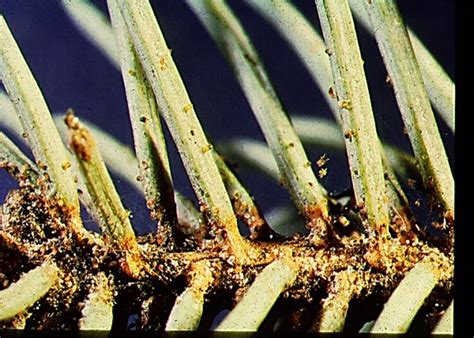
Table: quick reference for control options
| Control option | When to apply | Notes |
|---|---|---|
| Water wash | Spring; repeat 3-4 days | Physical removal; least disruptive |
| Insecticidal soap / horticultural oil | Early to mid-season; after monitoring | Thorough coverage; safer for beneficials |
| Neem oil | Mid to late season | Disrupts life cycle; integrate with other methods |
| Pyrethroid-based pesticides | Late season if needed | Effective on contact; can harm beneficials |
| Dormant oil spray | Mid-winter | Smothers overwintering eggs |
| Miticides (acaricides) | Spring or fall; when populations are active | Rotate modes; target multiple life stages |
Monitoring remains essential: check for eggs and mites on branches, inspect needle underside, and assess overall tree vigor. If you notice widespread damage or rapid population growth, consider professional guidance to implement an integrated plan that protects tree health while reducing mite numbers.