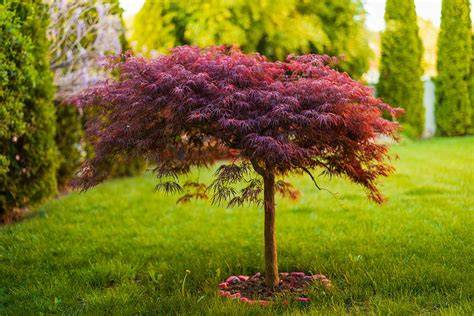
Japanese maples are renowned for their stunning beauty, graceful form, and vibrant foliage, making them a popular choice for gardens worldwide. Among the many varieties of Japanese maples, the weeping dwarf varieties stand out for their unique, cascading growth habit and compact size. These miniature trees provide an elegant touch to any landscape, whether planted in containers, used as focal points in garden beds, or planted alongside other plants for visual contrast.
The Weeping Dwarf Form: Cascading Beauty in Compact Size
Weeping Dwarf Japanese Maples are a subset of Acer palmatum that feature a distinct growth pattern. These trees have a naturally weeping or cascading form, with branches that gently droop downward, creating a soft, flowing silhouette. This growth habit makes them a standout in gardens and landscapes, where they provide visual interest and focal points. Additionally, their compact size makes them well-suited for smaller spaces like patios, courtyards, and small gardens. These trees typically have slower growth rates and maintain a manageable height, which is perfect for those who want the beauty of a Japanese maple without the commitment of a large tree.
Graceful, Cascading Form and Compact Growth
The defining feature of weeping dwarf Japanese maples is their cascading branches. Unlike other maples, which grow upward and outward, these trees have branches that cascade downwards in a graceful fashion, often giving them a more delicate appearance. Weeping Dwarf Japanese Maples are compact in size, remaining smaller than their standard counterparts. This makes them perfect for gardeners with limited space. They also have slower to moderate growth rates, meaning they don’t require frequent pruning or maintenance, and on average they grow about 6-12 inches per year depending on cultivar and growing conditions.
Popular Varieties: Color, Form, and Habit
There are several notable weeping dwarf Japanese maples, each offering distinct characteristics and color palettes. These varieties provide a range of foliage shapes, from highly dissected lace leaves to broader star-shaped forms, with colors spanning greens, reds, oranges, and purples across seasons.
- Acer palmatum 'Crimson Queen': a popular weeping dwarf with vibrant red foliage; deep burgundy to crimson in spring and summer, turning brilliant red in fall. Cascading habit adds dramatic color and elegance to landscapes.
- Acer palmatum 'Waterfall': feathery leaves that shift from green in spring to yellow and red in fall; more open structure with branches spreading horizontally before weeping downward.
- Acer palmatum 'Red Dragon': deeply lobed, red-purple leaves; fall foliage bright red; compact for a dwarf variety, often around 4 feet tall and 5 feet wide; tolerates sun in some climates but appreciates some shade in hotter areas.
- Acer palmatum 'Tamukeyama': deep red-purple foliage in spring and summer with red fall tones; cascading branches ideal for hanging over walls or as focal points; grows to about 6 feet tall and 10-12 feet wide, with moderate growth rate.
- Acer palmatum 'Viridis': green lace-leaf with light green spring foliage darkening through summer to yellow-gold in fall; typically 4-6 feet tall and wide, handling some sun but preferring partial shade.
- Acer palmatum 'Garnet': red color that persists into summer in many climates; weeping dwarf habit forming a mound, about 6 feet tall and 6-8 feet wide; tolerates full sun in warmer areas.
- Acer palmatum 'Crimson Queen' (重复): noted for its extended red color and pendulous habit; with a mature height of 4-6 feet and width of 6-8 feet; thrives with some shade in hotter climates.
- Acer palmatum 'Waterfall' (重复): another highly regarded lace-leaf cultivar with cascading growth and green-to-bronze fall color.
- Acer palmatum 'Ryusei': extremely pendulous with palmate leaves; often used as a striking ground-cover or container cascader; zones 5-9; good sun or shade tolerance depending on climate.
- Acer palmatum ‘Golden Falls’: yellow foliage with a dramatic weeping habit; fully palmate leaves unlike many lace-leaf varieties; best in partial sun, zones 5-9.
Other noted cultivars include 'Orangeola' with orange-tinged green spring foliage that matures to red tones; 'Red Dragon' with persistent red hues through heat; 'Tamukeyama' noted above for its depth of color and cascading form; 'Waterfall' and 'Crimson Queen' provide a spectrum from lime-green to crimson, each offering a distinct silhouette and color journey throughout the seasons. Some varieties such as 'Germaine’s Gyration' exhibit unique inner branching patterns with a mound-like outer form, while 'Ryusei' emphasizes a true pendulous canopy that nearly forms a cascading curtain.
Care Essentials: Light, Soil, Water, and Pruning
Weeping dwarf Japanese maples are relatively low-maintenance but thrive best when given particular conditions. First, they do well in partial shade to full sun, though full sun is tolerable in cooler climates. In hotter climates, filtered sunlight or light shade during the hottest part of the day helps prevent leaf scorch. Each variety has its own sun requirements, so observe individual performance for best results.
Soil should be slightly acidic to neutral with good drainage. If your native soil is heavy or clayey, consider planting the tree elevated to improve drainage. Mulching around the base helps retain moisture and regulate soil temperature. Water needs are moderate; regular watering is important, especially during dry spells, but avoid waterlogging. A thorough watering once per week is a common guideline, ensuring the soil stays moist but not soggy.
Pruning is generally light; most weeping dwarfs respond well to minimal shaping. Remove dead or damaged branches in late winter or early spring to maintain a clean silhouette, but avoid heavy pruning that may disrupt the cascading habit. For container plantings, choose a 24-inch decorative pot with good drainage, use acidic, well-draining potting mix, and water regularly since container plants rely on you for moisture. Mulching and consistent watering are key for container-grown maples as well.
To establish a healthy root system after planting, backfill with native soil, water slowly to remove air pockets, and maintain a mulch layer around the root zone. If planting multiple cultivars, group trees with similar care needs together to simplify maintenance and ensure uniform growth conditions.
Planting and Establishment: Quick Planting Guide
- Choose a site with partial shade to filtered sun and ensure well-drained, slightly acidic soil.
- Measure the root ball depth and dig a hole that depth, but twice as wide; backfill with the original soil line to accommodate root growth.
- Gently remove the tree from its container and loosen the roots; set the tree in the hole to check depth before planting.
- Backfill to the original soil line, then saturate slowly with a gentle hose flow to remove air pockets and hydrate the roots.
Because of their compact size and slow growth, weeping dwarf maples can be excellent focal pieces in landscapes, courtyards, and containers. They combine the elegance of traditional Japanese maples with an adaptable habit that suits a variety of spaces and design styles.
Historical and Aesthetic Context
Dating back to the 7th century, Japanese maples (Acer palmatum) have long been celebrated as living works of art. They fuse grace, color, and texture to transform ordinary gardens into serene sanctuaries. Today, hundreds of varieties exist, each with its own personality. Each season tells a different story: spring lace leaves in chartreuse, crimson, or coral; summer hues deepening to burgundy, bronze, or green; and autumn foliage blazing in scarlet and gold. Weeping and lace-leaf forms amplify this narrative with cascading branches and finely dissected leaves that delight year after year.
When selecting a cultivar, consider your climate, sun exposure, and space. For hotter climates, some cultivars perform better in partial shade or container environments. Pruning should be approached with care to preserve the natural cascading habit and delicate leaf structure that make these maples so beloved.
Practical Notes and Cultivar Spotlight
Acer palmatum 'Tamukeyama' is a standout for its red-to-crimson palette and graceful cascading habit, reaching about 6 feet tall and spreading 10-12 feet wide. It is well-suited for focal points where its color can draw the eye. 'Crimson Queen' is another iconic choice, valued for early-season red color that can persist with some shade in hot climates. 'Waterfall' offers a lighter, more open cascading form, while 'Garnet' emphasizes a robust deep red hue that holds through warm periods. 'Ryusei' and 'Golden Falls' showcase extreme weeping habits with unique leaf morphologies-palmate or dissected-adding variety to a mixed border or container collection.