Junipers, as part of the Cypress family, hold both functional and aesthetic value in a garden as well as in the landscape. With their resiliency, Junipers adapt and survive an array of climates. A dualistic pain point of let's say an awful blessing, is how Junipers flourish in a scarily fast manner. As the name suggests, Juniper shrubs do benefit from trimming. Not only does trimming help functionality, but it also improves the appearance of the Junipers.
Before any cut, the very first step of trimming a Juniper shrub is making an assessment. Are there branches that are dead? Overgrown? Misplaced? Having these minutes in line is the first step to the proper upkeep of your shrub. Make sure to check your shrub multiple times a year. You will need handheld pruning shears or long-handled loppers to trim the plants. Shrub Junipers are not the only plants that you can trim to 45 degrees. Make sure that all the limbs are cut at a 45-degree angle.
You can begin by cutting the dead or exposed branches. Like many evergreens, Junipers are able to produce new growth at any time of the year. New shoots that are green are most vulnerable because they can be pinched completely. Once you've done cutting the adolescent and dead portions of the shrub, start focusing on pruning it to your desired shape or look. Excessively grown Junipers can be very tricky. Cutting the shrub down to size and not maintaining it properly can cause the shrub to look barren and unkept due to a lack of new growth.
Key Tip: During cutting, no more than 25% of the entire shrub can be cut down. Have in mind that junipers should not be able to grow from the limbs in the middle or from the areas that have no greenery. Because they grow quickly, Junipers lend themselves well to the creation of topiary or neatly manicured hedges. Year 3: In the third season, you may begin to shape the shrub into your desired form. For a uniform shape, use a large rectangle of cardboard as a template.
Shaping a shrub is only half the work. Less is More: An over-pruned plant will look unnatural, and pruning too much at once is more stressful. Retain the Natural Shape: Having too many straight edges, as well as being boxy or bulbous, is a very unnatural shape for junipers. Inspect Regularly: Junipers in excellent condition do not become overgrown, and a little pruning each season is more effective than waiting for the plant to become large.
Although Junipers are beautiful and simple to care for, they are not the only shrubs that are great for landscaping. Boxwoods: These evergreen shrubs are ideal for formal hedges and topiaries. Need Experienced Advice? For any gardener or even beginner are free to access true passion works filled with proper guidance and stiff of our caring. For example, we care for junipers, planting start, or other shrubs. Everything ranges for wide options with domains like landscape designing. One can access it online or visit for planting shrubs and nurturing them.
Juniper bushes that are overgrown can be difficult to control. When dealing with very large shrubs, the best approach is to trim the shrub over a number of stages. Do not take off more than a quarter of the shrub at any one time, as over-trimming can create unsightly, sparse patches. Juniper shrubs can take a lot of chopping. But with every shrub, there is a limit to what is healthy for the plant. Take care not to cut too much at once, especially towards the center of the shrub or where there are bare branches. When chopping off the pieces, also remember to keep the natural shape of the shrub, so that it doesn't look too uneven. Before winters arrive, we must take a few steps to prepare the shrub so it can survive the winter. The first step is watering the plant. It is best to water it before the temperature begins to freeze so as to give the roots some time to absorb water. The second step is to cut off any dead or damaged branches a plant may have. Juniper shrubs are capable of regrowing on the condition that they are properly pruned.
If, however, a shrub is cut down to the center, or below the center, it will not be possible for that shrub to regenerate from there. Juniper plants, aesthetically pleasing as they may be, have a few downsides. First, if they were left unmanaged, they may be invasive, since they do grow at a pretty rapid pace. Then, some of the species may have aphids and spider mites. Bushes of juniper can outlive their owners, and some species even reach half a century if taken care of. Like most other plants, a juniper bush is dependent on the environment, care, and growing situations. If one of those is neglected, the bush would die sooner than expected.
Asked November 07, 2025, 12:19 PM EST I have some "Sea of Gold" junipers that are said to grow 3 ft tall and 4 ft wide. These were planted by previous owners but were still young when I moved in. They have reached about 8 ft wide and I was wondering if I can trim the juniper and how? The plant is thick and I can't get my legs very far in between the limbs. I can't reach the weeds growing up from the center of the plant. In some areas they are taking over the garden and are dominating the other plants. I can't physically dig them out and need my money for other projects that need fixing. Thanks. Wood County Ohio
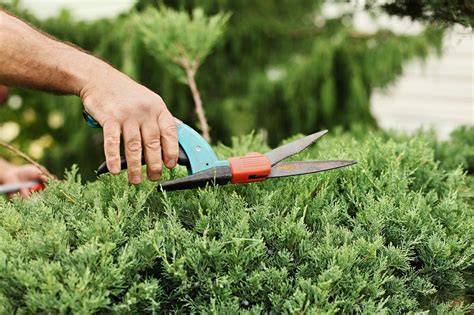
Expert Response: Thank you for your question about pruning back your juniper plants. This is a classic situation of right plant-wrong spot. Unfortunately, the junipers will keep growing larger in the coming years. However, they do respond well to pruning. Junipers are best pruned when the plant is pushing new growth in spring. They are among the conifers that do not form new buds on old growth, so avoid cutting back to brown older stems. (This is called the dead zone, and is an area where new growth cannot occur. If you prune into it you will have unsightly dead-looking areas in your shrubs.) Prune only on new growth, snipping the branch tips, unless entire branches will be removed to the base. To head the plants back, you can make cuts back toward the center of the plants, making each cut just beyond a new branch or at the trunk. Because they lack the dormant buds that broad-leaved evergreens such as hollies have in abundance, narrow-leaved evergreens such as junipers can’t be pruned heavily. In general, most narrow-leaved evergreen trees and shrubs need little pruning. They should be pruned in a way that will maintain their natural form. To retain this shape, prune individual stems rather than shearing the plant. Always make your pruning cut to an upward-growing side branch--this type of pruning is called a "thinning cut." It affords improved light penetration but doesn't stimulate heavy branching. Rules for pruning narrow-leaved evergreens are quite different those for pruning other evergreens such as hollies. Many broad-leaved evergreens can tolerate severe renewal pruning. It’s hard to kill plants such as privet or hollies by cutting them to the ground--they simply sprout back from the dormant buds. Junipers and other narrow-leaved evergreens will not come back after this type of pruning. If you must prune narrow-leaved evergreens, you should start when they are small--usually the second year after they are planted. Pruning a little each year can keep the plants healthy and in their allotted space for many more years than would be the case if they were left unpruned. That being said, you can save yourself a lot of work and expense by spending a little time researching the mature size of the plant you have in mind to plant in your garden.
Junipers aren’t as forgiving as some plants when it comes to pruning. We link to vendors to help you find relevant products. While these plants are notoriously low maintenance, when trimming up is necessary, it’s important to do it right. First, let’s get the bad news out of the way. The goal of taking the trimmers to your plant is to encourage bushier growth, remove dead wood, or create some shape. Now, if you want to shape your shrub into a topiary or other formal shape, that’s a different subject. Technically, as long as the temperature isn’t below freezing, you can prune at any time of year. Early spring or late winter is best. You want to try to break out the secateurs before the tender new growth forms. The method you’ll use depends on the size of the branch you are cutting. Whichever you use, don’t cut beyond the branch collar. The second cut should be made from the top side. About half an inch out from the lower cut, saw down through the branch about halfway at an angle, so you meet your undercut. Finally, saw away the remaining stump, taking care not to cut past the branch collar. If you trim back a branch beyond where the needles are growing, hoping to encourage branching, it won’t work. You should also remove any branch that doesn’t have needles on it. Regardless of how many branches you remove from the plant, avoid pruning the central trunk, which is known as the leader. Plants with multiple leaders tend to be weaker and are susceptible to damage from wind and heavy snow. Remember that junipers are slow growers, so don’t prune too much all at once. This is particularly true of plants in growing shadier spots. There’s no need to seal the end of the cuts. First, shearing the plant isn’t the way to go about it.
Juniper is a beautiful plant that you can find virtually anywhere once you know what to look for. Juniper is a coniferous plant belonging to the cypress family. It is a very common plant used in landscaping as garden hedges, hill coverings, and property barriers, to name just a few. Some juniper are low-laying creeper versions, while others are standalone bushes. For many plants, years of no pruning may not be an issue; chop them back when you get to it and it will grow back, similar to a haircut. Juniper is beautiful in appearance and has a wonderful, refreshing scent, so I would love to keep the bushes around if possible. Juniper also has many wonderful uses that make it a beneficial plant to have in your backyard. Juniper berries can also have a variety of uses from cooking, to healing salves, to essential oils. Juniper bushes are extremely dense plants that grow relatively quickly, which means a Juniper will typically have a dead center. Sunlight cannot reach the center of the plant causing the branches in the middle of the plant to brown and die. Unfortunately, as the plant grows, so does the dead center. Once the dead center grows, you will only be able to prune the plant back as far as the live branches begin.
Pruning the bush into the dead center will cause the bush to have large dead spots which will never grow back. In addition to being beautiful and having a variety of uses, it is also a very hearty plant that will grow with little care, which is one of the reasons it is so commonly used in landscaping. We have a creeping juniper plant as a hill cover in our backyard. Due to its heartiness however, it is very hard to weed and is also an inviting place for black snakes to hang out. We have a huge juniper bush which has been neglected for years. It measures approximately 10 feet wide and 7 feet tall. The dead zone is pretty much larger than the new growth at this point. Unfortunately, no amount of pruning can return the bush to a manageable size. Aside from a few of these overgrown bushes, we also have some in areas which require frequent pruning that we do several times a year. We have some lining a small pond on the property, as well as lining the road in front of our home. Early spring is the best time for us to focus on pruning the juniper bushes that line our driveway. We will also prune them back in early fall. Start from top to bottom, tapering down to maintain shape. Make sure to frequently check for pests that can be destructive to juniper bushes. One of the major ones that we have experiences are bagworms. Image above shows Juniper branch’s new growth extending from older, woody section. Juniper is a lovely plant with many benefits and uses.
“Don’t kill your Juniper Bonsai” : “A Step-by-Step Seasonal Guide”
Stephanie Leaf is transforming her family’s Maryland home into their homestead dream property. She and her husband own a masonry business and do the majority of the renovation projects themselves, with plans to expand their garden, cultivate herbs, build a chicken coop and involve their children in every aspect of self-sufficiency. All MOTHER EARTH NEWS community bloggers have agreed to follow our Blogging Guidelines, and they are responsible for the accuracy of their posts. Juniper shrubs and trees are a great asset to landscaping. They can grow tall and eye catching, or they can stay low and shaped into hedges and walls. They can even be formed into topiaries. Sometimes, though, like the best things in life, they get away from us. So, what can you do with a juniper that’s gotten out of hand? Keep reading to learn more about how to prune an overgrown juniper.
Pruning Unruly Junipers: Can you prune an overgrown juniper? Unfortunately, the answer to this question isn’t a definite yes. Juniper trees and bushes have something called a dead zone. This is a space toward the center of the plant that doesn’t produce new leafy growth. As the plant gets bigger and thicker, sunlight is unable to reach its interior, and the leaves in that space fall off. This is completely natural, and actually the sign of a healthy plant. Sadly, it’s bad news for pruning. If you cut back a branch below the leaves and into this dead zone, no new leaves will grow from it. This means that your juniper can never be pruned smaller than the border of its dead zone. If you keep up with pruning and shaping as the tree or shrub grows, you can keep it compact and healthy. If you try to attempt overgrown juniper pruning, you may discover that you just can’t get the plant down to a size that’s acceptable. If this is the case, the only thing to do is remove the plant and start again with a new one.
While overgrown juniper pruning has its limits, it is possible to trim your plant down to a more manageable shape. One good place to start is the removal of any dead or leafless branches-- these can be cut off at the trunk. You can also remove any branches that are overlapping or sticking out too far. This will give the remaining healthy branches more room to fill out. Just remember-- if you cut a branch past its leaves, you should cut it off at its base. I need advice regarding 2 huge towering conifers (I believe they would be junipers) that are probably at least 40 years old. These have grown way out of scale for the urban garden they inhabit and will continue to grow taller and top-heavier over the years. I don't have a picture but the base of the trunks are at least a foot in diameter and are about 30-40' tall. They grow in a distinctly flame-like shape - narrow at the base, widening in the middle (est. 10' W) and narrowing again at the top. The only pruning I've ever seen on this type of conifer is horrible -- usually they are just cut in half and end up looking like a wide mouth vase or coffee cup.
The owner prefers not to remove them but to reduce them in size by to about 1/2 current height. Is there any way to prune this type (and vintage) of conifer so that it will regrow in the same flame shape from a drastic cutting back position? Like most dense conifers, as soon as you cut into the outer green layer it is dead brown needles inside. The pruning you are seeking might be what arborists refer to as crown reduction, removing leaders by cutting down inside the canopy so subordinate leaders become the new tops. It's not crew-cut topping. If done properly, it works well. And you probably don't want to remove more than about 1/4 of the foliage. Hope so. If it is not feasible, the choice comes down to either removing them completely or leaving them as is and trying to maintain them at the present scale. This is not renovation pruning of a broadleaf shrub, where you take out 1/3 of the top over a three year period and the plant readily and vigorously bounces back from the roots.
Any form of taking a big chunk out of a developed evergreen conifer is liable to have a severe impact on its health and on its appearance. Hollowing out the center of the top of a 40' conifer and leaving most of the outside still in place is a facade, like clear-cutting all of a forest except the part that faces the highway. If these are in fact the fast-growing Leyland cypress 30'-40' is not a large specimen, ones 90' tall are known in Seattle with more than 100' having been seen in UK. If they are instead something slower-growing like Sawara cypresses or junipers they could be comparatively old, making cutting a big section out of them more of a travesty. Thanks Ron. My inclination at this time is actually to leave them be (with a program of "stay in place") which I'll be recommending to the client. I really don't want to be party to anything that would leave them mortally and/or esthetically ravaged.