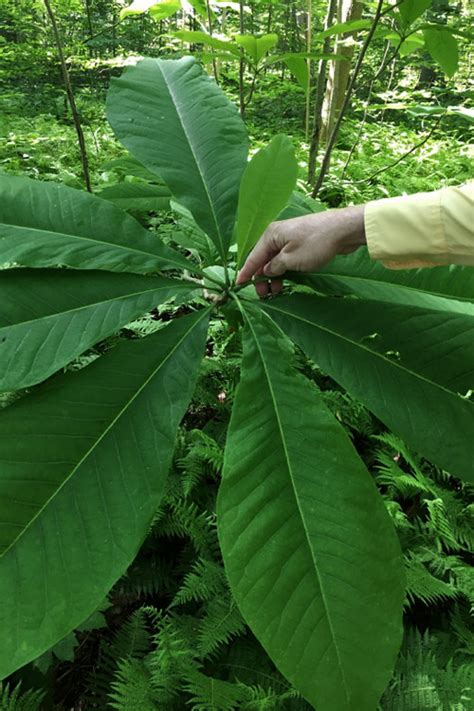
The Umbrella tree magnolia gets its common name from its tall stature and extremely large leaves (10 to 24 inches long) that form clusters at the ends of branches, which may resemble an umbrella. It is a North American native that can be found in moist woods but is also used in cultivation for the bold texture of its leaves. Members of the genus Magnolia are known for the stunning beauty of their usually large flowers, which emerge prior to the foliage in spring, and are often fragrant.
Botanical characteristics
While shades of pink are the most common bloom color, the Magnolia palette also includes white, yellows, and purples. Another dominant feature is a prominent fruiting body of small follicles forming a cone-like shape. Magnolia tripetala L. is described as a flowering, medium-sized tree or large shrub typically reaching a mature height of 30 feet with a 30 foot spread, although some may grow to 45 feet high. The very large leaves appear in whorl-like clusters at the end of stems and resemble the spokes of an umbrella, hence the common name. The alternate leaves may be up to 2 feet long.
Leaves, flowers, and fruit
The 10-inch flowers are bowl-shaped and creamy white and bloom in the spring. The 4 to 6 inch long aggregate fruit has a knobby surface. This magnolia also has large, white flowers blooming in April to May, that mature into spires of fruits that split open to reveal seeds with bright red coverings (arils).
Ecology and evolution
Magnolias are an ancient genus that appeared before bees; early pollinators are believed to have been beetles. The Umbrella Magnolia is native to the southeastern United States and found throughout the Appalachian Mountains. It is native to eastern and southeastern Asia and eastern North America, Central and South America; most are not hardy in the Chicago region. Buds and blooms of the magnolias that do thrive here are often subject to damage from cold spring nights.
Habitat and growth requirements
The Umbrella Magnolia is an understory, native tree found throughout North Carolina and surrounding areas, typically growing in organically rich, moist soils. It tolerates close to full shade, but will grow in full sun, particularly in northern climates, as long as soils are kept moist. It does best in partially shaded positions, with consistent watering, and should avoid extremely dry or extremely wet soils. Shallow rooted, it benefits from a layer of organic mulch to encourage a cool root environment and conserve moisture. This plant is a shallow-rooted specimen with a fleshy root system and is best planted in spring.
Size, form, and ornamentality
The Umbrella-tree magnolia is a stout, tall tree with a crown of spreading branches. The very large leaves are arranged in clusters at the ends of long branches, forming a striking umbrella-like silhouette. The flowers, pale and creamy, contribute to a refined texture in garden or woodland plantings. The fruiting cone-like aggregate of small follicles provides additional winter interest as it matures.
Garden uses and care tips
In cultivation, use this magnolia to create a bold textural statement in shade or partial shade gardens. It is suitable for woodland garden schemes, naturalized areas, or as a standout specimen tree. Protect tender growth from late spring frosts, which can damage buds and blooms. Water during dry periods and apply mulch to conserve soil moisture. When planting, select a site that is sheltered from strong winds to prevent tearing of the large leaves and to preserve overall tree integrity.
Notes on related forms and distribution
The genus Magnolia includes about 300 species and numerous hybrids and cultivars. Magnolia tripetala L. is one of several species within Magnolia that share similar floral characteristics but differ in habit and geographic distribution. In some regions, particularly in the United States, the range is described as eastern and southeastern areas, with some references to North Carolina as part of its native distribution.
Practical table: quick references
| Aspect | Details |
|---|---|
| Scientific name | Magnolia tripetala L. |
| Common name | Umbrella Magnolia |
| Height / spread | 15 to 30 feet tall; 15 to 30 feet spread (some up to 45 ft) |
| Leaves | 10-24 inches long; whorl-like clusters at branch ends |
| Flowers | 10 inches; bowl-shaped; creamy white; spring bloom |
| Fruit | 4-6 inch aggregate, knobby surface; cone-like |
| Soil and moisture | Moist, organically rich soil; consistent watering |
| Light | Partial shade; tolerates full sun if moisture kept |
| Hardiness considerations | Not all forms hardy in colder regions; buds damaged by late freezes |
To enhance the article visually, consider infographics on leaf arrangement and umbrella-like canopy, photos of large leaves in whorled clusters, and a diagram of the fruiting cone. Below are suggested media to accompany the text.