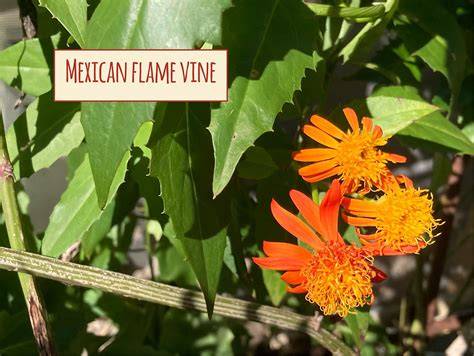
The Mexican Flame Vine is a vibrant variety that is truly "fiery" in its color. This heavy-blooming plant is also drought-tolerant, so it's easy even for plant novices! Plus, this vine has bright orange flowers on gorgeous green leaves for a rainbow of colors. Ready to inject some lively shades and beautiful vines into your home?
Overview and key features
This twining, evergreen sprawling vine has 4 inch long, coarsely toothed, dark green leaves and terminal clusters of orange-red, one-inch, daisy-like flowers with golden centers. Although it appears throughout the year, peak periods of bloom are spring and summer. The quick growth of Mexican flame vine is ideal to add interest to palm trunks, to soften fences, or to veil a trellis. Occasional heading helps some foliage and flowers at the bottom of a fence or other structure supporting Mexican flame vine.
Mexican Flame Vine is a tropical, drought-tolerant, herbaceous, flowering vine in the daisy family that is native to Mexico and South America. It is typically an ornamental with showy bright orange flowers and arrowhead-shaped green leaves. The plant does best in average to organically rich, medium consistent moisture, well-drained soils in full sun. It will tolerate some light shade and short periods of drought once established. Mexican Flame Vine is winter hardy in a narrow range (Zones 9-10) and will likely need winter protection in Zone 8 or be grown as an annual in other zones. Alternatively, it can be potted and overwintered indoors.
Planting and growing conditions
Planting: This plant prefers to grow in well-draining soil. It grows best in full sun but can tolerate some light shade in hot summer climates. The vine's stems root in the soil when they touch the ground. In cooler climates, grow your Mexican Flame Vine as an annual, or overwinter potted plants indoors. This plant is ideal for growing on structures such as fences, trellises, arches, or upright posts.
Growing Mexican flame vines have attractive, dark green foliage that can climb a trellis or other support or cascade over a wall. Leaves are as large as 4 inches (10 cm.) in length and add a lush, tropical feel to the area in which they're planted. When flowers appear, butterflies and hummingbirds will be regular visitors and may be enticed to remain if a water source is provided. Growing Mexican flame vines (Senecio confusus syn. Pseudogynoxus confusus, Pseudogynoxus chenopodiodes) gives the gardener a burst of bright orange color in sunny areas of the garden.
Pruning and maintenance
This plant needs support to grow. Without it, this vine will spread out like a shrub. To control the growth, you can trim the plant back. Pruning as part of flame vine care encourages blooms throughout the plant; those not pruned only flower at the top of the climbing vine. Flame vine care includes trimming the plant back to encourage a new flush of blooms in summer. Fire-vine pruning is often used to maintain shape and keep the plant from overtaking its support.
Blooming, flowers, and pollinators
Mexican Flame Vines are vigorous growers that can quickly cover fences, trellises, and arbors when planted in favorable conditions. Yes, Mexican Flame Vines attract butterflies, hummingbirds, and other pollinators. Their bright orange flowers provide a valuable nectar source throughout the growing season. When it flowers, Monarch butterflies and countless pollinators can’t resist. Peak bloom occurs in spring and summer, though in warm climates flowers can persist longer.
Growth rate and size
Mexican Flame Vines grow quickly in warm weather, producing brilliant orange flowers that pollinators can’t resist. Grown outdoors, the vine will spread to 12 to 20 feet. When grown as an annual, the length is less than 12 feet. The plant is drought-tolerant and fast-spreading, making it ideal for covering structures but needing monitoring to prevent overgrowth.
Environmental requirements and care routine
Growing Mexican Flame Vines have attractive, dark green foliage that can climb a trellis or other support. They tolerate poor soils and rocky areas, though a more profuse display of blooms occurs in organic soils; soil that is too rich may cause the plant to become unruly. The same is true with fertilization, so go easy on feeding as part of flame vine care. Once established in the landscape, caring for Mexican Flame Vines is low maintenance. The plant is drought-tolerant but will benefit from the occasional watering during dry periods.
Mexico Flame Vine is a tropical plant that will likely die back in frost but will quickly recover in USDA hardiness zones 8-9. Propagation is by seed or stem cuttings. Learning How to Grow a Mexican Flame Vine: Mexican flame flower is easily started in the garden from seed in spring. An herbaceous perennial or evergreen in USDA plant hardiness zones 8 and above, Mexican flame flower grows as an annual in lower zones. Rapid growth allows for development of foliage and flowers before the plant faces die back from frost. The same is true of seasons: growth is rapid in warm weather and slows with cold.
Propagation and overwintering
Propagation is by seed or stem cuttings. Take cuttings from the Mexican flame flower to overwinter in areas where it is grown as an annual. If grown as a perennial, cut back after flowering to encourage a fresh flush of blooms. Alternatively, it can be potted and overwintered indoors in cooler climates.
Practical care tips
- Provide full sun to light shade; ensure well-drained soil.
- Use a sturdy support structure such as fences, trellises, arches, or upright posts.
- Avoid overwatering; establish drought-tolerant routines after establishment.
- Prune to manage height and encourage new blooms.
- Protect from frost in zones where it is not hardy; treat as annual or overwinter indoors.
Figure 1. Full Form - Senecio confusus: Mexican flame vine. Figure 2. Leaf - Senecio confusus: Mexican flame vine. Figure 3. Flower - Senecio confusus: Mexican flame vine. Figure 4. Easily grown in full sun or partial shade, Mexican flame vine thrives in any soil with little care. Although knocked down by frost, it will quickly recover in USDA hardiness zones 8b and 9. Propagation is by seed or stem cuttings.
- Planting and care basics.
- Pruning for bloom and structure.
- Dealing with different climate zones and overwintering options.